
ABSTRACT
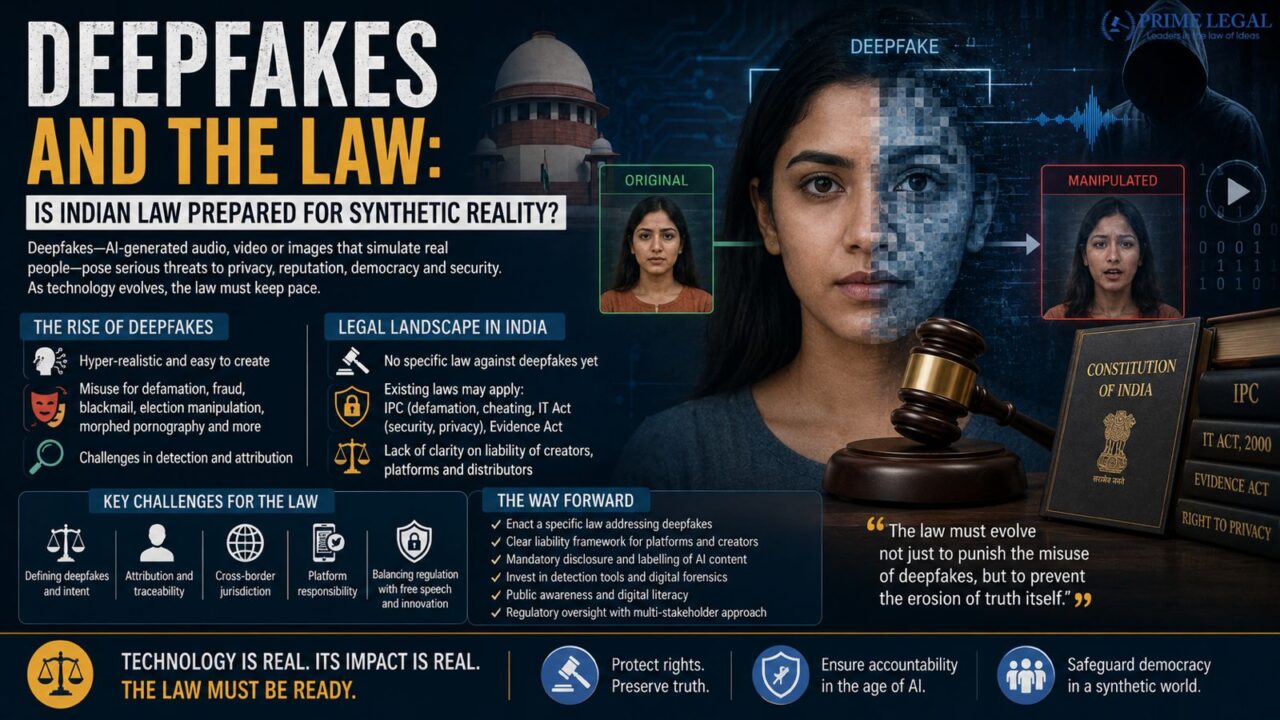
With the advent of the Deepfake technology, which is the AI-generated creation of realistic yet fictional audio-visual content, it has become one of the most destabilising challenges to personal dignity, democratic integrity and public trust in present-day India. In this article, we explore the lacking legal framework in India for the misuse of deepfakes, analyze historic court decisions, and examine the recent legislative changes, such as the 2025 IT Rules amendment and the Regulation of Deepfake Bill, 2025. It says India has made a decent progress with respect to regulation, but there are still fundamental defects, especially in the context of victims who are not celebrities and that a standalone statutory framework, forensic infrastructure, and strong electoral protections are much needed.
KEYWORDS: Deepfakes, Synthetic Media, Information Technology Act 2000, Personality Rights, MeitY, Generative AI, Digital Governance, Electoral Manipulation, Bharatiya Nyaya Sanhita
INTRODUCTION
Bollywood actress Rashmika Mandanna went viral in November 2023 in an image of her dancing in a video.Rashmika Mandanna went viral in India with her dancing in a Bollywood film video in November 2023. The face has been deep-faked onto her body with the help of a Generative Adversarial Network (GAN) that researchers describe as a “two-player adversarial game between two neural networks to generate ‘fake’ content that is indistinguishable from real content.” The maker, who is an engineer and 23-year-old from Andhra Pradesh, told the police that he had done it for the purpose of earning followers on Instagram. He was arrested in the span of a few weeks under Section 465, 469 IPC and Section 66C, 66E IT Act, 2000. PM Modi said it was a crisis. The incident was not a one-off occurrence. The Identity Fraud Report 2025 showed that in 2024, there was one recorded deepfake attempt every five minutes in the world, with 40% of all biometric fraud being of this type. Between 2022 and 2023, deepfakes surged by 3,000%. India, where the image of a celebrity has social value, with its culture of political polarisation, and 900 million internet users is the epicentre of this threat. The problem that this article addresses is stark: can Indian law rule synthetic reality?
THE LEGAL FRAMEWORK: PATCHWORK PROVISIONS IN A POST-AI WORLD
There are currently no Indian laws or provisions that reference ‘deep fake’. The charges were ad hoc, combinations of laws created for other occasions. The Information Technology Act, 2000 provided for weak instrumentality, namely Sections 66C, 66D and 66E, which create criminal offences of respectively identity theft (up to three years imprisonment), cheating by personation and privacy violation (by capturing or transmitting private images).
The Indian Penal Code (now replaced by Bharatiya Nyaya Sanhita, 2023) provided for forgery (Sections 465 and 469) and defamation (Section 499) laws. Such are originally designed for pre-AI days for the sake of documentary fraud, however. However, as Gupta and Dixit discuss in the International Journal of Research and Publication Review (2025), the “intent to cause damage” element of forgery law is a high bar to meet, as the intent to cause “entertainment” is often asserted. Civil defamation cases, however, are often a lengthy process, often lasting for years; not a timeframe of hours for content to go viral.
A man’s identity cannot be protected under the Copyright Act, 1957. Faces and voices of a person are not copyrightable works. Similarly, the Trade Marks Act has nothing to do with likenesses, it has to do with brand names and logos.
In Amitabh Bachchan v. Rajat Nagi & Ors. The future use of the celebrity’s image, voice and AI-generated likeness of his character by anyone else was awarded an injunction as inherent personality rights in the Delhi HC order passed on 16/04/2024. Anil Kapoor v. Simply Life India & Ors. In 2024, it extended the same protection, and by 2025, various celebrities, such as Hrithik Roshan, Katrina Kaif, Salman Khan and Aishwarya Rai, had come to the Delhi High Court asking for it. The judiciary was innovative. But, as Suresh et. All stated in IJFMR (2025), judicial protection is not yet available to victims beyond the scope of the average citizen with neither the public support to raise awareness about the issue nor the financial resources for emergency legal intervention.
PROGRESS AND GAPS IN THE REGULATORY SHIFT.
This watershed was accepted in late 2025. MeitY has on 22 October made changes in the IT (Intermediatory Guidelines and Digital Media Ethics Code) Rules, 2021 which took effect from 15 November 2025. The amendment opened the door to technology neutrality in the statutory definition of ‘synthetically generated information’ (Rule 2(1)(wa)), it put in place an obligation to label content, and it made platform accountability a reality, by making social media intermediaries liable if they fail to take action. Most importantly, it established specific time periods to delete deepfakes, 24 hours for sexual or explicit deepfakes and 36 hours for other deepfake misinformation.
The framework of 2025 looks more comprehensive than the EU AI Act (which does not contain any rules relating to deep fakes), and the United States DEEPFAKES Accountability Act (which has not passed yet). Yet gaps persist. The capacity of Indian law enforcement to act effectively on the enforcement front is very weak, they are always behind the viral content. In the 2024 Lok Sabha elections, AI-deepfaked voices of political leaders who have died were used in campaigning, false information regarding reservation policy was spread using AI-deepfaked voices of the Union Minister Amit Shah and more than 50 million calls with AI-generated voice-clones were made in just two months (Harvard Political Review, 2024). The Representation of the People act, 1951, the Model Code of Conduct can structurally give no answer to this threat. But there is still no fast, inexpensive legal remedy for the ordinary citizens, be they women in small towns, students, workers.
MORAL ASPECT
The deep fake crisis isn’t only a technical or legal issue, it’s a moral one. Deepfake misuse is, in essence, a violation of the right to privacy and dignity guaranteed by the Supreme Court in K.S. Puttaswamy v Union of India (2017), under Article 21 of the Constitution. It takes away that person, their face, voice, intimate life, as their own thing to play with, to entertain, to defraud, without their consent. A fake sexting video can be catastrophic for Indian women, who already face a lot of stigma in terms of sexuality and reputation. The damage is not theoretical, but real, and is happening now.
ROAD AHEAD
India should have a separate Synthetic Media Act with quick civil remedies and statutory damages available in the hands of all victims of synthetic media and not just the famous. It requires the establishment of the National Deepfake Forensics Centre by MeitY, having real-time detection capabilities. It should have election takedown protocols which must be followed when binding directives are issued by the Election Commission during periods of campaign. And it needs to be developed, and integrated into school and college curricula with digital media literacy so that citizens can question what they see and not take it on faith.
The question isn’t if, but when, India will see more deepfakes. The issue is: will the law be with citizens where the harm is occurring: on their phone, in their communities, before it becomes permanent? India is more prepared in 2026 than in 2023 yet, it doesn’t quite meet requirements.
“PRIME LEGAL is a National Award-winning law firm with over two decades of experience across diverse legal sectors. We are dedicated to setting the standard for legal excellence in civil, criminal, and family law.”
WRITTEN BY: Arnav Naik

