
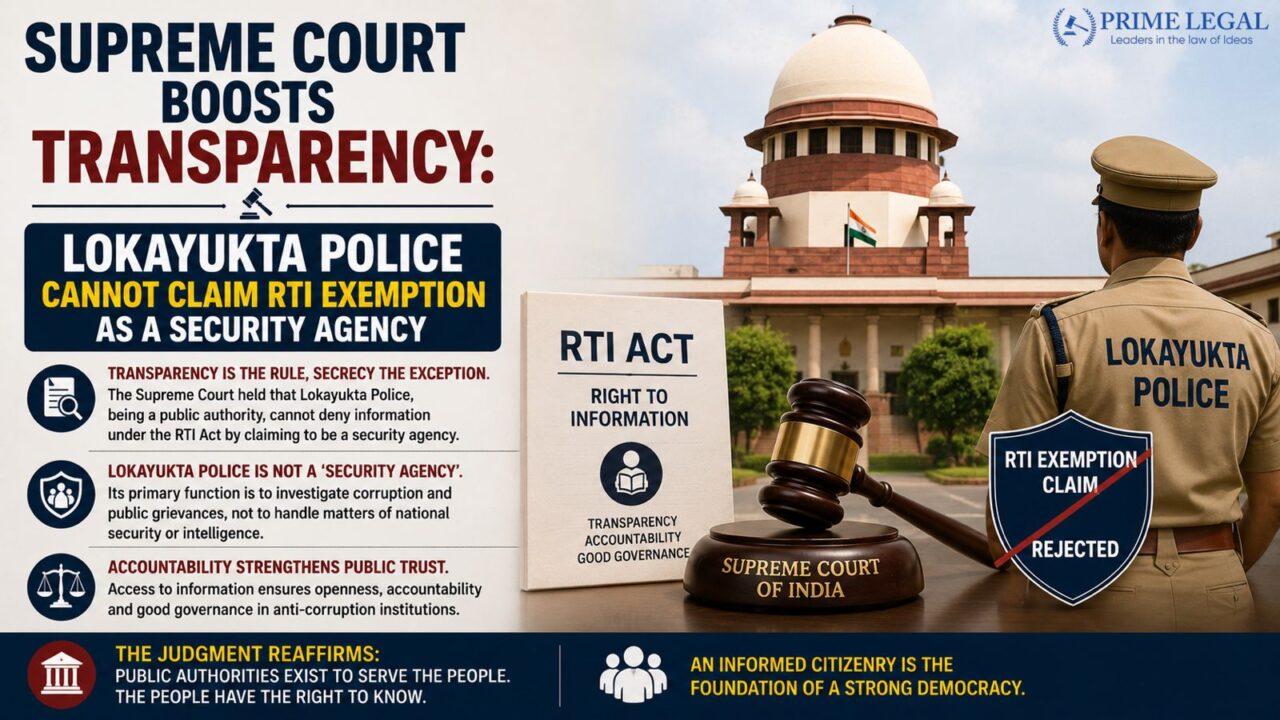
CASE NAME: Special Police Establishment v. Kamta Prasad Mishra & Ors.
CASE NUMBER: Criminal Appeal No. 3743 of 2024
COURT: Supreme Court of India
DATE: 15 June 2026
QUORUM: Hon’ble Mr. Justice J.K. Maheshwari and Hon’ble Mr. Justice Atul S. Chandurkar
FACTS
On 11 April 2017, Respondent No. 1, a Town Inspector, was involved in an enforcement action (trap) by the Special Police Establishment (SPE). An application was filed against him pursuant to the Prevention of Corruption Act of 1988, and the Home Department issued an order on 20 May 2020 authorising the prosecution of Respondent No. 1. To gain transparency, on 06 December 2020, he submitted an application to the State Information Commission (SIC) under Sec. 6(1) of the Right to Information Act (RTI) seeking information about decisions made in sanctioning his prosecution. This request was denied initially at the SIC level, and his appeal to the SIC was also rejected because the information was found to fall under the exemptions provided under Section 8(1)(h) of the RTI Act. The High Court subsequently set aside the SIC’s decision, holding that the investigation had not been completed. Therefore, the information sought could not be exempt under Section 8(1)(h), and ordered the SPE to provide the requested information.
ISSUES
- Whether the SPE can be legally classified as an ‘intelligence and security’ organisation for Section 24(4) of the RTI Act.
- Whether the State Government Notification dated 25.08.2011, which excluded the SPE from the RTI Act, is valid in law.
LEGAL PROVISIONS
- Right to Information Act, 2005: Section 8(1)(h) (Exemption from disclosure) and Section 24(4) (Exemption for state intelligence and security organisations).
- Madhya Pradesh Special Police Establishment Act, 1947: Sections 2(1) and 3.
- Madhya Pradesh Lokayukt Evam Up-Lokayukt Adhiniyam, 1981: Section 7.
ARGUMENTS
APPELLANT (SPE):
The Appellant (SPE) contended that Section 8(1)(h) of the RTI Act stipulates that the Appellant should not provide the requested information because providing such information would likely interfere with the current ongoing investigation or prosecution of the Respondent’s criminal proceedings. The Appellant also placed considerable reliance on a State Government Notification dated 25.08.2011, which was issued under Section 24(4) of The RTI Act (2005) and stated that the provisions of the RTI Act did not pertain to cases being investigated by the Appellant.
RESPONDENT:
Respondent No. 1 argued that Section 8(1)(h) was irrelevant to the present information because the investigation had already been completed and a charge sheet had been filed. The Respondent submitted that merely providing information about how communications were generated or the processes leading to granting the sanction will not impede any investigations at this time.
ANALYSIS
The Supreme Court has conducted its own initiative(Suo moto) review of the validity of the 25.08.2011 Notification and has held that, in accordance with the law, the authority of the Constitutional Courts to declare subordinate legislation invalid for going beyond the power conferred by the statute creating the subordinate legislation exists independent of whether the said legislation is challenged in the writ petition that would ordinarily be filed. In examining the statutory provisions relating to the constitution of the SPE, the Court found that the SPE was established to investigate only economic and corruption-related crimes, primarily under the Prevention of Corruption Act or certain sections of the Penal Code. The Court also pointed out that, unlike agencies like the Border Security Force or the Central Reserve Police Force, which investigate matters of “intelligence” and “security”, SPE does not investigate matters of “intelligence” or “security”. As a result, the Court found that it could not make a claim of blanket exemption under section 24(4) of the RTI Act since they are the only type of organisation that has been established for the purpose of investigating matters of “intelligence” and “security”.
JUDGMENT
The Criminal Appeal against the decision of the Special Police Establishment (SPE) has been dismissed by the Supreme Court. The Court has also declared that the State Government Notification dated August 25, 2011, which excluded the SPE from the provisions of the RTI Act, is bad in law and unreasonable. As a result of this finding, the court has confirmed the directive of the High Court ordering the Appellant to provide information to Respondent No.1 within a specified timeframe.
CONCLUSION
The Supreme Court held that State Governments can only exclude State standard investigation agencies from the provisions of the RTI Act if those agencies meet all the detailed and functional criteria of an “Intelligence & Security Organisation” under the RTI Act. The judgment serves as evidence that subordinate legislation will be invalidated if it does not comply with its parent/substantive law or exceeds the state government’s specific legislative authority limits.
“PRIME LEGAL is a National Award-winning law firm with over two decades of experience across diverse legal sectors. We are dedicated to setting the standard for legal excellence in civil, criminal, and family law.”
WRITTEN BY: VINEET SEERVI
Read the judgment copy below:

