
INTRODUCTION
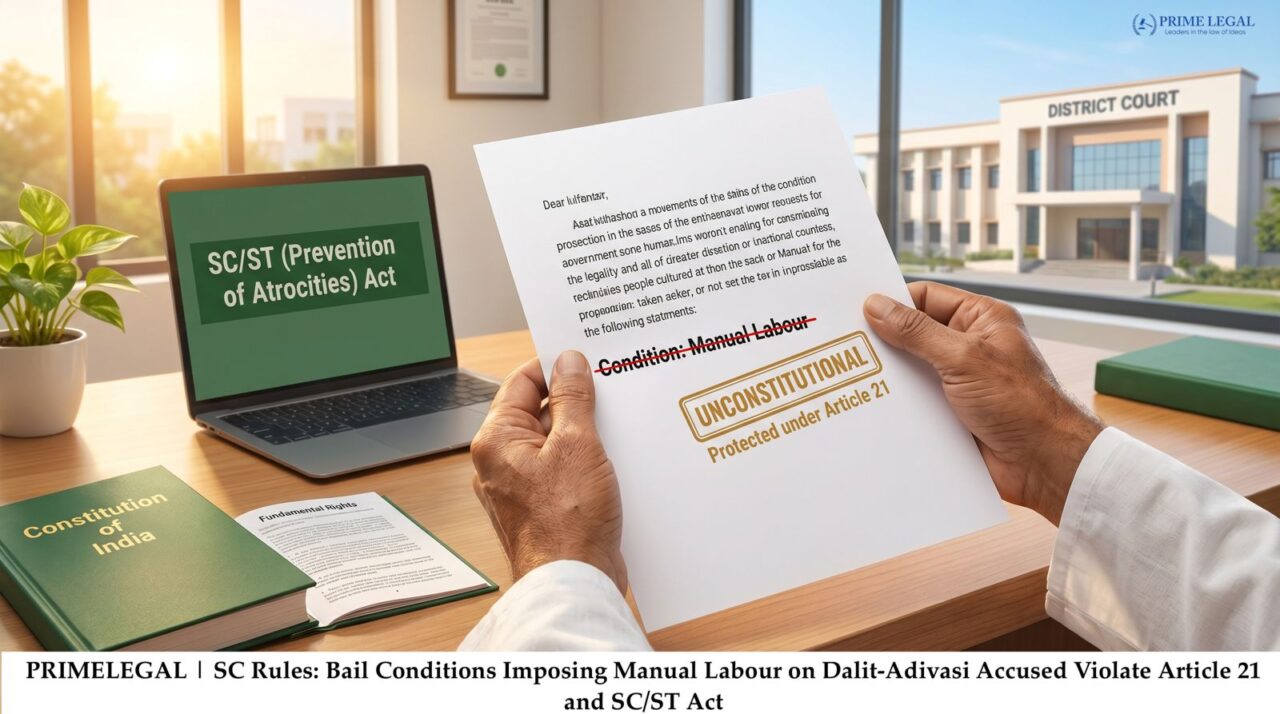
The Supreme court of India has reaffirmed in its latest judgement that the Judiciary as an organ of state machinery must act as a guardian of fundamental rights rather than a tool of systematic oppression. The present ruling In Re: Condition Being Imposed While Granting Bail by High Court of Orissa Suo Motu Writ Petition (Criminal) No. 2/2026 (Diary Number 27052 / 2026) highlights the intersection between Article 21 (Right to Life and Liberty) and the SC/ST (Prevention of Atrocities) Act, 1989, clearly highlights that imposing humiliating manual labour as a condition for bail is not only legally impermissible but also ex-facie (on the face of it) discriminatory. The court held that these conditions violate human dignity and operate under the unlawful assumption of guilt prior to trial.
BACKGROUND
The present controversy originated in Odisha, where a number of Trial Courts and even the High Court imposed “onerous and humiliating” conditions for bail on the Dalit and Adivasi community- based protestors. These individuals were arrested during the anti-mining protests which even involved Vedanta, which eventually turned violent.
While granting them bail, the courts required them to clean the police stations for two months as manual labour as part of their conditions for bail. However, reports suggested that such conditions were imposed only on the marginalized Dalit and Adivasi communities whereas accused persons from the privileged communities were not given the same punishment for the same offence.
KEY POINTS
- The Court ruled that forcing an accused person to perform manual labor for the State violates the right to live with dignity. It noted that bail conditions must be preventive or regulatory, not punitive or degrading.
- The Bench observed that the nature of these bail conditions suggests “casteism” bias within the State Judiciary. By subjecting Adivasi and Dalit communities to activities they were traditionally associated with, the Judiciary is creating systemic discrimination.
- Imposing labour as a “punishment” even before a person was convicted assumes for him a level of guilt and serves a pre-trial assumption, which is contrary to the criminal law jurisprudence of INNOCENT UNTIL PROVEN GUILTY.
- The major objective of the SC/ST Act is to prevent the humiliation of marginalized communities. However, the court found such bail conditions in complete contradiction to the purpose of this act and disheartening that the judiciary which meant to uphold this act was itself imposing such conditions.
RECENT DEVELOPMENT
In the case titled In Re: Condition Being Imposed While Granting Bail by High Court of Orissa Suo Motu Writ Petition (Criminal) No. 2/2026 (Diary Number 27052 / 2026), a Bench led by CJI Surya Kant and Justice Joymalya Bagchi took suo motu notice of these practices.
The Hon’ble SC on 4 May, 2026 held that such bail conditions are ‘Null and Void’ and issued ‘omnibus direction’ for all the Courts in Odisha to immediately act upon such offending conditions and delete such conditions and the Hon’ble SC also cautioned all the other State Judiciary to Not to impose such ‘caste-coloured and oppressive’ conditions while granting the bail. And the Registry was also directed to circulate this order to every High Court to ensure that judicial officers across the country are cautioned against such practices.
CONCLUSION
The Supreme Court’s ruling in this given matter serves as a vital check on judicial overreach and system bias. By making such bail conditions null and void, the Court has made it clear that law must be blind to casteism but sensitive to human dignity. This judgment is a clear reminder that the colonial mindset of using manual labour as a tool of oppression cannot be done in modern constitutional democracy, especially the one governed by the egalitarian vision of Article 21.
“PRIME LEGAL is a National Award-winning law firm with over two decades of experience across diverse legal sectors. We are dedicated to setting the standard for legal excellence in civil, criminal, and family law.”
WRITTEN BY: LISHIKA BATRA

