
INTRODUCTION:
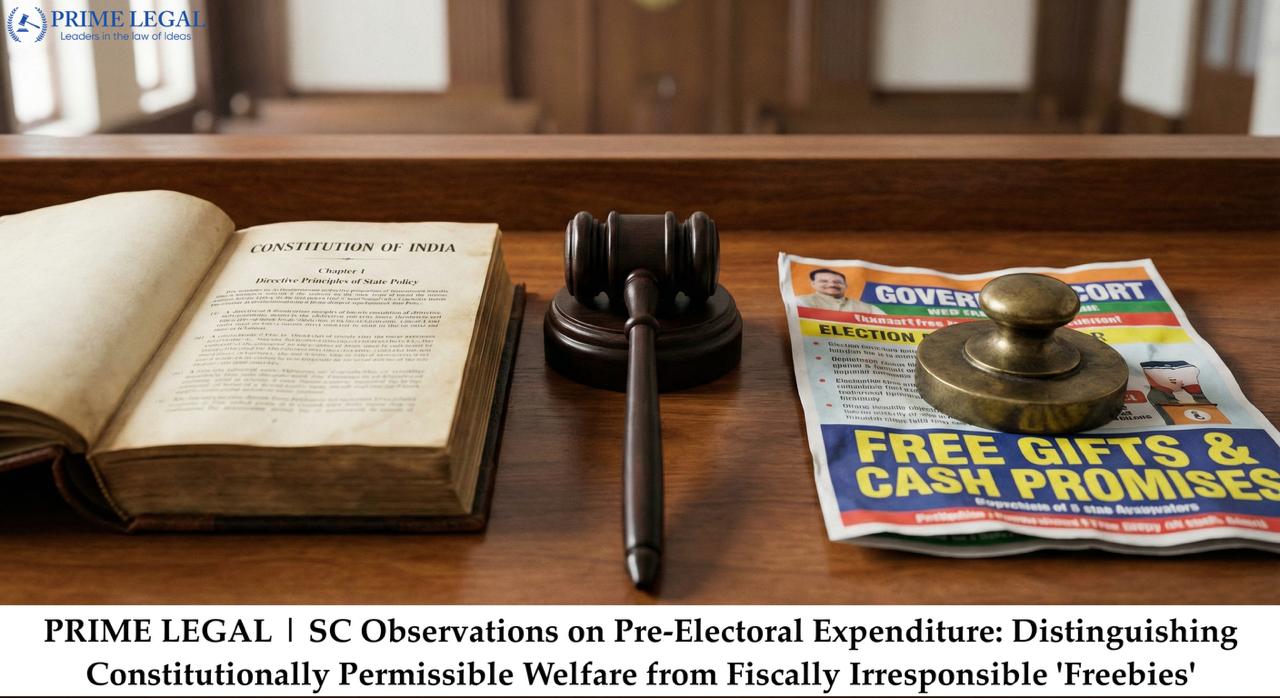
The issue of the national impacts of pre-electoral “freebies” once again became a matter of national attention, The Supreme Court of India has effectively pushed the idea of such transfers and promises across a severe constitutional divide-over those that are legitimate welfare measures and those that were fiscally imprudent electoral promises. In proceedings conducted on 19 February 2026, the Court reiterated that it had been concerned first in litigation published in September 2023 about whether there is a lack of fiscal responsibility and the long-term governance of the state due to the unchecked expenditure of funds on electoral campaigns before an election takes place.
While the Court has not yet given a definitive opinion declaring such schemes unconstitutional, the indications by the Court from recent observations of the case should be seen as pointing to persistent judicial scrutiny of the constitutional and economic limits of State-sponsored welfare and electoral inducements.
BACKGROUND:
The controversy over electoral freebies was triggered by a case Ashwini Kumar Upadhyay v. Union of India,W.P.(C) No. 43/2022 [a Public Interest Litigation which has been instituted from the year 2022]. The petitioner, Ashwini Kumar Upadhyay, wanted directions against political parties and governments promising of irrational financially unviable freebies during election. The main respondent in the situation is the Union of India, Election Commission of India and others.
In earlier hearings, welfare schemes as part of the constitutional vision of the Directive Principles of State Policy have been acknowledged by the Supreme Court. However, the Court noted that free distribution of government goods and services indiscriminately without consideration of financial sustainability raises issues on fiscal discipline and democratic accountability.
The matter has since subsided, with intermittent hearings on the wider implications on the constitution and economy of such policies.
KEY POINTS:
- Hearing on 19 February 2026
On 19 February 2026, while dealing with questions related with State matters as fiscal policy and regulations surrounding subsidies, the Supreme Court reconsidered the more general issue of pre-electoral spending. While the issue before the Court was that of regulatory and financial constraints posing problems for the structure of subsidy in the States, the Bench used the occasion to reiterate its worries about the growing culture of indiscriminate electoral giveaways. The Court noted that several States which have announced expansive schemes for subsidies are already operating under heavy fiscal deficits. It asked what the position on governance would be vis-a-vis feasible sustenance if large-scale financial promise is made without adequate consideration of the long-term economic consequences. Importantly, the Court could not pass a final order invalidating any scheme on that date. The observations were made in the process of submissions for the evidence during the hearing and are part of the on-going judicial conversation on the same subject.
- Distinction Between Welfare And ‘Freebies’
A chief theme in the Court’s observations was the constitutional difference between targeted welfare and freebies to the masses. The Bench made clear that schemes for welfare of weaker sections such as food security, access to healthcare or assistance for education are legitimate exercises of State power and are often flowing from constitutional mandates.
However, without regard to economic status (especially if announced soon in the run-up to elections), universal benefits may not necessarily qualify as constitutionally justified welfare. The Court stated that such measures must pass scrutiny with regard to rational classification, financial feasibility and public interest.
- Fiscal Responsibility and Accountability
The Court went on to note that if expenditure under pre-election is not checked it may have an effect on capital investment in infrastructure, public facilities and long-term development. Excessive borrowing in exchange for subsidies is likely to saddlebag economic stability for future generations.
While stressing on the need for the courts to have a bridled approach in matters concerning economic policy, the Bench reaffirmed the fact that fiscal management cannot be disassociated from the accountability of the Constitution. The question of balance between social justice and financial prudence is at the very heart of the ongoing proceedings.
RECENT DEVELOPMENTS:
As of 19 February 2026 the issue is still pending in front of the supreme court in the ongoing jurisprudence emanating from Ashwini Kumar Upadhyay v Union of India. No authoritative constitutional decision has been made yet as to the legality of electoral freebies.
However, the recent observations of the Court are indicative of continuous judicial concerns with respect to the fiscal implication of pre-poll expenditure. By raising the issue anew during State subsidy framework hearings the Supreme Court gave a signal that the constitutional limits of welfare policy and electoral inducements will continue to be under examination.
Further hearings are likely to be held on such matters as whether institutional guidelines, expert consultation or regulatory frameworks are required to ensure fiscal responsibility without compromising legitimate welfare objectives.
CONCLUSION:
The recent observations of the Supreme Court re-establish the frail constitutional equilibrium between social welfare and financial discipline. While welfare measures constitute the governance and commitment under the constitution, patch electoral freebies cast serious questions of sustainability and accountability. As the proceedings continue, the eventual determination of the Court may shape to a great extent the jurisprudence in respect of pre-electoral expenditure and the constitutional limitations of welfare policy in India.
“PRIME LEGAL is a National Award-winning law firm with over two decades of experience across diverse legal sectors. We are dedicated to setting the standard for legal excellence in civil, criminal, and family law.”
WRITTEN BY: TANUSH RAJ

