
INTRODUCTION
The Indian maritime legal framework is based out of Merchant Shipping Act, 1958, which provides 560 sections being constructed via amendments in 70 years. The statutory framework contains regulatory gaps in functioning, uncertainties and provisions of the act increases burden of stakeholders like shipowners, operators and service providers. These amendments left the legislation to be impractical, inefficient and does not align with rules establish under International maritime Law. The need for reformation of Indian Maritime Laws arises due to expanding maritime trade and commitments under International Maritime Organization conventions
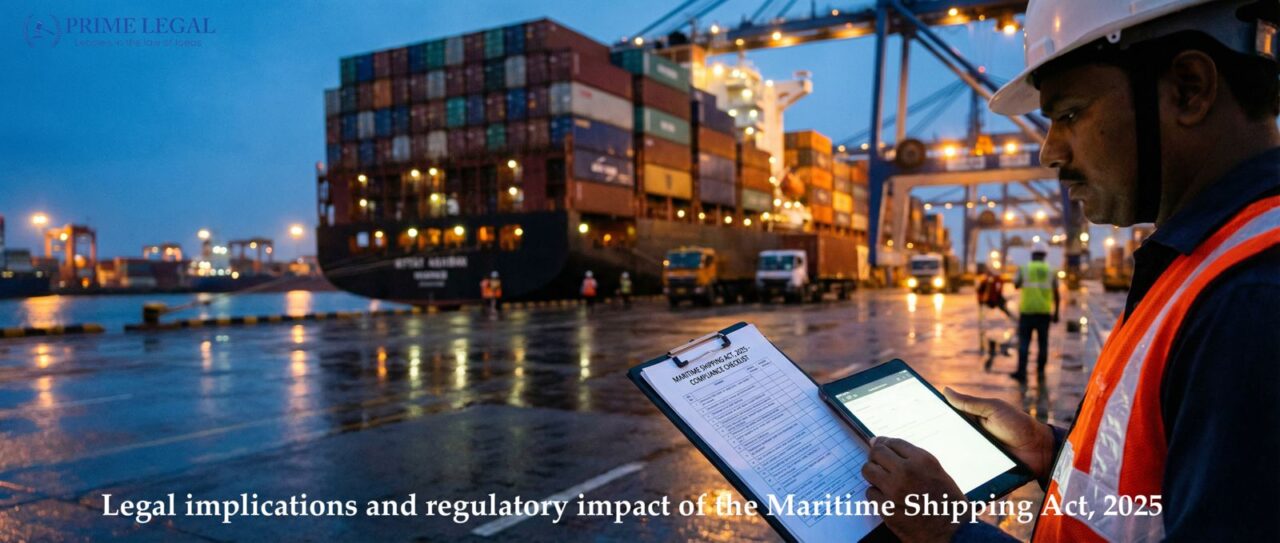
The Maritime shipping Act,2025 enacted by presidential assent which had reflected the parliament’s deliberate modernization initiative as it was approved by the Lok Sabha on August 6, 2025, and in Rajya Sabha on August 11, 2025, with proper legislation consolidation as maritime regulation had streamlined to be a 16 part structure consisting 325 clauses which had replaced 561 clauses Act and this restructuring had fundamentally redefined the Maritime Administration, vessel government, safety protocols, environment compliance mechanisms and commercial shipping practises across Indian maritime Laws
Structural and Institutional Reforms
The newly introduced 2025 act had established institution modifications which have strengthen the maritime administrator and governance as the Director General of shipping has been reconstituted as Director General of Maritime Administration, who had assumed the powers of expanded Secretary authority which transcends broader supervisory responsibility across Indian maritime sectors.
This statutory provision had mandated establishment of the National Shipping Board which comprises of members of Parliament. Central government appoints the member, shipowners, seafarers which ensures a multi stakeholder governance participation. Mercantile Marine Department and shipping offices at major Indian ports are providing a decentralisation administrative support which has enhanced the regulatory accessibility and operational efficiency.
Vessel Registration and Coverage expansion
A fundamental reconstruction involves expansion, of mandatory visual registration requirements as a legislation has broadened the coverage for encompassing over the sea going vessels which had previously been excluded from the formal regulatory frameworks. The vessel registration has been applied to all mechanised and non-mechanised craft regardless all the tonnage classification which had extended beyond traditional merchant vessels for including the mobile offshore drilling units and submersibles. The registration categories have been categorised into 4 units- permanent, provisional, temporary and bare boat charter restoration where each accommodates diverse vessel ownership structures and these expansion registration regimes have been necessary rated for comprehensive reassessment by the maritime companies regarding the fleet documentation compliance on the governance structure optimization.
International Maritime Convention Alignment
This Act mandated compliance with the core International Maritime Organisation conventions, including the safety of life at sea, marine pollution Prevention, standard of Training, certificate and watch keeping and the Maritime Labour Convention. The vessels are expected to maintain mandatory certificates addressing stability, load line marketings and seaworthiness determination with proper provision. Establishing maritime incident reporting protocols as obligatory assistant rendering requirements as Environmental Protection receives statutory emphasis through mandated compliance with MARPOL, Ballast water management convention, antifouling systems Convention provision which requires pollution prevention certification and adequate port reception facilities.
Commercial transparency and Shipping charges
A very significant commercial practise reformation which has mandated transparency in maritime shipping charges as the service providers and agents are involved in carriage of goods by sea, must transparently disclose all the applicable charges, fees and surcharges through the comprehensive documentation being provided. This is a mandate to requirement as these addresses long standing commercial grievances regarding undisclosed building practises protecting exporters, importers and consignees from non-transparent fee structures. Non-compliance through the charging consignment usually is liable for penalties and designated authority being responsible for penalty imposition an appealing, establishing predictable dispute resolution mechanisms.
Maritime E-Governance and Digitalization
The 2025 introduced Act had mandated digitalization of maritime amendment process where it allows comprehensive electronic filing, certification, insurance, payment processing and regulatory approvals as implementation of the risk based digital vessel inspection system are being supported by the centralised database infrastructure which reflects the significant advancement in the regulatory efficiency. This E governance system has reduced administrative delay in a great number, has announced transparency and facilitated data-driven regulatory oversight which benefits the shipowner, port operators and logistics stakeholders using streamlined compliance.
Enhanced enforcement and Maritime security
This Act has strengthened the Indian maritime enforcement capabilities consistent with the United Nations Convention or Laws of Seas (UNCLOS) provisions as it is being designated for authorities for gaining, pursue and intercept foreign vessels on high seas for violations committed within the Indian coastal waters as these vessels are lacking nationality facing detentions on authorities, which addresses the maritime security imperatives and the strategic national interest.
Labour and seafarer welfare provisions
One of the most significant developments in this Act are mandating of the strengthened labour protections, certification standards and welfare entitlements for the maritime workers as the crew agreements, insurance coverage and training standards are being received statutory emphasis which requires maritime companion for updating employment arrangement which employee’s proper compliance with the enhanced certification application being consistent with International Maritime labour standards.
Regulatory implications for stakeholders
This amended Act had restricted the compliance obligation across the maritime services, offshore operations, ports, insurance and trade centres where the industry stakeholders should reassess vessel portfolios regarding all the revised registration classification. Evaluating ownership optimization, implementing updated employment protocols and ensure certificate compliance as companies require comprehensive legal audit which assists the operation alignment with new regulatory requirements.
CONCLUSION
Overall, this Maritime Shipping Act 2025 has reflected a very transformative significant legislative milestone, which is modernised India’s maritime governance framework using the institutional restructuring, International Convention alignment, Commercial transparency mechanism and enforced enforcement capabilities as this has replaced the old legal architecture with a proper regulatory framework. This Act has positioned India’s maritime sector with a major boost within global shipping networks. This implementation majorly depends upon the stakeholder compression of the substandard legal frameworks, proactive compliance planning and coordinator administrative execution, which allows the act for advancing maritime safety, Environment Protection and commercial situation.
“PRIME LEGAL is a full-service law firm that has won a National Award and has more than 20 years of experience in an array of sectors and practice areas. Prime legal falls into the category of best law firm, best lawyer, best family lawyer, best divorce lawyer, best divorce law firm, best criminal lawyer, best criminal law firm, best consumer lawyer, best civil lawyer.”
WRITTEN BY: KRISHNA KOUSHIK

