
CASE NAME: Court on its Own Motion vs. State of Maharashtra and Ors
CASE NUMBER: Suo Moto Public Interest Litigation No. 1 of 2021
COURT: Nagpur Bench of High Court of Judicature at Bombay
DATE: 12th January 2026
BENCH: Hon’ble Justice Anil S. Kilor and Hon’ble Justice Raj D. Wakode
FACTS
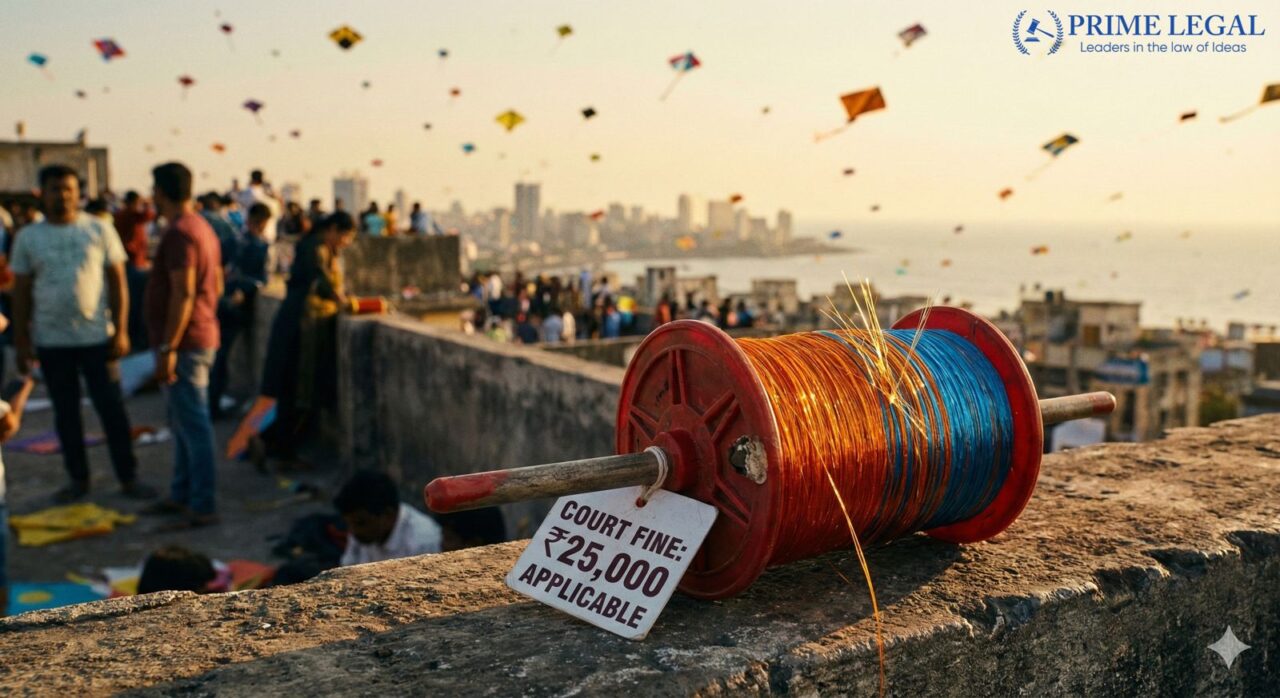
The case arises from suo moto cognizance for the public interest litigation taken up by the High Court of Maharashtra based upon newspaper reportage documenting fatalities and injuries resulting from usage of nylon thread (manja) for the purposes of kite flying in Maharashtra. The matter was pending since 2021, during which several judicial orders were passed on the same subject matter. Despite continuous legislative and administrative intervention, rampant utilization of nylon manja persisted unabated throughout Vidarbha Region. Annual mortality and morbidity statistics demonstrated significant human casualties attributable to nylon manja contact injuries. Earlier directives by the Court proved insufficient to deter this dangerous practice in the absence of statutory legislation or comprehensive regulatory frameworks. The Court preliminarily proposed imposition of fines, which included Rs. 50,000 per individual kite-flyer and Rs. 2,50,000 per vendor. Upon following the receipt of public suggestions and owing to the lack of any substantive opposition, the Court issued a refined order on 12th January 2026 established amended fine structures with emphasis on parental accountability.
ISSUES
- Whether Courts possess the constitutional authority to impose restrictive economic sanctions through contempt powers or suo moto public interest jurisdiction when legislative non action propagates demonstrable public health catastrophe.
- Whether parental financial liability constitutes as constitutionally permissible enforcement mechanism to control the violations of the Court orders perpetuated by the minors.
- Whether proportionality principles which govern the imposition of judicial remedy permit increased monetary penalties regulated according to culpability categories.
- Whether the establishment of dedicated revenue collection system and victim compensation mechanism falls within appropriate scope of judicial decree administration in PIL.
LEGAL PROVISIONS
- Article 226 of the Constitution of India: High Courts’ jurisdiction to issue writs and directions for enforcement of fundamental rights and violations of lawful governmental authority.
- Public Interest Litigation Principles: Have established for recognition of expanded remedial authority when governmental inaction creates apparent public emergency or constitutional violation.
- Parental Responsibility Doctrine: The set of legal principles which impose parental accountability for damages caused by minors and violations as extension of guardianship duties.
- Contempt of Court Authority: Judicial power to impose sanctions for violation of court orders, encompassing both criminal and civil contempt mechanisms.
ARGUMENTS
PETITIONER/COURT:
The Court presented the rationale that recurring administrative directives and public awareness campaigns has failed to mitigate the persistent public health menace caused by usage of manja. The abandonment of legislative bodies in this regard and absence of statutory prohibitions which can be mandated by application of judicial innovation which employs deterrent economic mechanisms. The imposition of vicarious liability on the parents is representative of usage of logical extensions of fundamental guardianship principles. Parents, being mentors and guardians of the minors, hold inherent duty to instill responsible conduct, self-restraint and consequential familiarity of the actions of minor children. Graduated penalty structures reflect proportionality between culpability categories. Individual kite-flyers face Rs. 25,000 fines; vendors face Rs. 2,50,000 fines; parental liability applies exclusively to minors. The establishment of dedicated Public Welfare Account helps to ensure the pecuniary proceeds which directly benefit the victims and create moral accountability beyond mere punitive dissuasion.
RESPONDENT STATE/OPPOSING INTERESTS:
The arguments by the counsel representing the State of Maharashtra relied heavily on the concerns of judicial overreach into pronouncing application of legislative domains, imposing of excessive penalties and causing of the disproportionate economic hardships to the parents for the acts of minors. Also, the arguments highlight the constitutional constraints that would be caused by imposing vicarious liability on the parents for the acts of children without statutory authorization.
ANALYSIS
The judgement of the two-judge bench demonstrates transformative judicial activism to address the issues which were failed to be addressed by the legislative and administrative spheres. The contemporary landscape indicates a lack of action by the governmental authorities in this regard with respect to identifiable public health catastrophe, which justifies the expanded judicial remedial authority which as exercised under public interest litigation doctrines. The Court’s reasoning reflects sophisticated proportionality analysis, wherein, the initial proposal of fine amounting up to on Rs. 50,000 individuals and Rs. 2,50,000 upon vendors was modified based on the consultation with public to Rs. 25,000 individual fines, representing 50% reduction taking into consideration the economic impacts.
Parental liability jurisprudence demonstrates principled extension of guardianship accountability. The judgment articulates that parental obligation encompasses not merely material provision but ethical and behavioral instruction. This formulation avoids absolute parental vicarious liability (which would constitute constitutional anomaly) by restricting parental responsibility to minors—thereby preserving individual culpability for adult offenders. The rationale that parental financial consequence incentivizes enhanced supervision and moral instruction represents defensible public policy position, though potentially vulnerable to constitutional challenge regarding proportionality and due process implications.
However, the judgment showcases several vulnerabilities pertaining to enforcement against vendors. The commercialization of manja sis suggestive of functioning of organized distribution networks which cannot be eradicated by isolated vendor-level prosecutions which do not prove to be sufficient without simultaneous prohibitionary obligations imposed on manufacturers and wholesale distribution.
JUDGMENT
The High Court imposed graduated monetary penalties: Rs. 25,000 per individual kite-flyer (Rs. 25,000 from parental resources if perpetrator is minor); Rs. 2,50,000 per vendor possessing nylon manja stocks. These collected fines constitute for recovery of land revenue if non-payment within 15 days. Establishment of Public Welfare Account which is handled by the triad of the Collector, the Commissioner and the Registrar manages resources for victims’ medical treatment. Cyber cell WhatsApp complaint systems enable for effective digital reporting. The negligence by the police officers pertaining to the enforcement triggers show cause notices and contempt proceedings.
CONCLUSION
This case showcases the employing of sophisticated judicial technique to synthesize remedial innovation, constitutional accountability and public health protection within the frame of Public Interest Litigations. The revised penalty structure coupled with the parental accountability mechanisms and victim compensation provisions showcases an unconventional modern approach which extends beyond generally practices punitive approaches. However, the efficiency of this approach lies primarily on the on the supply and chain prohibition which addresses the manufacturer and wholesale distribution networks. The significance of this judgement extends beyond the prohibition of nylon manja and illustrate the capacity of judiciary to impose remedies for the prolonged neglected actions while considering the summation of individual occurrences for public benefit. The approach in this judgement inclines towards judicial activism which can calibrate the rigorousness of procedural functions and parallelly maintaining constitutional accountability while maintaining legitimacy bounds.
“PRIME LEGAL is a full-service law firm that has won a National Award and has more than 20 years of experience in an array of sectors and practice areas. Prime legal falls into the category of best law firm, best lawyer, best family lawyer, best divorce lawyer, best divorce law firm, best criminal lawyer, best criminal law firm, best consumer lawyer, best civil lawyer.”
WRITTEN BY: KRISHNA

