
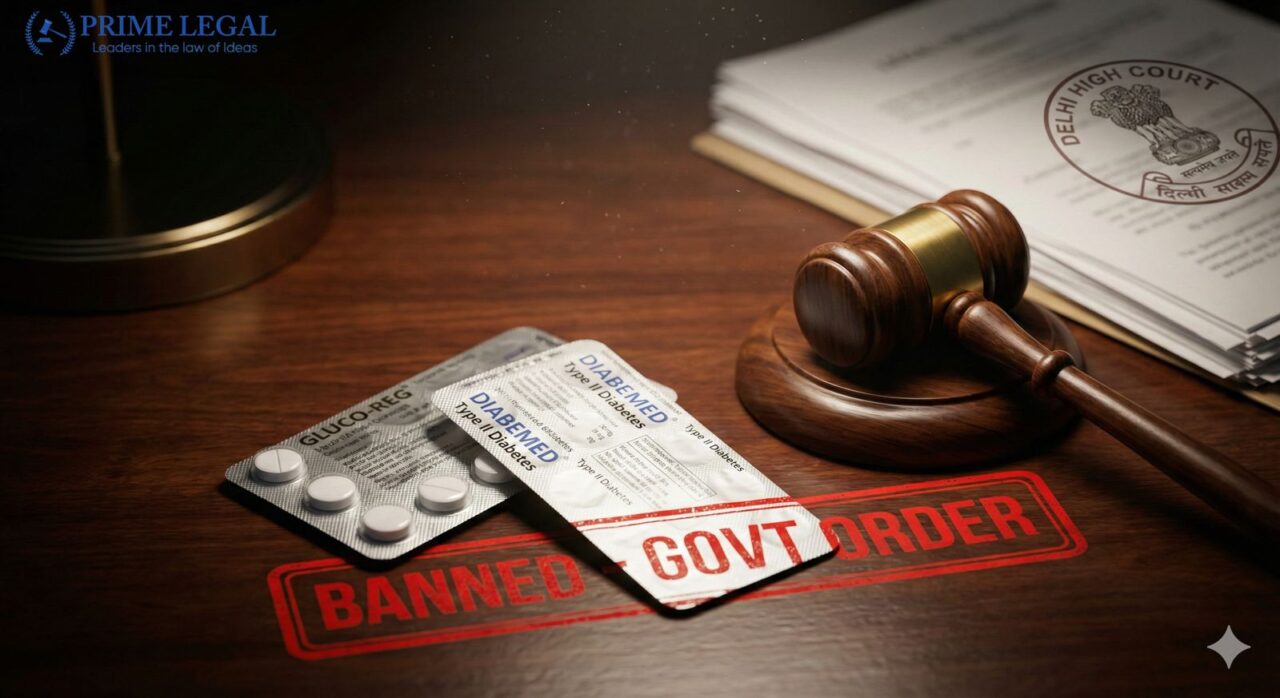
CASE NAME: All India Drug Action Network v Lupin Ltd & Ors
CASE NUMBER: LPA 671/2019 & CM APPL. 45953/2019
COURT: The High Court of New Delhi
DATE: 09.01.2026
QUORUM: Hon’ble Mr Justice Anil Kshetarpal, Hon’ble Mr Justice Harish Vaidyanathan Shankar
FACTS
These Letters Patent Appeals arise from a common judgment dated 13 February 2019, delivered by a learned Single Judge of the Delhi High Court. By that judgment, two notifications issued by the Central Government under Section 26A of the Drugs and Cosmetics Act, 1940, were set aside. The said notifications had prohibited the manufacture, sale, and distribution of certain Fixed Dose Combinations containing Glimepiride, Pioglitazone, and Metformin in dosages of 850 mg and 1000 mg, which were used in the treatment of Type II Diabetes Mellitus.
The impugned prohibitions were issued in compliance with the directions of the Supreme Court in Union of India v. Pfizer Limited & Ors, 2018 (II) SCC 39, where earlier bans on certain fixed-dose combinations were remitted for fresh consideration by the Drug Technical Advisory Board, DTAB or a Sub-Committee thereof. The Court directed that such re-examination shall be strictly within the letter and spirit of Section 26A, only after affording an opportunity for hearing to the concerned manufacturers as well as to public-interest groups, such as AIDAN.
In furtherance thereof, a DTAB Sub-Committee was constituted to examine the impugned fixed-dose combinations. It opined that the combinations lacked safety and efficacy data relating to the pair, posed a risk of hypoglycemia, had dosing-related issues, and presented the risk of medication error. Acting upon this recommendation by experts, the Central Government issued the impugned notifications. The notifications were challenged by the pharmaceutical companies before the Single Judge, who declared them null and void, thereby triggering the present appeals by the Union of India and AIDAN.
ISSUES
- Whether the learned Single Judge has exceeded the permissible limits of judicial review in reassessing the sufficiency and weight of expert scientific material.
- Whether prior approval of individual drug components and their dosages automatically validates the safety and efficacy of their combination in an FDC.
- Whether the satisfaction of the Central Government in terms of Section 26A was sufficient to meet the threshold under the statute, namely, “likelihood of risk” to public health.
LEGAL PROVISIONS
- Sec. 26A, Drugs and Cosmetics Act, 1940: It empowers the Central Government to regulate, restrict, or prohibit drugs if satisfied that they involve risk to human beings or animals, lack therapeutic value, or contain ingredients without therapeutic justification, where such action is necessary or expedient in the public interest.
- Rule 122E, Drugs Rules, 1945: This law categorises Fixed Dose Combinations as “new drugs,” which are treated separately from the individual components themselves.
ARGUMENTS OF THE PETITIONERS (APPELLANTS – UNION OF INDIA AND AIDAN)
It was contended by the appellants that the learned Single Judge erred in holding approval for individual drug components as an approval for their combination. An FDC is a unique therapeutic entity whose safety and efficacy have to be independently evaluated. It was also highlighted that no clinical or safety data was provided by the manufacturers with regard to the combination.
The Appellants further submitted that Section 26A does not require proof of actual harm; rather, a mere likelihood of risk suffices for regulatory intervention in public interest. They maintained that the DTAB Sub-Committee had followed the Supreme Court’s directions in Pfizer, considered relevant material, heard all stakeholders, and recorded sufficient reasons. Judicial interference, it was argued, must be limited where expert evaluation forms the basis of administrative satisfaction.
ARGUMENTS OF THE RESPONDENTS (PHARMACEUTICAL COMPANIES)
The Respondents thus pleaded that the DTAB Sub-Committee had failed to comply with the Supreme Court’s directions in Pfizer truly. They thus argued that reasons recorded for prohibition were cryptic, speculative and internally inconsistent. As such, the Sub-Committee itself acknowledged the therapeutic value of individual components thereby undermining the reason for prohibition.
They further contended that as individual drugs and dosages were already approved and widely prescribed, the total prohibition of FDCs was not at all justified and was disproportionate. It was contended that issues like dosage variation and over- or under-prescription were common to very many FDCs and cannot alone justify prohibition.
ANALYSIS
The Division Bench held that it was a case where the learned Single Judge traversed beyond the permissible parameters in the matter of judicial review in place of bringing in judicial analysis in a domain where scientific assessment was done by experts. The Court reiterated that adjudication on the domains related to pharmacology was beyond the capacity of the Court and the Court was required to defer to experts unless it was able to establish that the process was arbitrary and unlawful.
It brought out that an FDC has to be independently assessed since its pharmacological effect may be different from that of its constituents. It elaborated that Section 26A represents a precautionary standard and does not require provable injury; a reasonable probability of risk, such as hypoglycaemia, absence of safety data, lack of international regulatory acceptance and potential medication errors, was adequate to prohibit it. The requirement of higher proof by the Single Judge was held inconsistent with the statutory scheme.
JUDGMENT
The Division Bench allowed all three appeals and held that the learned Single Judge erred in interfering with the notifications issued under Section 26A. The impugned judgment dated 13.02.2019 was set aside, and the validity of the notifications was upheld. No order as to costs was passed.
CONCLUSION
The Court has thus reiterated that public health regulation in terms of Section 26A is precaution-driven and expert-driven. Judicial review would have to stay limited; commercial interests cannot override public safety. On merits, the prohibition on the impugned FDCs was reinstated in the interest of public health.
WRITTEN BY: USIKA K

