
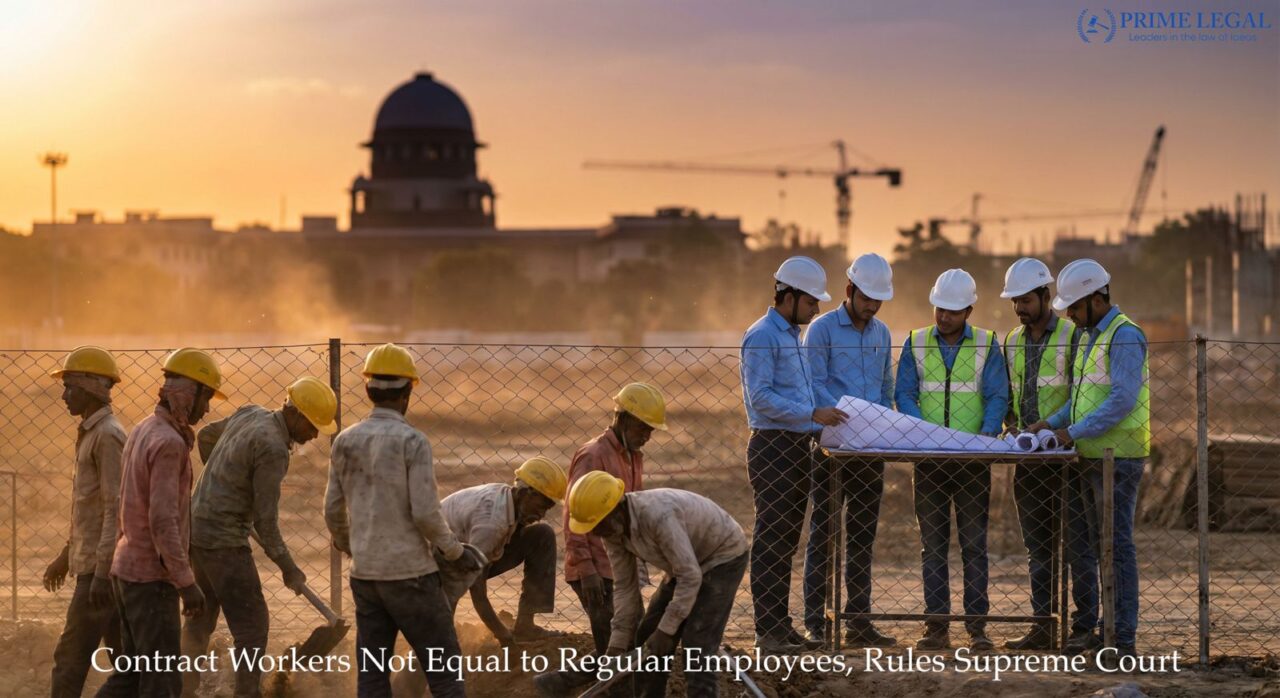
Case Name-Municipal council, Nandyal v. K. Jayaram & other
Case Number– Civil Appeal No_of 2025
Court– Supreme court of India
Date of Decision– 16 December 2025
Quorum – Justice Ahsanuddin Amanullah, Justice Vipul M. Pancholi
Facts of case
The respondent was working the hospital Nandyal Municipality since 1994 but was not appointed as a by municipality rather it was hired by a private contractor who used to supply worker to the municipality and with the changing year the contract kept changing but the same worker continued doing the same municipal work for many years without any break.
So as the workers were doing the same work an employee was doing the workers felt that they were treated unfairly and they approached Administrative Tribunal and they had two demands. The first demand was that their service should be regularized and the second demand was that they should be paid at least minimum salary given to the regular employees.
The Tribunal rejected their appeal so they went to the High Court. The High Court passed an order directing the municipality to pay the minimum time scale of salary and give them a yearly increment just like a regular employee.
ISSUES
1 Whether the workers who were hired through private contracts can claim their salary and the benefits similar or like a regular employee of a municipality?
2 Does the rule of equal pay equal work apply when the workers are not directly employed but contractual employees?
3 Whether the High Court’s decision was right in ordering the municipality to pay the workers minimum timescale pay and annual agreement?
4 Whether the game play of sympathy A long year of service can override the constitutional rules governing public employment?
Relevant provisions
Article 12 Constitution of India state
Article 14 Constitution of India equality before law
Article 16 Constitution of India equality of opportunity in public employment
Principles governing public employment and regularization
Arguments of petitioner
The municipality argued that the workers were not their employees at all, rather the workers were hired by a private contractor not a municipality directly so the municipality only had a contract with contractors to supply manpower and it was a contractor’s responsibility to pay the workers with their wages and give them service of benefit.
The municipality argued that there was no employer- employee relationship so no legal right to demand the same pay and benefits arises. They also argue that if workers were given the same pay benefits as a regular employee it would also destroy the constitutional system of public employment because regular posts are filled through a proper and transparent selection process open to all citizens giving equal benefits to workers higher through contract would encourage entry into government service.
Arguments of respondents
The workers argued though they were not officially hired through contract in reality but they have been working in the municipality for years and are performing the same duties and functions as the regular employee and not only this that they said that paying them less while taking the same work was unfair discriminatory and against the principle of equal when equal work But the story didn’t stop here they also pointed out that in some other municipalities similar place workers had been given much benefits and therefore denying the same was unjust to them. They further said that they had devoted most of their life to the municipality and deserve fair treatment and financial security.
Judicial analysis
The Supreme Court carefully examined the facts of the case and the court said that the most important question was whether the workers were actually employer municipalities or not and the court found that workers were not directly appointed by the municipality and they were hired by a private contractor and the municipality only paid the contractor not the workers. The court came to the decision that as there is no direct employer employee relationship the workers could not be eligible to claim the same salary and same benefits as a regular municipal employee.
The Court accepted that the workers had served several years to municipality and their situation deserves sympathy But that doesn’t mean that law will go unfair so the court stated that public employment is a public trust and every citizen has right to compete for government jobs in fair and transparent process and if workers hired through contractors are given same benefits of regular employee it would allow people to enter the service without following the constitutional rules which won’t be again fair.
The court also clarified that the judgment in Jagjit Singh (State of Punjab & Others v. Jagjit Singh & Others, (2017) 1 SCC 148) could not help the workers because in that case workers were directly appointed by the government whereas in this case, they were appointed by a private contractor.
But as Indian courts always Say that Justice must reach even the last person and even the weakest voice must be heard. The court tried to balance law and humanity here while rejecting the legal claim of workers. The court advised the municipality to consider regularizing them compassionately since they had worked continuously for decades but it made clear that this was a special direction not a general rule.
Judgment
Supreme Court allowed the municipality appeal to set aside the High Court’s order and restore the decision of administrative Tribunals which was rejected the workers claim for regularization and equal pay However considering the long service of workers the court directed municipality to compassionately consider their regularization if permanent posts were available without testing this as a precedent.
Conclusion
The judgment reinforced that constitutional rules of public employment cannot be compromised even on sympathetic grounds. Well the court reconsidered the hardship faced by the long service workers and it was held that contract labor engaged to private contracts cannot claim the same rights as regular employees. At the same time the court balanced law and humanity by advising the Municipality to consider the workers’ case for regularization on compassionate grounds.
“PRIME LEGAL is a full-service law firm that has won a National Award and has more than 20 years of experience in an array of sectors and practice areas. Prime legal falls into the category of best law firm, best lawyer, best family lawyer, best divorce lawyer, best divorce law firm, best criminal lawyer, best criminal law firm, best consumer lawyer, best civil lawyer.”
WRITTEN BY: NISHTHA JAIN

