
INTRODUCTION
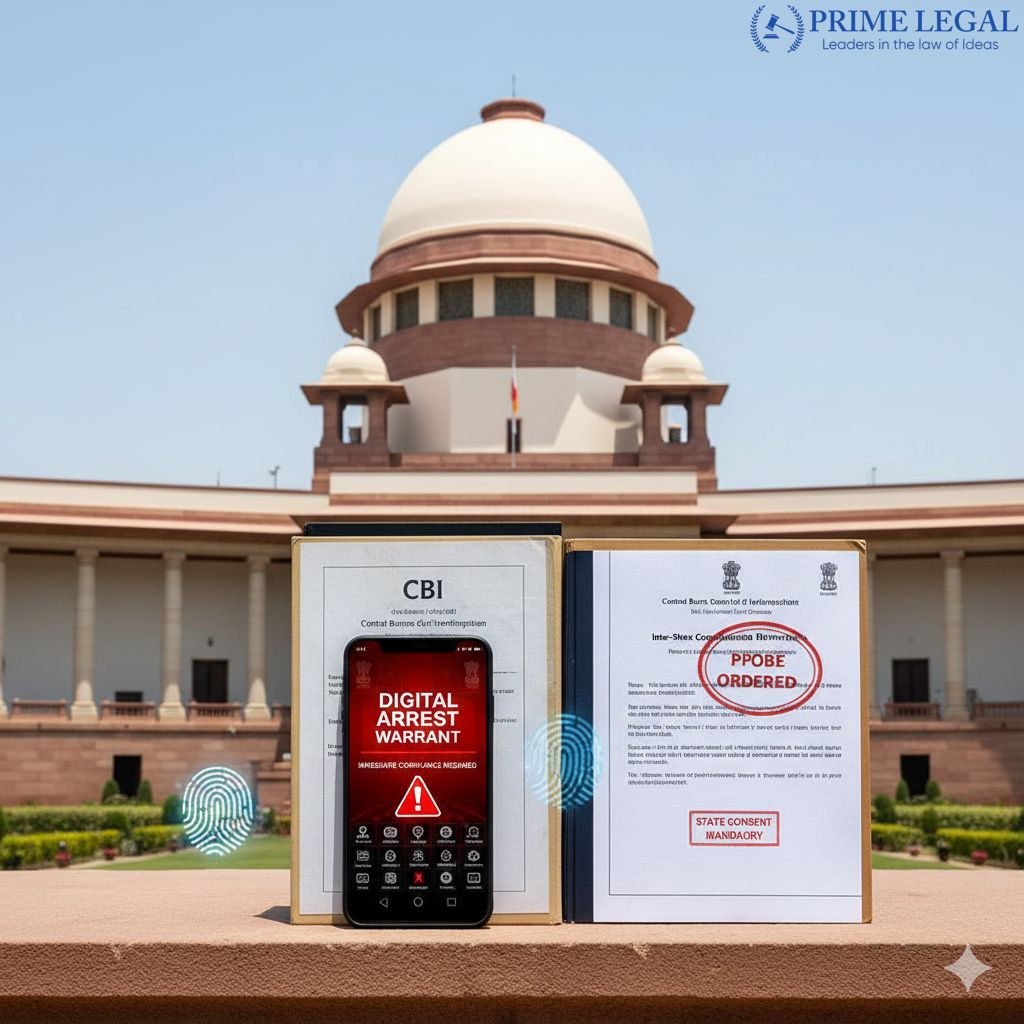
The Supreme Court of India has directed the Central Bureau of Investigation (CBI) to conduct a nationwide probe into the rising cases of digital arrest scams in the country, flagging the issue as a matter requiring “immediate attention of the premier investigating agency”. A bench comprising Chief Justice of India Surya Kant and Justice Joymalya Bagchi ordered that the agency treats such scams as its first priority, noting the sophisticated methods used by scammers to impersonate law enforcement and extort money from citizens.
BACKGROUND
Digital arrest scams have seen a steep rise across the country, characterized by fraudsters posing as police officials, CBI officers, judges or government agencies personnel. This is a growing form of cyber crime in which fraudsters use audio or video calls to intimidate victims, effectively holding them “hostage” and coercing them into paying money. These frauds often involve mule bank accounts and offshore call centres. Since cognizance was taken, several victims have approached the court seeking a centralized probe due to the interstate and international nature of these fraud networks.
KEY POINTS
- The directions were issued in a suo motu case filed by an elderly couple in Haryana, who complained that they were defrauded of Rs 1.05 Crore by digital arrest fraudsters. The Court also detected a pattern of organized crime which highlighted the targeting of senior citizens by adopting different devices to dupe them.
- A mule account is a bank account integral to the scam which allows fraudsters to move money swiftly and anonymously. These accounts are usually opened using forged documents or misleading credentials.
- The Court gave the CBI a free hand to examine the role of bankers under the Prevention of Corruption Act, 1988 and shall firstly investigate cases of digital arrest scams, with other forms of cyber crimes to be taken up at later stages. The Bench emphasized that the nature of the crime required a coordinated nation level inquiry.
- The Supreme Court issued a notice to the Reserve Bank of India and sought an explanation as to why Artificial Intelligence or machine learning technology had not proactively been integrated into preventing fraud frameworks.
- Authorities governed by the Information Technology (Intermediary Guidelines and Digital Media Ethics Code) Rules, 2021 such as social media platforms have been directed to cooperate with the CBI fully throughout the investigation process.
- To ensure uniformity of action, states and UTs that have not yet provided consent to the CBI have been told to do so immediately. They’ve also been ordered to set up a regional and state cyber crime coordination centre to deal with such online offences and provided them permission to freeze all bank accounts used in defrauding citizens.
- The Court also instructed the Ministry of Home Affairs to collaborate with the Department of Telecommunications, Ministry of Electronics and IT, Internet service providers and Telecom operators to block fraudulent communication channels, track spoofed caller IDs and prevent misuse.
RECENT DEVELOPMENTS
Following the directives, the Supreme Court on November 3rd said that digital arrest cases must be dealt with “an iron hand” expressing shock at the magnitude of the scam, with over Rs.3,000 crore allegedly extorted from victims nationwide. The court made these remarks after perusing two sealed cover reports submitted by the Ministry of Home Affairs and Central Bureau of Investigation (CBI), which detailed the scale, operational methods and threats posed by such cybercrime networks. The court also took note of media reports indicating the occurrence of the crime in several other states and sought responses from the CBI, while requiring the assistance of the Attorney General of India.
CONCLUSION
It could be concluded that the Supreme Court’s intervention marks an important step in addressing the rapidly growing menace of digital arrest scams. By directing a nationwide CBI probe, permitting scrutiny of bankers under the Prevention of Corruption Act and mandating cooperation from the IT intermediaries, the court had strengthened the framework for tackling digital arrests and cybercrime as a whole. These directions provide a timely and coordinated approach to investigation, prevention and public protection in India’s digital ecosystem.
“PRIME LEGAL is a full-service law firm that has won a National Award and has more than 20 years of experience in an array of sectors and practice areas. Prime legal falls into the category of best law firm, best lawyer, best family lawyer, best divorce lawyer, best divorce law firm, best criminal lawyer, best criminal law firm, best consumer lawyer, best civil lawyer.”
WRITTEN BY: ARCHITHA MANIKANTAN

