
INTRODUCTION
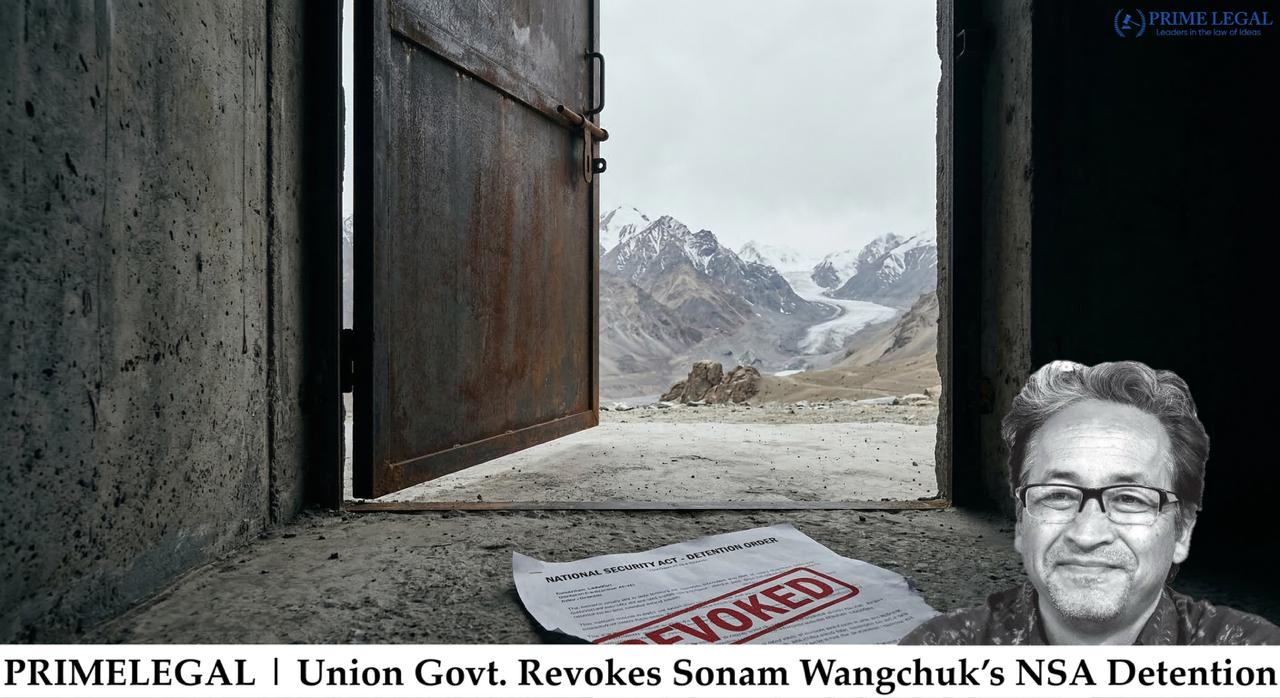
The Union government has revoked preventive detention of climate activist and educationist Sonam Wangchuk on March 14 allowing his immediate release from Jodhpur Central Jail after nearly six months in custody without trial. The Ministry of Home Affairs (MHA) cited that the revocation is to promote “peace, stability, and mutual trust” in the Ladakh region in the middle of the ongoing demands for constitutional safeguards. The decision of the Union government to release Sonam Wangchuk was announced just few days before the scheduled Supreme Court’s hearing on the habeas corpus petition filed by his wife.
BACKGROUND
Sonam Wangchuk was taken into custody by the Leh authorities on 26 September 2025 due to violent protests in Leh that resulted in the deaths of 4 individuals and left several others injured. The protesters were demanding for full statehood of Ladakh, its inclusion under the Sixth Schedule of the Constitution, and the creation of separate Lok Sabha constituencies for Leh and Kargil. Authorities contended that Wangchuk’s speeches and video messages had incited the protesters, thereby posing a significant threat to public order. Wangchuk’s wife, Dr. Gitanjali Angmo, moved a habeas corpus petition under Article 32 before the Supreme Court challenging the detention and disputing characterization of his speech and the procedural compliance.
KEY POINTS
- Detention Revoked: Union Home Ministry revoked Sonam Wangchuk’s preventive detention order under Section 3(2) NSA, 1980 with immediate effect after nearly six months, stating the the decision was taken “after due consideration” to create space for “constructive dialogue”, noting that Wangchuk had already undergone nearly half of the maximum permissible period of preventive detention under the NSA.
- Arrest Context: Detained on Sept 26, 2025 from Leh after violent Ladakh protests on Sept 24 casing 4 deaths, wherein they demanded statehood & Sixth Schedule protections, subsequently he was lodged in Jodhpur Central Jail.
- Demands of Protesters: The Ladakhi protesters demanded for full statehood for Ladakh, protection under Sixth Schedule for its 90% tribal population, autonomous councils powers over land, forests, and local governance.
- SC’s findings: The Supreme Court while hearing the Habeas Corpus Petition on 29th Jan 2026 highlighted the procedural errors including failure to supply alleged videos to accused, vague grounds based on “stale FIRs,” and “borrowed satisfaction” from police reports, violating Article 22(5) and NSA Section 8.
RECENT DEVELOPMENTS
Following the Centre’s order, Wangchuk was released from Jodhpur Central Jail and returned to an emotional reception by supporters, who framed his freedom as a “welcome step”. Civil society groups emphasized that the revocation does not erase the months spent in custody without trial, and have called for a deeper judicial pronouncement on the limits of NSA use against peaceful dissenters. Further, the SC proceedings are expected to address the questions of constitutional rights of the accused and other issues, even if the detention has been revoked.
Whereas, the grievance and demands of the Ladakhi protesters for full statehood of Ladakh and Sixth Schedule status, driven by fears of demographic change, loss of land to outside interests and unregulated infrastructure projects in an ecologically fragile zone, are again in the limelight. The Centre has reiterated its “commitment” to engage with Ladakhi representatives through the existing High‑Powered Committee mechanism indicating probable political negotiation over the Ladakh region.
CONCLUSION
Sonam Wangchuk’s release after 6 months under NSA detention represents a balancing National Security claims and constitutional protections for civil liberties. The Centre’s revocation offers temporary relief to one of Ladakh’s most visible public figures, but it also serves as a reminder of how preventive detention can be used to end mass protest in sensitive regions. For Ladakh’s people, the question of fact is whether this release is an attempt to meaningful progress on their demands.
“PRIME LEGAL is a National Award-winning law firm with over two decades of experience across diverse legal sectors. We are dedicated to setting the standard for legal excellence in civil, criminal, and family law.”
WRITTEN BY: ABIA MOHAMMED KABEER

