
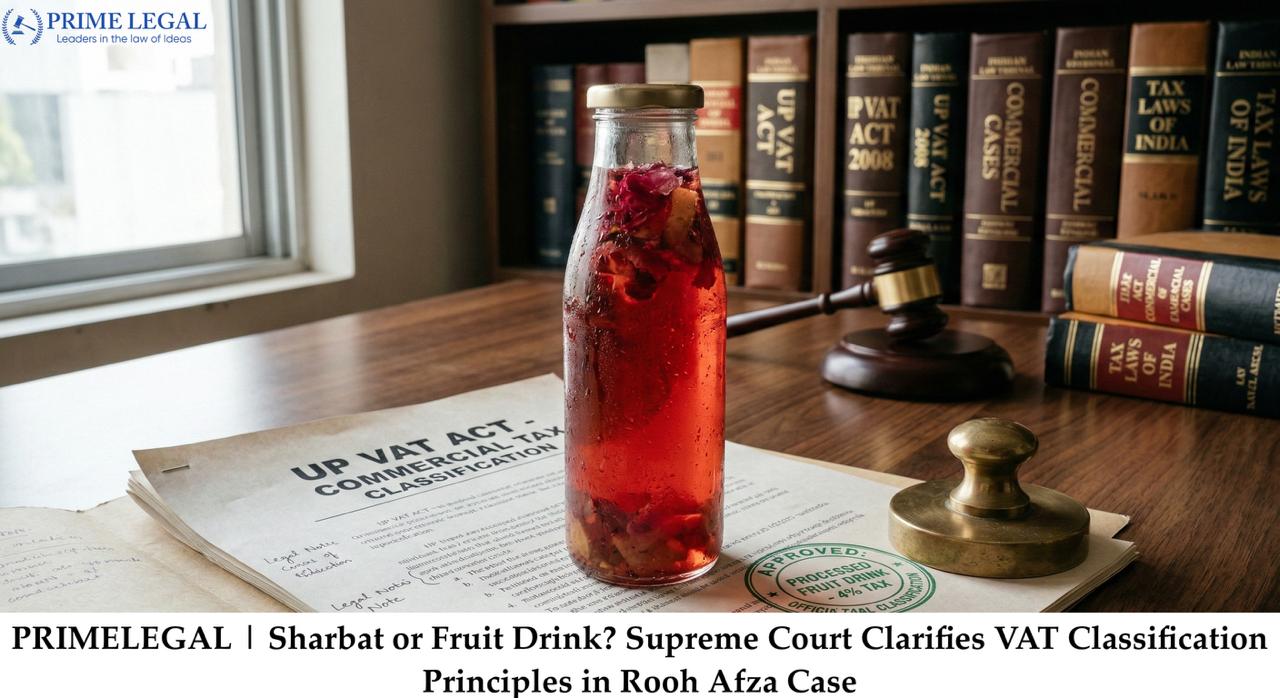
CASE NAME: M/S Hamdard (WAKF) Laboratories v. Commissioner, Commercial Tax, U.P. Commercial
CASE NUMBER: Civil Appeal No. 2579 of 2026
COURT: Supreme Court of India
DATE: 25 February 2026
QUORUM: Justice B.V. Nagarathna and R. Mahadevan
FACTS
The present appeal arises out of the common judgment and order dated 2 July 2018 passed by the High Court of Judicature at Allahabad, wherein the Court dismissed the revisions preferred by the appellant and affirmed the order of the Commercial Tax Tribunal, holding that the appellant’s product “Sharbat Rooh Afza” was liable to Sales Tax / Value Added Tax at the rate of 12.5% under the residuary entry contained in ‘Schedule V’ of the Uttar Pradesh Value Added Tax Act, 2008.
The dispute pertained to the period from 01 January 2008 to 31 March 2012. The appellant is the manufacturer of the product Sharbat Rooh Afza, a non-alcoholic, sweetened beverage prepared from inverted sugar and blended with fruit juices. According to the appellant, the fruit juice content is 10%. During the assessment years, the appellant manufactured and sold and paid VAT at the rate of 4% on the sales with its monthly returns, treating the product as Fruit Drink or Processed Fruit covered under Entry 103 of Part A of Schedule II of the UPVAT Act. During provisional assessment, the Joint Commissioner (Corporate Circle) held that Sharbat Rooh Afza was an unclassified item taxable at 12.5% under the residuary entry in Schedule V. Aggrieved by this, the appellant approached the Additional Commercial (Appeals), Commercial Taxes Range, Ghaziabad and then the Tribunal, wherein the appeals were dismissed. Challenging the Tribunal’s order, the appellant approached the High Court. Aggrieved by the High Court’s judgment, the Appellant then approached the Supreme Court.
ISSUES
- Whether “Sharbat Rooh Afza” shall be classified under Entry 103 of Part A of Schedule II or under the residuary entry contained in Schedule V.
- Whether “Sharbat Rooh Afza” is eligible to tax at the rate of 4% under Entry 103 of Part A of Schedule II or at the higher rate of 12.5% as an unclassified commodity under the residuary entry contained in Schedule V.
LEGAL PROVISIONS
- Entry 103, Schedule II, Part A and Entry 1, Schedule V of Uttar Pradesh Value Added Tax Act, 2008.
- Uttar Pradesh Goods and Services Tax Act, 2017
- Fruit Products Order, 1955.
- Central Excise Tariff Act, 1985.
ARGUMENTS
APPELLANT:
The counsel on behalf of the Appellant submitted that the product is a non-alcoholic summer drink and contains not less than 10% fruit juice. They contended that since the inception of UPVAT, the appellant maintained uniformity in classification and sought to bring the product under Entry 103, namely, processed or preserved vegetables and fruits, including fruit jams, jelly, pickle, fruit squash, paste, fruit drink and fruit juice. This entry is an inclusive and umbrella entry intended to cover all products having a substantial nexus with fruits and fruit-based beverages. It was contended that the High Court erroneously accepted the contention of the Revenue by applying the common parlance test and holding the product to be a miscellaneous preparation exigible to tax under the residuary entry, and observed that in the absence of the word “sharbat” in entry 103, the product must necessarily fall outside the said entry. The counsel submitted that Supplementary Note 3 to Chapter 21 of the Central Excise Tariff Act, 1985, defines Sharbat as a non-alcoholic sweetened beverage or syrup containing not less than 10% fruit juice or flavoured with non-fruit flavours. They contended that this definition is materially in consonance with Rule 2(j) of the Fruit Products Order, 1955. Thus, both the taxing statute and the food regulation framework recognise “Sharbat” as a fruit-based beverage or fruit drink, leaving no scope for treating the product as a miscellaneous or residuary item.
Further, they contended that the High Court failed in correctly applying the Common Parlance Test and erred in not applying the essential character test, which mandates that classification must be determined based on the constituent that imparts the product its essential character. They contended that although sugar syrup constitutes approximately 80% of the composition, it merely functions as a preservative medium. The fruit component, though stated to be about 10% in absolute terms, is the ingredient that imparts the product its identity and essential character. The counsel relied on Mauri Yeast India Pvt Ltd v. State of Uttar Pradesh [(2008) 5 SCC 680] to state that where a specific entry is capable of encompassing the product, recourse to the residuary entry is impermissible. They further relied on Commissioner of Customs, Mumbai v. Dilip Kumar & Co. [(2018) 9 SCC 1], which stated that taxing statutes must be interpreted strictly and literally. They submitted that Rooh Afza is classified as a fruit drink taxable at the lower rate in all other States, except Uttar Pradesh and Haryana.
RESPONDENT:
The counsel on behalf of the Respondent contended that Entry 103 does not expressly include either Sharbat or Fruit Product within its ambit. The Assessing Authority rejected the claim of the appellant and held that the product falls under the residuary entry, i.e., Entry No. 1 of Schedule V of the UPVAT Act, and accordingly levied tax at 12.5%. They submitted that the appellant’s licence under the Food Products Order, 1959, authorises it to manufacture “Non-Fruit Syrup / Sharbat”. Clause 11 of the FPO prescribes mandatory conditions in which fruit and non-fruit products are to be described and labelled, under which it stipulates that any beverage not containing at least 25% fruit juice shall not be described as fruit syrup, and must be described as “Non-Fruit Syrup” and mandates non-fruit beverages and sharbats to be clearly marked as Non-Fruit. Thus, they contended that the appellant is statutorily prohibited from marketing the product as a fruit product, as the mere presence of 10% fruit content does not qualify the product as a fruit drink. They highlighted that interpreting entries in Excise or Sales Tax statutes, the meaning as understood in common or commercial parlance must prevail, unless the statute provides otherwise.
The counsel contended that applying the common parlance test, Sharbat Rooh Afza, containing only 10% fruit juice, being marketed and labelled as a non-fruit syrup, cannot be a Fruit Drink, as a product containing some quantity of fruit extract does not automatically qualify as a fruit drink under Entry 103, especially when statutory restrictions prohibit such marketing. They contended that the tax burden, as alleged by the appellant, is neither sudden nor excessive. It was further submitted that the appellant had deposited the tax demand at 12.5% under protest, the assessments attained finality, and the collected tax amount had already been passed to customers, hence, restitution at this stage would be impracticable.
ANALYSIS
The Hon’ble Court observed the evolution of the statutory regime governing the levy of sales tax/ VAT on the commodity in question. Under the Uttar Pradesh Trade Tax Act, 1948, Sharbat Rooh Afza fell under Section 63, namely, Soda water, lemonade and other soft beverages and syrups, squashes, jams and jellies, subjected to 12% tax. Subsequently, in 2005, Entry 24 with 16% tax rate stood relevant. With the Uttar Pradesh Value Added Tax Act, 2008, coming into effect, the VAT regime introduced a multi-stage levy on value addition, under Entry 103 of which, the Appellant sought to bring Rooh Afza with 4% VAT. With the introduction of GST, VAT was subsumed under Uttar Pradesh Goods and Services Tax Act, 2017, and the relevant entry stood Section 150 describing Fruit pulp or fruit juice-based drinks with 2.5% CGST.
The court observed that Sharbat Rooh Afza admittedly contains 10% fruit juice (8% pineapple juice and 2% orange juice) along with inverted sugar syrup and certain herbal distillates. Communication issued by FSSAI clarified that under Part-II of the Second Schedule of the FPO, a “fruit syrup” must contain a minimum of 25% fruit juice, and Sharbat Rooh Afza fell within the category of a non-fruit syrup containing 10% fruit juice. The court observed the contention of the appellant that regulatory classification under food safety legislation cannot solely govern the interpretation of an undefined fiscal entry under the UPVAT Act merits acceptance, and that fiscal statute must be interpreted in its own language. Since the term “food drink” is not defined under the UPVAT Act, the settled principle of interpretation mandates application of the common parlance test, and if a commodity reasonably fits within a specific entry, it ought not to be consigned to a residuary entry. Further, it was noted that if the Revenue seeks to classify a product under a residuary or entry different from that claimed by the assessee, the burden lies squarely upon it. Classification relates directly to chargeability; therefore, the onus of establishing the applicability of a taxing entry rests upon the Department. The court stated that the Revenue produced documentary material to demonstrate that the product is not understood in commercial circles as a fruit-based beverage preparation and failed to discharge the burden cast by law, as it cannot substitute the evidentiary burden required to displace classification under a specific entry.
The court analysed the test of essential character and stated that, though invert sugar syrup constitutes approximately 80% by volume, its function is essentially that of sweetening the preservative medium. The flavour, aroma and beverage character of the fruit juice component imparts a distinctive character. Sharbat, as per legislative understanding, is a flavoured beverage concentrate intended for dilution and consumption. Entry 103 does not prescribe any minimum threshold of fruit content and is inclusive to expand a broad category of fruit-based preparations, hence it cannot be confined solely to ready-to-consume bottled beverages, and Sharbat Rooh Afza bears a reasonable and substantial claim to classification as a fruit drink within Entry 103. It cannot be relegated to the residuary entry merely because it is marketed as a sharbat. They stated that if, on a proper application of the common parlance and essential character tests, the product reasonably answers the description of a fruit drink, the same cannot be denied merely on account of its label or regulatory categorisation.
JUDGMENT
The Hon’ble Court held that the product contains declared fruit juice and derives its essential beverage identity from fruit-based constituents, and the product is classifiable under Entry 103 of Schedule II, Part A of the UPVAT Act and is eligible for VAT at the concessional rate of 4%. The appeals were therefore allowed.
CONCLUSION
In conclusion, the present case highlights the foundational principles of tax jurisprudence by holding that classification under fiscal statutes must be guided by statutory language, commercial understanding, and the essential character of the product, rather than rigid reliance on regulatory labelling.
“PRIME LEGAL is a National Award-winning law firm with over two decades of experience across diverse legal sectors. We are dedicated to setting the standard for legal excellence in civil, criminal, and family law and taxation matters.”
WRITTEN BY: STUTI ANVI
Click here to read the judgment.

