
INTRODUCTION
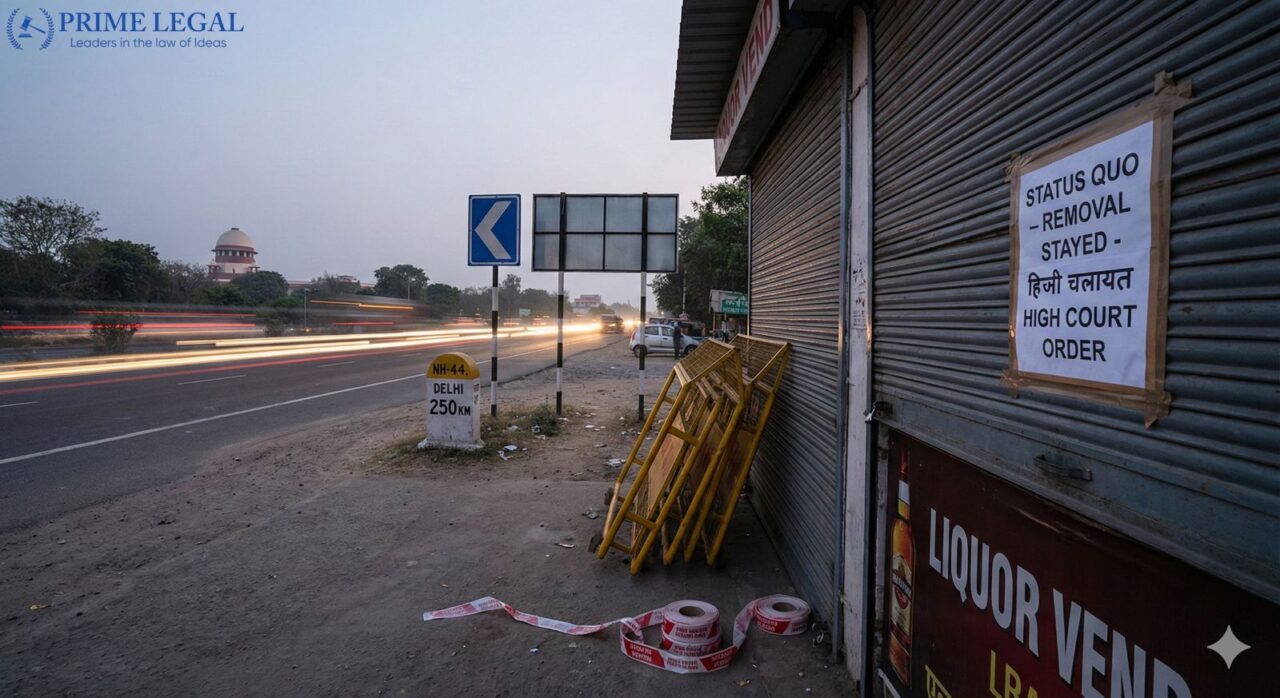
The Supreme Court of India, on Monday, January 19, 2026, stayed the operation of an order passed by the Rajasthan High Court, which had directed the State Government to shift or remove 1,102 liquor vends existing within 500 meters of National and State Highways in the State of Rajasthan. The Supreme Court stayed the operation of the order passed by the High Court. While staying the operation of the order, the Supreme Court agreed that deaths due to drunk driving are a serious matter of public safety. But it also felt that the order passed by the High Court was too wide and comprehensive, and thus required careful consideration from a legal perspective.
BACKGROUND OF THE CASE
The challenged order was pronounced on November 24, 2025, by a Division Bench of the Rajasthan High Court consisting of Justices Pushpendra Singh Bhati and Sanjeet Purohit in the course of hearing a Public Interest Litigation (PIL) case filed in 2023 by residents of Sujangarh village in Churu district, who alleged that there were violations of the Excise Act and Rules in respect of liquor vends situated along highways and that there was a dramatic increase in cases of drunken driving resulting in fatal accidents in Rajasthan.
During the proceedings, the High Court made a thorough analysis of the road safety statistics and largely relied on the Supreme Court’s landmark decision in the case of State of Tamil Nadu v. K. Balu (2017) 2 SCC 281, which held that liquor vends were not to be established within 500 meters of National and State Highways. Dismissing the State’s rationale that liquor vends were valid despite the fact that the highway stretches were within the municipal or local body limits, the High Court observed that such demarcations actually defeated the very purpose of road safety. The High Court, therefore, ordered the removal or shifting of all liquor shops within the prohibited area within two months, irrespective of the municipal, local self-governing body, or statutory development authority jurisdiction.
KEY ISSUES BEFORE THE SUPREME COURT
The statewide order issued by the Rajasthan High Court saw a array of petitions filed before the Supreme Court by liquor vendors and also by the Rajasthan state government itself. The main contention was that the High Court appeared to disregard a Supreme Court clarification contained within a judgment given in 2017 and titled K. Balu. The clarification excluded licensed liquor shops situated inside municipalities from the ban on highways and left it to state administrations to extend the ban inside areas controlled by self-governance bodies and development authorities.
Mukul Rohatgi, the senior advocate, appeared on behalf of one of the petitioners and argued that the HC came out with an order affecting the whole state without giving an opportunity of hearing to the stakeholders, despite the original PIL being against only a few licensed liquor shops in the Sujangarh village. He submitted that such a statewide directive directly contradicted binding Supreme Court precedent.
Regarding the state’s response to this issue, Solicitor General Tushar Mehta mentioned various constraints in enforcement related to the directives issued by the High Court and referenced that many cities and towns are situated along National and State Highways. He submitted that strict enforcement of the 500-metre rule would effectively eliminate liquor vends from large urban areas, despite their lawful operation and their contribution of over ₹2,200 crore annually to the revenue of the state.
RECENT DEVELOPMENTS AND THE COURT’S OBSERVATIONS
A Bench consisting of Justices Vikram Nath and Sandeep Mehta issued notice on the appeals and stayed the operation of the order of the High Court until further orders. The Court noted that although the concern of the High Court about the rise in deaths caused by drunken driving was “absolutely genuine,” the legalities involved in the directions had to be carefully examined, especially in the light of the earlier decisions of the Supreme Court.
Justice Mehta also pointed out the presence of surrogate and indirect advertisements by liquor vendors, where billboards carry indirect references or symbolic signs pointing towards liquor shops. The Court held that the interim stay should not be deemed to dilute the public safety concerns and made it clear that the State can deal with these issues while formulating its future liquor policy.
CONCLUSION
The Supreme Court’s stay on the interim order is an indicator of a careful balance between the concern for road safety expressed by the judicial body and its commitment to precedents set by cases. Though the issue of increasing road accidents attributed to alcohol intake is very important, the court held that it is clear that, at least for now, this concern will have to be dealt with in appropriately formulated policies and not by judicial dictums alone. The ultimate decision in this case will have very important ramifications for policies on liquor, federal discretion, and road safety policy in India.
“PRIME LEGAL is a National Award-winning law firm with over two decades of experience across diverse legal sectors. We are dedicated to setting the standard for legal excellence in civil, criminal, and family law.”
WRITTEN BY: USIKA K

