
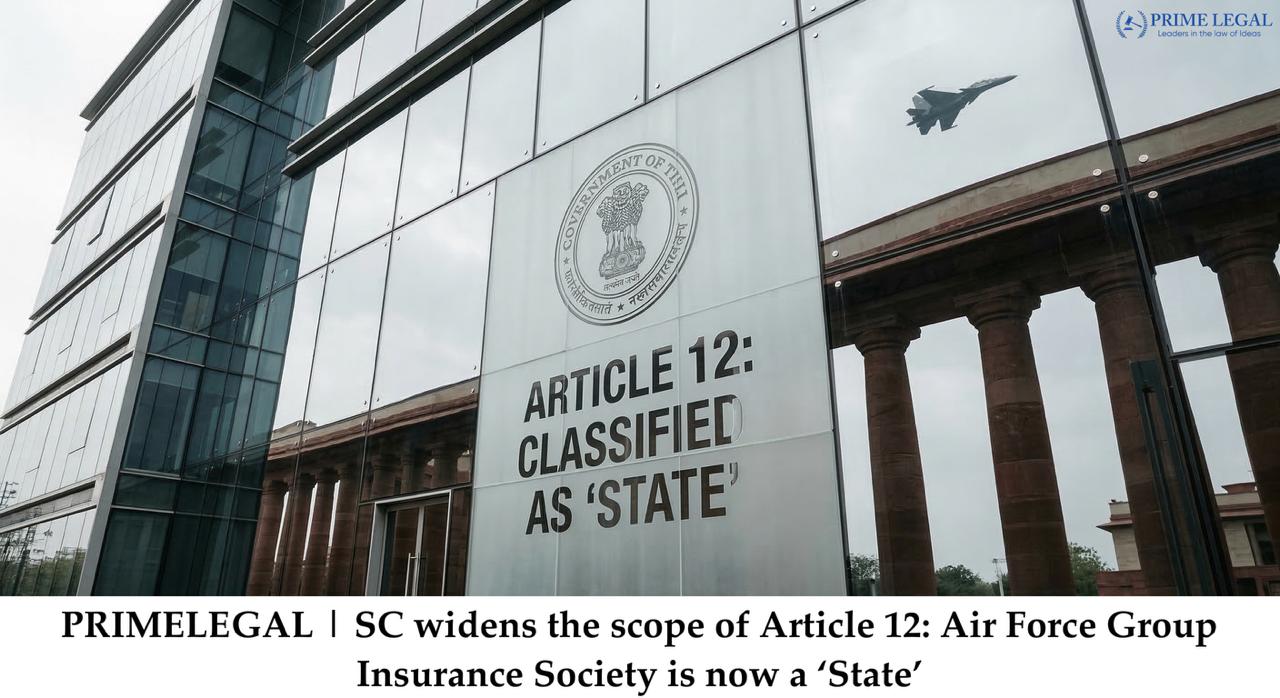
CASE NAME: Ravi Khokhar & Ors. v. Union of India & Ors.
CASE NUMBER: Civil Appeal arising out of SLP (C) No. 27366 of 2023
COURT: Supreme Court of India, Civil Appellate Jurisdiction
DATE: 12 March 2026
QUORUM: Hon’ble Justice Sanjay Karol and Justice Vipul M. Pancholi
FACTS
The Air Force Group Insurance Society (AFGIS) was set up in 1976 and registered under the Societies Registration Act, 1860 with the President’s sanction to run a compulsory group insurance scheme for Air Force personnel. The AFGIS Board of Trustees had initially decided to revise employees’ pay scales in accordance with the Sixth Central Pay Commission, but subsequently decided to deviate from it and asked employees to accept revised terms by a notice. The aggrieved employees filed multiple writ petitions before the Delhi High Court challenging the unilateral withdrawal and seeking continuation of Central Pay Commission benefits. The Division Bench of Delhi HC dismissed all petitions as not maintainable on the ground that AFGIS is not “State” or “other authority” under Article 12. Following which the employees approached the Supreme Court challenging the Delhi HC judgement and arguing that the AFGIS should be treated as “State”
ISSUES
- Whether the Writ Petition before the Supreme Court is maintainable?
- Whether the Air Force Group Insurance Society is “State” or “other authority” within the meaning of Article 12 of the Constitution of India?
- Whether the Delhi High Court erred in its judgement holding that the writ petitions were not maintainable?
LEGAL PROVISIONS
- Article 12 of the Constitution of India – definition of “State”
- Precedents on Article 12:
- Ramana Dayaram Shetty v. International Airport Authority of India, (1979) 3 SCC 489;
- Ajay Hasia v. Khalid Mujib Sehravardi, (1981) 1 SCC 722
- Pradeep Kumar Biswas v. Indian Institute of Chemical Biology, (2002) 5 SCC 111
- Zee Telefilms Ltd. v. Union of India, (2005) 4 SCC 649
- Rajkaran Singh v. Union of India, 2024 SCC OnLine SC 2138.
ARGUMENTS
APPELLANT:
The employees argued that AFGIS is a State instrumentality as it was established with Presidential sanction under Ministry of Defence authority. Moreover, the membership is compulsory for all officers and airmen and the contributions are compulsorily deducted from salary by the Air Force Central Accounts Office. Further, the Board of Trustees and Managing Committee consist entirely of serving senior IAF officers on deputation. They highlighted that AFGIS itself has claimed to be “Government” to claim tax and service‑tax exemptions, that it enjoys statutory tax exemptions and estate duty relief, and that its schemes are included into Air Force service conditions through Air Force Instructions and Government of India letters. Relying on the judgements in Ajay Hasia, Pradeep Kumar Biswas and especially Rajkaran Singh, on a similar compulsory savings fund for the Special Frontier Force, they contended that the cumulative financial, functional and administrative control, coupled with the public duty of protecting armed forces personnel, brings AFGIS within Article 12.
RESPONDENTS:
AFGIS and the Union of India supported the High Court’s view that the Society is not “State”, emphasizing that it is a non‑public fund body, self‑financed entirely from member premiums, with no inflow from the Consolidated Fund of India and no audit by the CAG. AFGIS pointed out that while IAF officers sit on the Board and are deputed to the Society, their salaries during deputation are borne by AFGIS and trustees receive no remuneration for their Board role. They stressed that AFGIS is not created by statute, does not perform functions for the public at large, and that regulatory or supervisory links with the Government are insufficient to meet the “deep and pervasive” control test under Ajay Hasia and Pradeep Kumar Biswas.
ANALYSIS
The Supreme Court said the Article 12 test cannot be reduced to labels like “non‑public fund” or to one factor such as the financial source. Instead, it went back to Ramana Dayaram Shetty, Ajay Hasia, Pradeep Kumar Biswas and Zee Telefilms and stressed that the real question is whether, taken as a whole, an entity is financially, functionally and administratively dominated by the Government and is performing a public duty. Further, the Court relied on certain documents such as the 1976 Defence Ministry sanction directing that it be run departmentally for Air Force welfare, the 1987 Air Force Instruction making membership and salary deductions compulsory, the internal Manual showing a Board and Secretary made up entirely of serving IAF officers and Government letters treating posts in AFGIS as formal deputations with Presidential approval.
It also noted that AFGIS regularly reports its finances to senior Air HQ officers and that key structural changes need Presidential sanction. All together, the control was sufficient in the Court’s view to meet the “deep and pervasive” control test, even though the fund itself comes from member contributions. The Court also stressed that compulsory insurance for serving and retired personnel is part of the State’s welfare function and not an ordinary private business, and it found it hard to accept that AFGIS could call itself “Government” to claim tax exemptions yet deny that status when its own employees invoke Article 12.
JUDGMENT
The Supreme Court disagreed with the Delhi High Court and held that AFGIS is indeed “State” within the meaning of Article 12. The Court therefore held that the writ petitions were maintainable under Article 226. Further, the Bench restored the principal writ petition to the file of the Delhi High Court, requesting that it be decided expeditiously given that it dates back to 2017. Accordingly, the appeal was allowed and pending applications were disposed of.
CONCLUSION
The judgment of the Supreme Court in this case widens the definition of “State” to include AFGIS, when it sits at the intersection of defense, welfare and compulsion. By looking beyond the formal tag of a “non‑public fund society” and focusing on how AFGIS actually operates on compulsory membership, service‑condition linkages, continuous oversight by senior Air Force officers and Presidential sanction, the Court signals that functional reality, not funding labels, will drive Article 12 analysis.
“PRIME LEGAL is a National Award-winning law firm with over two decades of experience across diverse legal sectors. We are dedicated to setting the standard for legal excellence in civil, criminal, and family law.”
WRITTEN BY: ABIA MOHAMMED KABEER
Read the judegement copy here

