
CASE NAME: Amrik Singh Saini and Anr. v. State of Maharashtra and Ors
CASE NUMBER: W.P. No. 4833 of 2024 & W.P. No. 724 of 2025
COURT: High Court of Judicature at Bombay
DATE: 9th December 2025
BENCH: Hon’ble Justice Bharati Dangre and Hon’ble Justice Shyam C. Chandak
FACTS
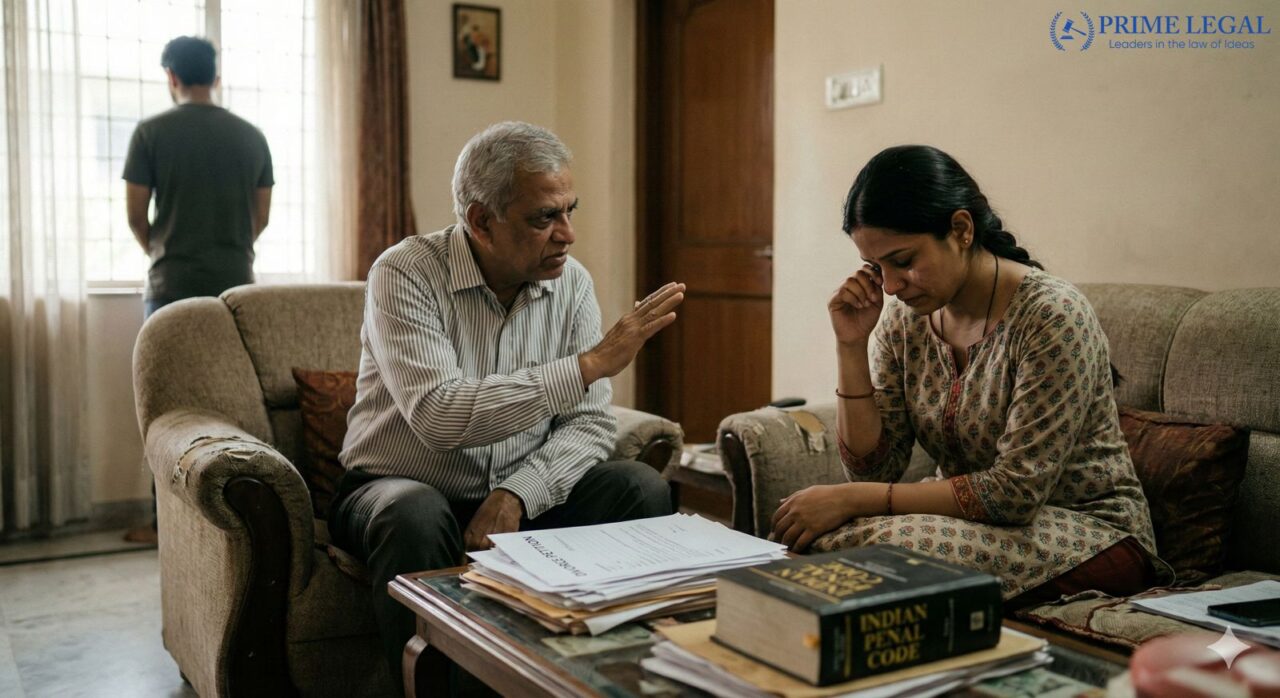
The petitioners Amrik Singh Saini (father-in-law) and Amit Saini (brother-in-law) filed the petition to challenge FIR No. 533 of 2024 registered at Sinhgad Road police station under Section 85, Section 351(2), Section 115(2), Section 3(5) and Section 352 of Bharatiya Nyaya Sanhita, 2023. The complainant, respondent-wife, alleged that after her marriage to Rumit Saini on 20 June 2014, the petitioners and her husband induced her to hand over gold and silver ornaments, promising return after their Hong Kong trip. The complaint went on to allege that the father-in-law poisoned his son’s mind against the complainant which led to an occurrence of physical assault. When the complainant discovered her husband’s extramarital affair and questioned him, he allegedly assaulted her. Upon approaching the father-in-law with grievances, he allegedly responded that she was harassing her husband and expressed dissatisfaction about insufficient dowry and/or car gifts. The brother-in-law allegedly taunted her to tolerate the beatings.
ISSUES
- Whether the allegations against petitioners amount to being legally cognizable offences under Sections 498A of IPC and corresponding provisions of Bhartiya Nyaya Sanhita arising from matrimonial disputes.
- Whether allegations made against distant in-laws and relatives during matrimonial disputes without specific instance substantiation cause violation of due process of law and constitute abuse of criminal process.
- Whether invocation of High Court jurisdiction under Article 226 of Constitution and Section 482 Bhartiya Nagarik Suraksha Sanhita, 2023 remains available to protect innocent persons unnecessarily implicated in matrimonial disputes.
LEGAL PROVISIONS
- Section 498A IPC which criminalizes cruelty by husband or his relatives constitutes grounds for divorce; requires specific conduct demonstrating deliberate acts causing mental trauma.
- Article 226 of Indian Constitution which provides High Court jurisdiction to issue writs for enforcement of constitutional rights and preventing abuse of process of law.
- Section 482 Bhartiya Nagarik Suraksha Sanhita, 2023 which details the inherent powers of the High Court to quash proceedings when facts and circumstances demonstrate abuse of legal process.
- Section 498A Explanation: Legal definition of ‘cruelty’ requiring conduct calculated to cause mental trauma or physical injury.
ARGUMENTS
PETITIONERS:
The counsel representing petitioners submitted that matrimonial disputes between respondent and her husband were purely personal matters. But still, the petitioners faced unnecessary implication through ulterior motives. Allegations imposed against the petitioners were entirely false. Even if the prosecution narrative is accepted, no cognizable offence to be imposed against the petitioners. The act of father-in-law merely expressing disapproval for the insufficiency of the dowry and brother-in-law making remarks during the marital discord does not deem fit for the applicability of Section 498A. The aforementioned conduct does not constitute cruelty under statutory definition. FIR and charge-sheet warranted quashing.
RESPONDENT STATE:
The Additional Public Prosecutor submitted that FIR and witness statements sufficiently demonstrated cruelty and jewelry misappropriation. Whether petitioners committed alleged offences constituted factual question requiring trial determination within Article 226 Constitution jurisdiction and Section 482 BNSS scope limitations. The trial remained an appropriate forum for such factual adjudication; premature FIR quashing violated settled criminal procedure principles.
ANALYSIS
Hon’ble Justice Shyam C. Chandak’s in his judgment meticulously examined the allegations against petitioners under matrimonial cruelty provisions. The Court identified two discrete allegations- father-in-law’s alleged response dismissing complaints by expressing dowry dissatisfaction and brother-in-law’s comments suggesting tolerance of marital disharmony. When compared to Section 498A IPC explanation defining ‘cruelty,’ these conduct categories manifestly failed threshold requirements. The judgment invoked Supreme Court precedent in Kahkashan Kausar @ Sonam vs. State of Bihar (2022) 6 SCC 599, wherein apex court repeatedly expressed concern regarding Section 498A systematic misuse and heightened tendency implicating husband’s relatives in matrimonial disputes without rigorous legal threshold analysis. The Court emphasized that Supreme Court jurisprudence consistently cautioned lower judiciary from proceeding against distant relatives when prima facie cases remained unestablished. K. Subba Rao vs. State of Telangana (2018) 14 SCC 452 established binding precedent that distant relatives warrant protection against omnibus allegations absent specific involvement substantiation. The judgment acknowledged profound consequences of unfounded criminal accusations: mental trauma, professional repercussions, reputation destruction, and financial devastation. High Court jurisdiction under Article 226 Constitution and Section 482 BNSS remained constitutionally available for abuse of process prevention, particularly protecting innocent individuals unnecessarily entangled through matrimonial litigation strategically targeting extended family members.
JUDGMENT
The High Court allowed writ petitions and went on to quash FIR No. 533 of 2024 and the following charge-sheet proceedings. The Court held that continuation of criminal proceedings against petitioners’ amounts to the abuse of legal process. This was because the respondent had filed a complaint to address the personal matrimonial disputes which unnecessarily implicate the relatives through ulterior motive without any substantiation of criminal culpability.
CONCLUSION
This judgment upholds judicial protection in cases involving prejudicial use of Section 498A in matrimonial litigation through indiscriminate allegations. By meticulously applying statutory definition of cruelty and by invoking constitutional abuse of process doctrine, the High Court laid down an important precedent which safeguards innocent in-laws and relatives from collateral criminal predicament arising out of matrimonial disputes. The decision reiterates that matrimonial disagreements shall be used as a justification for imposing implications on extended family members through allegations which don’t merit in proving culpability under Section 498A. The judgment strikes balance between providing safeguard for genuine dowry-related cases and preventing malicious criminal prosecution.
“PRIME LEGAL is a full-service law firm that has won a National Award and has more than 20 years of experience in an array of sectors and practice areas. Prime legal falls into the category of best law firm, best lawyer, best family lawyer, best divorce lawyer, best divorce law firm, best criminal lawyer, best criminal law firm.”
WRITTEN BY: KRISHNA KOUSHIK

