
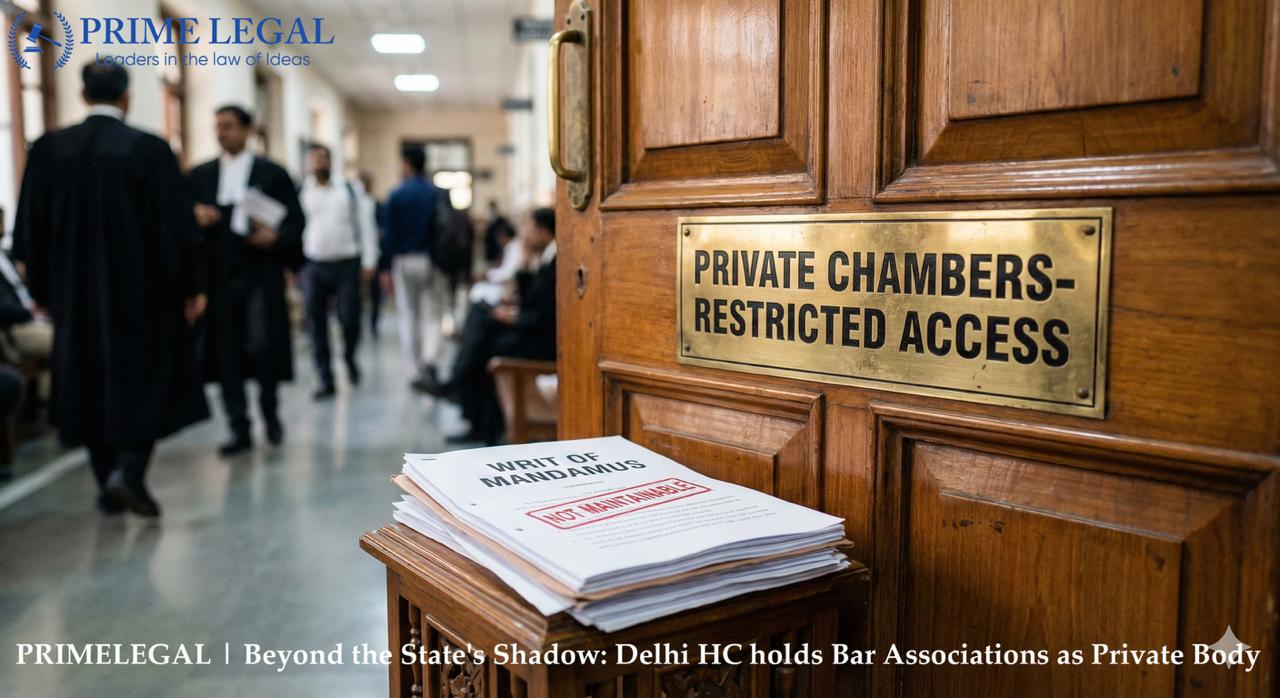
CASE NAME: Sangita Rai Vs New Delhi Bar Association & Ors.
CASE NUMBER: LPA 368/2024
COURT: High Court of New Delhi
DATE: 16.01.2026
QUORUM: Hon’ble The Chief Justice, Hon’ble Mr Justice Tejas Karia
FACTS
The instant intra-court appeal has arisen due to the dismissal of W.P.(C) No. 3331/2023 by the learned Single Judge vide order dated 30.10.2023. The appellant is an Advocate enrolled in the year 2000 and has been in regular practice, representing various government agencies and public bodies. According to the appellant, in 2013, one Mr Asgar Ali, the allottee of Chamber No. 279A at Patiala House Courts, allowed her to occupy the said chamber on a monthly rent basis. The appellant claimed that in 2023, Mr Asgar Ali, along with some others, forcibly broke open the lock of the chamber, threatened her, and tried to dispossess her. It was also alleged that the office bearers of the New Delhi Bar Association put an additional lock on the chamber and forced her to vacate, making her professional files unapproachable. The allegations that complaints to the police and representations to the Bar Association and judicial authorities did not produce any result led the appellant to file a writ petition for restoration of possession of the chamber and for taking action against the advocates who were allegedly involved in trespass.
ISSUES
- Whether the writ petition is maintainable under Article 226 of the Constitution?
- Whether a writ of mandamus can be issued against a Bar Association?
- Whether directions can be issued to initiate criminal or disciplinary action against the advocates on the allegations made by the appellant?
LEGAL PROVISIONS INVOLVED
- Article 226 of the Constitution of India
- Article 12 of the Constitution of India
- Societies Registration Act, 1860
- Advocates Act, 1961
- Code of Criminal Procedure, 1973
ARGUMENTS OF THE PETITIONER
The appellant claimed that she was illegally removed from the hall where she worked for a long time, and that the Bar Association and some lawyers assisted in illegal trespass. She also claimed that the learned Single Judge failed to notice prayer B of the writ petition, which prayed for action against the concerned lawyers by the Bar Association and/or Bar Council of Delhi. She relied upon an order of 08.05.2024 to show that prayer A was not pursued and only prayer B was left, and therefore the writ petition ought to have been decided at least on the issue of disciplinary action.
ARGUMENTS OF THE RESPONDENTS
The respondents raised a preliminary objection on the maintainability of the writ petition. They claimed that the Bar Association is neither a “State” nor an Article 12 instrumentality, nor does it carry out any public function. They also claimed that the appellant was only a permissive possessor of the hall and did not have any legal right to claim it. As regards the criminal offenses, they claimed that adequate remedies are available under criminal law and cannot be claimed under a writ petition.
ANALYSIS
The Division Bench upheld the finding of the Single Judge that the appellant was not an allottee of the chamber; he only held it permissively as an allottee. As he had no legal right to the chamber, he could not seek relief under the writ jurisdiction to get possession of it. The Court further held that Prayer ‘B’ was not maintainable as it prayed for the issuance of a writ of mandamus against the Bar Association, which was a private body registered under the Societies Registration Act, 1860, whose main object was the welfare of its members. As the Bar Association does not carry out any public functions, it does not fall within the meaning of Article 12, and as such, no mandamus could be issued against it.
Regarding the appeal for the filing of criminal charges, the Court agreed with the learned Single Judge that the appellant had available remedies in criminal law. The Court cited the principles laid down in the case of Sakiri Vasu v. State of U.P, (2008) 2 SCC 409 and Priyanka Srivastava v. State of U.P., (2015) 6 SCC 287, which emphasise that criminal law remedies must be sought in accordance with the procedure laid down in the Code of Criminal Procedure, 1973, and not through writ jurisdiction. The Court further noted that, despite the fact that the Bar Council of Delhi is a statutory body with disciplinary powers, the appellant had neither filed with it nor made it a party to the case, which is necessary for the filing of a writ of mandamus.
JUDGMENT
The Division Bench held that there was no merit in the appeal and upheld the order of the learned Single Judge in dismissing the writ petition as not maintainable. The appeal was, therefore, dismissed.
CONCLUSION
In dismissing the appeal, the Court held that the appellant is free to avail himself of the proper civil or criminal remedies or to approach the appropriate authority, including the Bar Council of Delhi, as required by law. There was no order as to costs.
“PRIME LEGAL is a National Award-winning law firm with over two decades of experience across diverse legal sectors. We are dedicated to setting the standard for legal excellence in civil, criminal, and family law.”
WRITTEN BY: USIKA K
Find the true copy of the Judgement here: SANGITA RAI Vs NEW DELHI BAR ASSOCIATION & ORS.

