
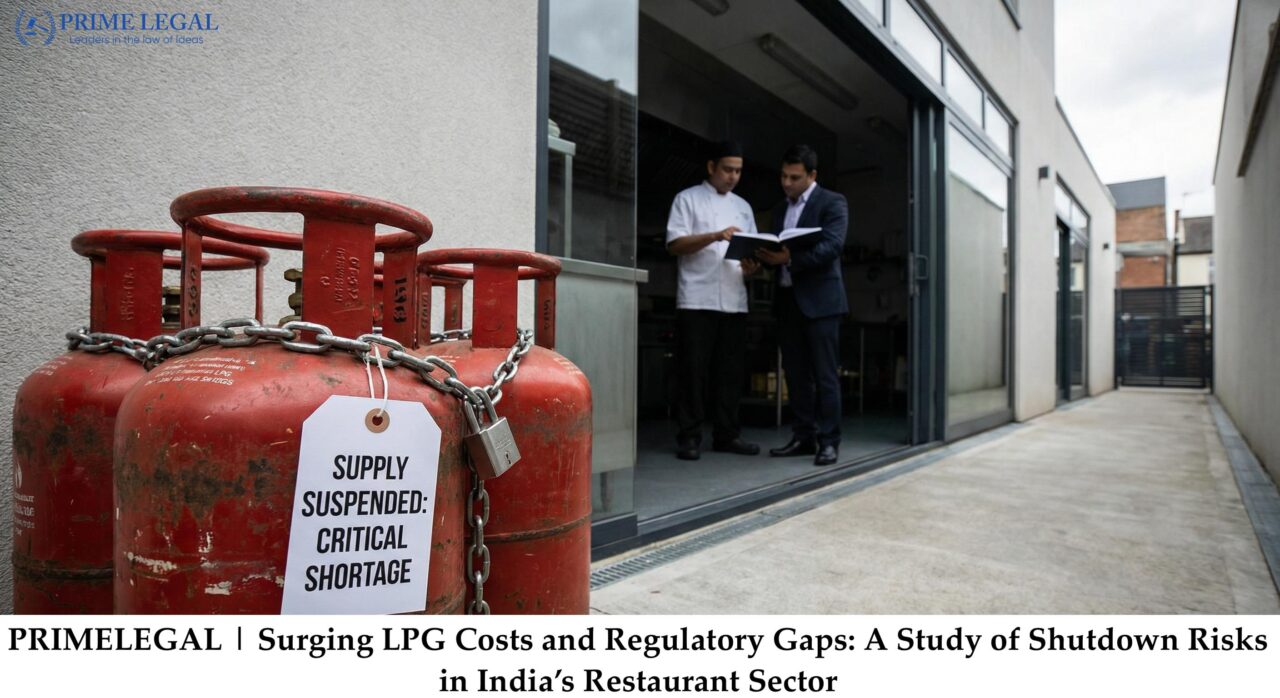
ABSTRACT:
Liquified Petroleum Gas (LPG), it serves a primary cooking fuel for a majority of restaurants and food establishments in India. Recently in India, disruptions arose in LPG supply chains, which led to its shortage which resulted in the increased fuel prices, and regulatory interventions have created serious operational challenges for the restaurant sector. The situation has been aggravated by the global geopolitical tensions affecting the LPG imports in the country, as well as the policy response prioritizing the household consumption over commercial use which led to extreme shortage of gas in the commercial zone which resulted in the shutdown of many restaurants and places. This article analyzes the impact of surging LPG costs and the supply shortages on India’s restaurant industry while examining the regulatory framework governing LPG distribution also emphasising the role of the Essential Commodities Act, 1955 in controlling supply, preventing the hoarding, and regulating distribution during crisis. The article also argues that while the Act serves an essential role in ensuring equitable access to the critical resources, its implementation during the supply shortage may create unintended consequences for the commercial sectors such as the restaurants.
KEYWORDS:
Surge, shortage, LPG gas, Restaurants, domestic, commercial, Essential Commodities Act.
INTRODUCTION:
The energy accessibility is a crucial component of the economic stability and the public welfare. In India, LPG has become one of the most widely used fuels for cooking due to its efficiency, affordability, and relative environmental advantages compared to traditional fuels such as coal or firewood. Restaurants, hotels, and food vendors across the country rely heavily on commercial LPG cylinders to maintain the daily operations of the life.
However, the recent developments have exposed the vulnerabilities in India’s LPG supply system. Supply disruptions also have a major link with the on-going geopolitical tensions in West Asia, and the logistical bottlenecks have caused a shortage of the commercial LPG cylinders used in daily lives across several Indian cities highlighting the developed states as well such as Bangalore, Mumbai etc. These disruptions have significantly affected all the hospitality sector, forcing some of the restaurants to reduce operations or temporarily shut down due to the lack of the cooking fuel in the country.
Industry representatives have warned that nearly about 95% of the restaurants depend on the LPG as their primary cooking fuel, meaning any disruption can severely affect the food services and employment across the sector. In response to these disruptions, the Indian Government has invoked the Essential Commodities Act, 1955 granting the authorities the power to regulate the supply and distribution of the essential goods including LPG. While all these measures aim to protect households and prevent hoarding, they have also intensified the supply constraints for the commercial users, raising questions about the regulatory balance.
The LPG Crisis and Its Impact on the Restaurant Sector:
Dependence on Commercial LPG:
The world is entirely reliant on the LPG cylinders and the Fuel. The massive shortage in the LPG gas have left the country suffering from its shortage as it is an everyday part of the life. The restaurants in the country are mostly relied on the LPG gas cylinders for their production. The country heavily relies on the outer culture of foods, in which the restaurants in the country play a great role. And having shortages in the LPG gas have made it difficult for the restaurants to function properly. The shortage in the gas has led to the increase in the prices of gas as well, which is a negative factor for the economy. The rise in the shortage of the gas led to many restaurants getting closed or in an increased food rate.
Rising Costs and Operational Pressure:
The rising costs has led to the surge in the demand for the gas and has also led to the increase in the prices to another level. The several states of the country are facing this issue in the country. This has created financial pressure too on the restaurant owners and the common citizens of the country. The LPG gas cylinders shortage clearly disrupted the country as 95% of the restaurants in the country primarily depend on the LPG gas for the production and created double pressure or double burden on the businesses. Restaurant must either absorb that higher prices from the customers or let it pass, either way it’s causing trouble to the owners.
The LPG shortage has even started the increase in the black- market sales for the cylinders at an inflated price. The restaurants to continue with the shortage of the gas have been compelled to purchase from the unofficial channels to follow up the demand ratio of the country.
Operational Disruptions and the Shutdown Risks:
The shortage has clearly harmed the restaurant owners instantly, which resulted in the shutdown or the temporarily closure of the places. This has caused disruptions in the multiple states of the country. In some states, the restaurants have even increased the prices of the food items and even cut down on the food items which require a lot of cooking time, food items such as the slow-cooked curries or the baked dishes. Reports have claimed that this has led to the temporary shutdown of the places due to the insufficient LPG supply.
Such closures in the economy does not even affect the business owners but have impacted the economy of the country in a broader way, which resulted in the inflation in the basic food items in the country.
The role of the Essential Commodities Act, 1955:
The Essential Commodities Act, 1955 was established and enacted by the Parliament of the country to ensure the basic availability of the essential food items to the citizens of the country at a fair and reasonable price. It was enacted to protect the citizens from the harsh and unfair prices of the basic commodities by the salesmen to the consumers of the country. This act empowers the state or the government to regulate the prices, demands and supply of the basic commodities.
Over the time, several commodities- including the food grains, petroleum products, LPG has also been included in the act as under the basic commodities criteria. This act allows the state to take regulatory measures or emergency measures at the time of shortage or emergency. This includes the fixing of the prices of the commodities, also regulating the production to meet the demand. This act prioritizes the basic or essential sectors of the commodities to be looked on first. This power intends the government to safeguard the rights of the consumers and to protect them from the unfair prices at the time of the crisis.
During the current LPG shortage in the country, the government has invoked the guidelines, or the provisions of the essential commodities act to preserve the uninterrupted supply of the cooking gas to the households. Authorities have placed greater emphasis on the domestic supply of the cooking gas than the commercial sector. The government has even directed the machineries and the companies to prioritize the domestic needs first. Under this, the consumers are being given the priority to fulfil the domestic demand. This aims to stabilize the surge and the shortage of the LPG in the country and the economy and to distribute it where it’s needed most that is, in the domestic sector.
Regulatory Gaps and the Policy Challenges:
The Essential Commodities Act plays a crucial role in safeguarding the essential resources, but certain regulatory gaps have also been exposed. Here, under the act, the government is prioritizing the domestic customers over the owners in the restaurant and cafe industry. The commercial food industry bet it, restaurants, cafes, small street food vendors, also plays a crucial role in managing the food supply in the country or in the urban areas by providing the meals at an affordable price to a millions of the people.
Secondly, the state focuses on the supply control of the LPG gas rather than solving the vulnerabilities faced by the citizens in the LPG supply chain. India imports most of its oil, fuels and gas demands from other countries, but due to the current condition of the world where the transportation link is being disrupted led to the unavailability of the LPG gas.
The sudden shortage can even create confusion among the regulatory divisions in the distribution of the gas in the country. The shortage can even give rise to the temporary delay in the delivery or in the suspension of the deliveries across various regions.
All these factors highlight a need for the balanced regulatory approach to protect both the households, and the owners in the commercial food industries.
Policy Considerations and Future Resolutions:
To address the challenges that the country is currently going through posing the LPG shortages, the policymakers must consider several reforms for a more balanced economy.
There should be adoption of alternative measures which would be helpful in stabilizing cooking in both the domestic field and in the commercial sector. Measures such as the use of inductions or piped natural gas which would turn out to be more feasible in nature in this situation.
It is also being suggested that if there is a strategic reserve of the LPG cylinder, this could actually lead to a better distribution of the gas in the country and could help in mitigating the current issue caused by the global geopolitical disruptions and inability to currently fulfil the demand.
The Essential Commodities Act should have a more refined guideline to benefit both the households and the commercial sector people.
The regular monitoring of the LPG gas distribution would help in preventing the hoarding or the black-market activity involving the buying and selling of the LPG gas from unauthorized sources.
CONCLUSION:
The overall shortage in the supply of the LPG gas in the country has disclosed the fragile dependence of the restaurants of the country on a single energy source. This shortage has glorified the impact of the LPG gas in daily lives and how the millions of people rely on the LPG gas for their food. If not taken seriously, the LPG gas shortage could pose serious risks in the economic and social sector of the country. The prioritizing of the domestic users of the LPG gas has placed immense pressure on the restaurant sector exposing the gaps in the current framework. To address all these recurring issues requires a holistic approach that would benefit the commercial sectors as well, strengthening both India’s energy security and the economic resilience.
“PRIME LEGAL is a National Award-winning law firm with over two decades of experience across diverse legal sectors. We are dedicated to setting the standard for legal excellence in civil, criminal, and family law.”
WRITTEN BY: MEENAKSHI DANGI

