
CASE NAME: H v. W
CITATION: NC: 2026:KHC:36045-DB
CASE NUMBER: Miscellaneous First Appeal No. 4343 OF 2026 (FC)
COURT: High Court of Karnataka at Bengaluru
DATE OF JUDGMENT: 15.07.2026
QUORUM: Hon’ble Mr. Justice D K Singh & Hon’ble Mr. Justice T.M.Nadaf
Facts:
The appellant-husband and the respondent-wife were married for 21 years. The marriage between the parties was a love marriage and an inter-caste marriage. Out of the wedlock, a daughter was born, who is now almost a major. The husband had filed a petition seeking a decree of divorce in M.C.No.381/2019 alleging cruelty by the respondent, whereas, the wife had filed the petition in M.C.No.857/2019 under Section 9 of the Hindu Marriage Act for restitution of conjugal rights. Both the petitions were clubbed together and disposed of by a common judgment whereby, the petition filed by the respondent-wife in M.C.No.857/2019 came to be allowed and the petition filed by the appellant-husband in M.C.No.381/2019 came to be dismissed. The Family Court held that the allegation of cruelty as provided under Section 13(1)(ia) of the Hindu Marriage Act against the respondent-wife could not be proved. A miscellaneous first appeal was filed by the husband against the judgment and decree dated 06.03.2026 passed by the family court.
ISSUES:
- Whether the husband is entitled for divorce on the ground of non-resumption of marriage even after passing of the decree of restitution of conjugal rights, prayed by the wife?
- Whether the family court was correct in allowing the petition filed by the respondent-wife and dismissing the petition filed by the appellant-husband?
LEGAL PROVISIONS:
- Section 9 of the Hindu Marriage Act
- Section 13(1A) of the Hindu Marriage Act, 1955
- Section 19(1) of the Family Courts Act, 1984
ARGUMENTS:
Appellant:
The appellant alleged that after passing of the judgment dated 06.03.2026 for restitution of conjugal life, the parties did not make any efforts to re-establish their conjugal life and they have been living separately in their places at Mysuru. It was further argued that despite sincere efforts and several requests made by the husband to the wife to come and join him and lead a marital life, the wife neither responded nor joined him. The marriage between the parties had broken down irretrievably.
Respondents:
The Respondent contended that she had looked after the appellant (Husband) and his parents well and gave them all love and affection. The husband’s parents advised the appellant and the respondent- to stay on the first floor of their house for the purpose of offering prayers and for preparation of food as the respondent belonged to Brahmin caste. They lived on the first floor of the house, but she never insisted on a separate residence. She denied the allegation of incompatibility between them. It was further argued that the respondent never picked up any quarrel with the appellant or his family members even for a single day. All other allegations were also denied.
ANALYSIS:
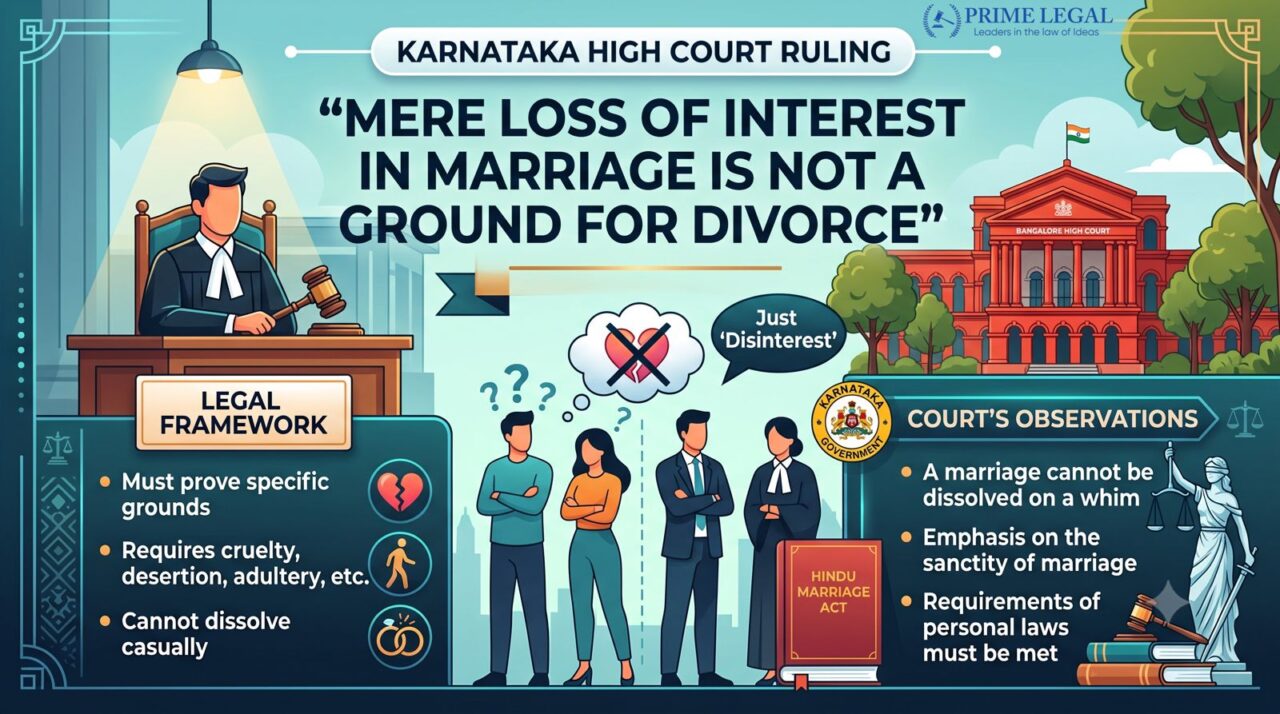
The Karnataka High Court denied divorce to the husband stating that the husband failed to establish a legally valid ground for dissolution of marriage. The court stressed on the fact that the husband had himself testified that he did not intend to resume cohabiting with his wife even after the decree of restitution of conjugal rights. After analysing the contentions, the court opined that the appellant wanted to take advantage of his own wrong. It was recorded that, the person who fell in love with the respondent and fathered a girl child came before the Court stating that he was left with no interest in the marriage and thus filed a petition for divorce. While dealing with the issue of dissolution of marriage the court reiterated the principle that, “marriage under the Hindu Law is a sacrament and it is not a contract”. Once the parties are married, the marriage is for life and one person cannot walk away from the marriage on the ground that he/she is left with no interest in the marriage with the other party. Thus, the court found no ground to interfere with the impugned judgment and decree passed by the Family Court.
JUDGEMENT:
The appeal did not survive for any consideration and was therefore disposed off.
CONCLUSION:
The ruling upheld the sacramental nature of Hindu marriage while invoking the doctrine of “no one can benefit from his own wrongdoing.” It ruled that the husband could not take refuge in non-resumption of married life when the husband was the cause of his own wife living separately from him. The Court reinforced the principle that one cannot walk away from the marriage on the ground that he/she is left with no interest in the marriage with the other party.
“PRIME LEGAL is a National Award-winning law firm with over two decades of experience across diverse legal sectors. We are dedicated to setting the standard for legal excellence in civil, criminal, and family law.”
WRITTEN BY: SOMSUTA PAUL
Read the judgement copy below:

