
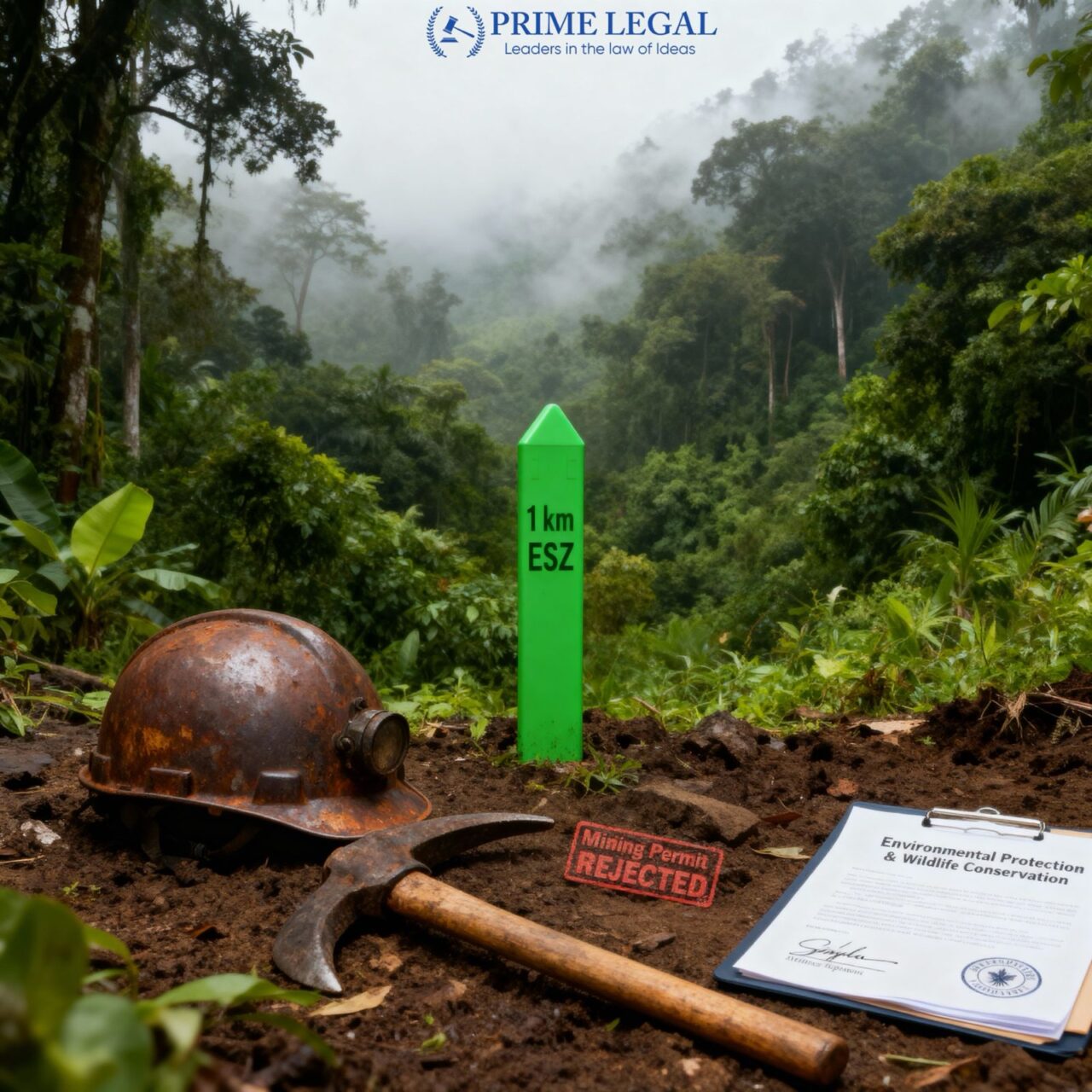
Case Name – In Re: Saranda Wildlife Sanctuary
Case Number – Writ Petition (C) No. 202 OF 1995
Date – Thursday, Thirteenth Day of November, Two Thousand and Twenty – Five
Quorum – Chief Justice of India Justice B.R. Gavai and Justice K. Vinod Chandran
FACTS
The Saranda forest area in Jharkhand which is one of the most pristine Sal forests with rich biodiversity was notified in 1968 by the erstwhile State of Bihar as the Saranda Game Sanctuary covering 31,468.25 hectares. Despite this declaration there was no proper declaration as a Wildlife Sanctuary under the Wildlife (Protection) Act, 1972 (WP Act) was initiated by the State of Jharkhand (GoJ). The mining operations in nearby areas, especially Kiriburu and Meghahatuburu, caused ecological disturbance. An application before the NGT (OA No. 59/2020/EZ) led to directions in 2022 asking the state to consider notifying the area as a sanctuary. When no action was taken, an IA was filed before the Supreme Court seeking declaration of 1968 Game Sanctuary as a deemed Wildlife Sanctuary.
During the year of 2024 – 25 multiple affidavits were filed by GoJ stating that the entire 31,468.25 hectares was pristine forest with no operational mines inside 126 compartments. The State later proposed expanding the sanctuary to 51,516.41 hectares based on a communication from the wildlife Institute of India (WII) and later the proposal got reduced to only 21,941.64 hectares citing habitation, infrastructure, tribal livelihood, mining interests and security concerns. Despite earlier statements, the state sought modification of the Court’s directions and submitted a draft notification declaring only 24,941.64 hectares as a sanctuary. This matter culminated in the recent judgment.
ISSUES
- Whether the State of Jharkhand was justified in reducing the proposed sanctuary area from 31,368.25 hectares to 24,941.64 hectares.
- Whether the area of 31,468.25 hectares, previously notified as a Game Sanctuary in 1968, must necessarily be declared a Wildlife Sanctuary under Section 26A of the WP Act.
- Whether the State’s conduct in repeatedly changing its stand constituted a breach of its duty under the WP Act, constitutional obligations, and earlier orders of the Court.
- Whether mining, habitation, livelihood, and security considerations could legally justify exclusion of ecologically significant areas from sanctuary declaration.
LEGAL PROVISIONS
- Section 18 of Wildlife (Protection) Act, 1972 – Allows the State Government to declare its intention to constitute any area as a sanctuary if it is of ecological, faunal and floral significance.
- Sections 19 – 24 of Wildlife (Protection) Act, 1972 – inquiry determination, and acquisition of private rights in or over land intended to be declared as a wildlife sanctuary.
- Section 26A of Wildlife (Protection) Act, 1972 – procedure for a state government to declare an area a sanctuary.
- Article 48A and Article 51A (g) of the Constitution of India – Duty of the State to protect and improve the environment, and citizens to protect and improve forests and wildlife respectively.
- Fifth Schedule of the Indian Constitution – Recognition of tribal-inhabited scheduled areas.
ARGUMENTS
APPLICANT / AMICUS CURIAE – The learned Amicus Curiae Shri Parameshwar, outlined the historical trajectory from the 1968 notification to the present proceedings, highlighting that the state has consistently admitted the ecological importance of Sarada. He has submitted that the power to notify a sanctuary is a power coupled with a duty and the State is obligated through constitution to protect the area.
The applicant argued that deforestation and mining had damaged the habitat, disrupted elephant movement, reduced wildlife populations and impacted the Koina River. They highlighted that declaring the area as a sanctuary would not affect existing rights of Scheduled Tribes due to statutory protection under the Forest Rights Act, 2006. The applicant asserted that the state had failed in its constitutional and statutory obligations.
THE STATE – the State of Jharkhand contended that the region falls under the Fifth Schedule which is inhabited by Ho, Munda, Uraon and other Adivasi communities whose livelihood depends on forest produce. They even said that the proposed sanctuary area includes roads, schools, health centres, agricultural lands, and other infrastructure. The State submitted that the mining activities in the area are crucial for the steel industry and employment, and declaring the entire 31,468.25 hectares as a sanctuary would disrupt the economic stability.
The State claimed that the initial proposal of 57,519.41 hectares were based on confusion arising from internal WII communications. It further stated that tribal displacement, socio-cultural disruption, mining-related economic security, and insurgency-related security issues as grounds for restricting the sanctuary area to only 24,941.64 hectares.
ANALYSIS
The Court observed that the State of Jharkhand has consistently admitted through multiple affidavits that no mining activity existed in the 31,468.25 hectares area that comprised pristine forest with high ecological value. The Wildlife Institute of India’s 2025 report reaffirmed that Sarada is a critical ecological corridor supporting elephants, threatened species such as the Four – Horned Antelope and rich in biodiversity across taxa, therefore bringing the area within Section 26A(1)(b) of the WP Act, 1972.
The Court found no jurisdiction for the State’s shift from its earlier stand especially when the area had already been notified as a Game Sanctuary in 1968 and met all the statutory criteria for declaration as a Wildlife Sanctuary. The Court relied on the constitutional mandates under Article 48A and Article 51A(g) of the constitution of India, the National Forest Policy 1988, and the National Wildlife Action Plan 2017–31 to reinforce the duty of the State.
Justice M. B. Shah Commissions Report, 2013 further demonstrated that Sarada is one of India’s finest elephant habitats and vulnerable to mining – induced degradation. The Court rejected the State’s reliance on habitation and livelihood concerns, as the Wildlife (Protection) Act, 1972 expressly allows continuation of existing rights under section 24(2)(c). The Court held that State’s inconsistent conduct disregarded the Court’s directions.
JUDGEMENT
The Hon’ble Supreme Court held that the area of 31,468.25 hectares, already notified as the Saranda Game Sanctuary in 1968, clearly satisfies the requirements of Section 26A of the Wildlife (Protection) Act. The Court refused the State of Jharkhand’s attempt to reduce the sanctuary area to 24,941.64 hectares, acclaiming that the State had earlier affirmed that the entire 31,468.25-hectare region was pristine forest with no mining activity.
The Court concluded that there was no legal or ecological justification to exclude any part of the original area. The Court held that the State had repeatedly shifted its stand and failed to honour its statutory and constitutional obligations.
The Court therefore directed the Government of Jharkhand to notify the full 31,468.25 hectares as the Saranda Wildlife Sanctuary.
CONCLUSION
The Court highlighted that Sarada’s ecological significance and statutory protection obligations cannot be compromised. The State’s inconsistent positions were rejected and the Court declared the entire 31,468.25 hectare as a Wildlife Sanctuary.
“PRIME LEGAL is a full-service law firm that has won a National Award and has more than 20 years of experience in an array of sectors and practice areas. Prime legal falls into the category of best law firm, best lawyer, best family lawyer, best divorce lawyer, best divorce law firm, best criminal lawyer, best criminal law firm, best consumer lawyer, best civil lawyer.”
WRITTEN BY- SUSMITA ROYCHOWDHURY
Click here to read more: In Re Saranda Wildlife Sanctuary

