
INTRODUCTION
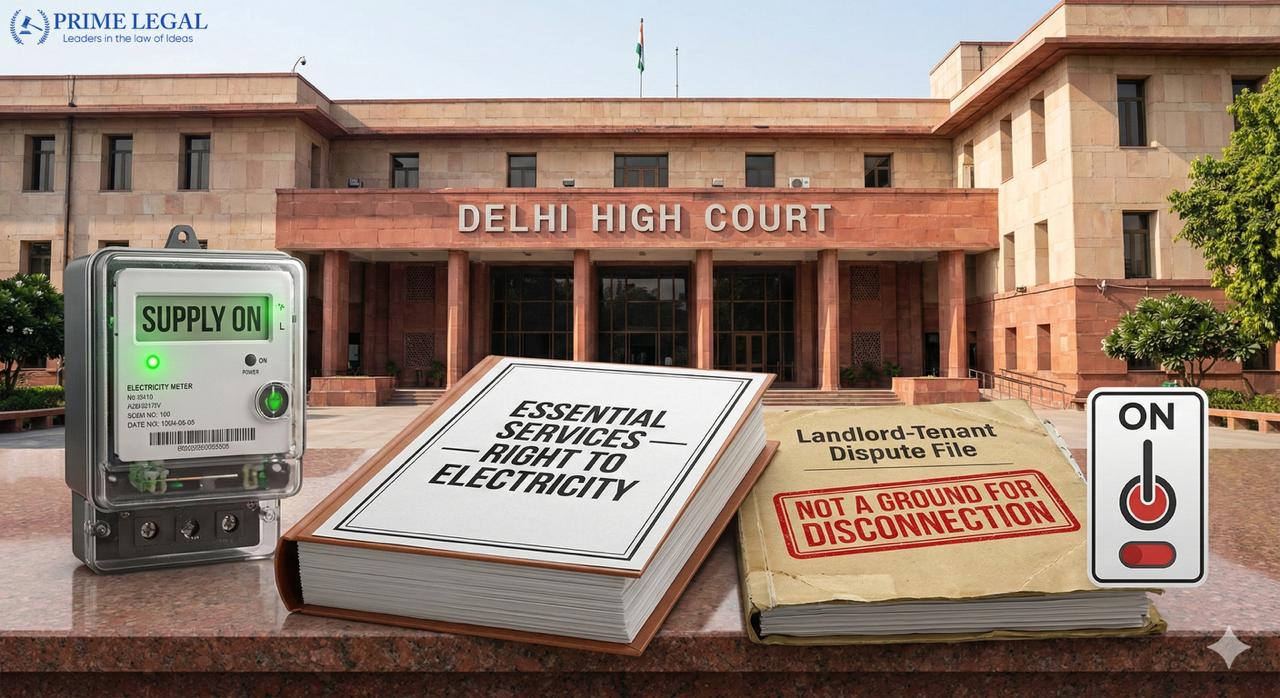
In a key ruling that safeguards access to vital services, the Delhi High Court has declared that electricity cannot be cut off just because landlords and tenants are locked in a dispute. The court stressed that power is a fundamental need, woven right into the right to live with human dignity under Article 21 of the Constitution. It made clear that no one can weaponize such essentials to bully someone in a private spat and ordered power companies to keep the lights on for anyone lawfully occupying the property.
This decision carries real weight in cities, where landlord-tenant clashes crop up all the time and shutting off utilities often serves as a dirty trick to push evictions.
BACKGROUND
The trouble started when a tenant turned to the Delhi High Court after the landlord got the electricity cut off at the rental place amid their spat. The landlord insisted the meter and connection were in their name, so the tenant had no say, and they’d asked the power company to pull the plug because of the row.
The tenant fired back that this was pure harassment—arbitrary and leaving them high and dry without a basic need—and that you can’t just yank electricity without proper steps under the Electricity Act, 2003, and the rules.
The distribution firm stuck to its guns, saying it followed the owner records and the registered user’s request. The court had to sort out if a tenant holding lawful possession could get left in the dark just over a private beef with the owner.
KEY POINTS
- The Court held that electricity stands as an essential service, forming a core part of the constitutional right to life and personal dignity enshrined in Article 21.
- It ruled squarely that power supply cannot be snapped off simply because a landlord and tenant are caught up in some dispute—those matters have to play out through the right legal routes.
- The Bench laid it out clearly: being in lawful possession or occupation of the premises, rather than just holding the ownership deed, is enough to claim continued access to electricity.
- The Court stressed that electricity distribution companies carry out a public utility role and must operate strictly by the book under statutory rules, not jump at private instructions from landlords.
- It pointed out that pulling the plug on electricity to squeeze a tenant into vacating amounts to outright illegal pressure tactics, something the law simply won’t tolerate.
- The Court confirmed that tenants can step up and apply for their own separate electricity connections registered in their name, as long as they meet the laid-down regulatory standards.
- Distribution companies received a firm caution: they cannot disconnect supply without going through the proper due process mandated by the Electricity Act and its regulations.
RECENT DEVELOPMENTS
This judgment fits right into a steady stream of court decisions that treat access to basic utilities as a fundamental need, not some optional perk tied to a contract. The Delhi High Court has struck the same chord before in cases about water and electricity, insisting these services can’t be withheld just to muscle through private claims.
Legal experts point out that the ruling could push electricity companies to rethink their procedures, especially for rental properties. It gives tenants much stronger footing, especially in major cities where landlords routinely pull the plug on utilities to bully people into leaving. The ruling is bound to echo in other live cases about essential services and give solid direction to fellow High Courts grappling with these disputes.
CONCLUSION
The decision of the Delhi High Court is a sharp wake-up call to the constitutional principles, as it clearly differentiates between what is vital and what is routine, between landlord-tenant rows. By stating that electricity cannot be switched off during such confrontations, the Court put human dignity, basic living standards and due process of law above all.
The ruling sent a hard warning, telling the landlords to seek redress in the courts instead of employing their own hands to get utilities and that it is the responsibility of the public to provide access to the un-luxurious necessities. In the process, it strengthens the rights of tenants and establishes a perception that core services are in the form of entitlement and not a way of gain.
“PRIME LEGAL is a full-service law firm that has won a National Award and has more than 20 years of experience in an array of sectors and practice areas. Prime legal falls into the category of best law firm, best lawyer, best family lawyer, best divorce lawyer, best divorce law firm, best criminal lawyer, best criminal law firm, best consumer lawyer, best civil lawyer.”
WRITTEN BY: ARCHITHA MANIKANTAN

