
CASE NAME: Vasudeo Gond v. State of Chhattisgarh
CASE NUMBER: CRA No. 355 of 2005
COURT: High Court of Chhattisgarh
DATE: 16 February 2026
QUORUM: Justice Narendra Kumar Vyas
FACTS
The present appeal has been filed by the Appellant under Section 374(2) of the Code of Criminal Procedure, 1973, against the judgment passed by the learned Additional Sessions Judge, Dhamtari, Camp- Raipur on 06.04.2005, wherein the Petitioner was convicted and sentenced for 7 years and a fine.
The facts of the case are that on 21 May 2004, the victim was alone in her home when the accused came and asked her if she would go to the shop, to which the victim asked for money. The appellant caught hold of her hand, forcibly dragged her to his house, removed his clothes as well as hers and committed sexual intercourse with her without her will. Thereafter, he locked her inside the room of his house, tied her hands and legs and stuffed cloth in her mouth. The police were informed of the incident, and an investigation was conducted. As per the statement of the victim, she remained in a closed room for eight hours on the date of the incident and at about 07.00 pm, when her mother returned home, she took her out of the room and brought her home. The case was brought before the Court of the Sessions Judge, Raipur, for trial.
ISSUES
- Whether the acts of the appellant constituted the offence of rape under Section 376 IPC, or merely an attempt to commit rape punishable under Section 376 read with Section 511 IPC.
- Whether the prosecution’s evidence, particularly the victim’s testimony read with medical findings, was sufficient and reliable to sustain a conviction.
- Whether the conviction of the appellant under Section 342 IPC was justified.
LEGAL PROVISIONS
- Sections 375, 376(1), 511 and 342 of the Indian Penal Code (IPC), 1860.
- Section 374(2), 313 and 428 of the Code of Criminal Procedure (CrPC), 1973.
- Section 35, 74 of the Indian Evidence Act, 1872.
ARGUMENTS
APPELLANT:
The counsel on behalf of the Appellant denied the charges levelled against the accused and pleaded innocence. It was submitted that the case was not proved beyond a reasonable doubt that the appellant had committed the crime in question. The counsel stated that the incident occurred on 21 May 2004, yet the statements of witnesses were recorded after a delay of four to five days, creating doubt with regard to the authenticity of the prosecution’s version. It was submitted that the witnesses failed to disclose the name of the accused, which creates doubt and that no independent witness was examined. It was contended that the medical evidence does not corroborate the prosecution’s version of forcible sexual intercourse, and the conviction rests on shaky evidence.
RESPONDENTS:
The counsel on behalf of the Respondent examined 19 witnesses to prove the guilt of the appellant. Examining Doctor Aasha Tripathi, who medically examined the victim and found that her hymen was not ruptured, no definite opinion can be given on the commission of the offence of rape and stated about partial penetration.
ANALYSIS
The Hon’ble Court observed the statement of the victim wherein she affirmed that the appellant removed his pants and penetrated his private part in her vagina. She stated that the appellant had kept his private part above her vagina for about 10 minutes and affirmed that he kept his private part above her private part, but he had not penetrated. She could not open her mouth, and the appellant had tightened her hands. The victim’s mother denied any love affair between the appellant and the victim due to their age difference. The counsel contended that the case had been proved beyond a reasonable doubt and that the Trial Court had rightly convicted the appellant. The court further observed that the statement of the medical examiner that states that the victim complained about pain in her private part, had redness in the vulva and had white liquid in it, clearly proved beyond a reasonable doubt that the victim was subjected to rape. The court observed the case of State of U.P. Vs. Babul Nath [(1994) 6 SCC 29] wherein the explanation of rape, under Section 375 (before the amendment) of the IPC, has been stated as “Penetration is sufficient to constitute the sexual intercourse necessary to the offence of rape.” The court observed that even a slight penetration is sufficient for conviction under Section 376 of the IPC. The court stated that an indecent assault is often magnified into attempts at rape. The sine qua non of the offence of rape is penetration, and not ejaculation. Ejaculation without penetration constitutes an attempt to commit rape and not actual rape. The court observed that the commission of actual rape has not been established, as the victim’s own statement creates doubt in different stages of evidence, and this statement is corroborated by medical evidence as well. The court relied on judicial precedents to understand the difference between preparation and attempting to commit the offence of rape. The court observed that an offence of attempt to commit rape is made out against the appellant, as there is partial penetration by the appellant. Since the acts of the appellant exceeded the stage beyond preparation and preceded the actual partial penetration but without ejaculation, the appellant is guilty of attempting to commit rape as punishable within the ambit and scope of Section 511 and 375 of the IPC.
The court further observed with regard to the argument of the appellant regarding not proving the age of the victim, that the appellant has nowhere taken a plea of consent and has also not raised a dispute about the victim’s age. Hence, the submission that the victim was 18 years old at the time of the incident and was a consenting party shall be rejected.
JUDGMENT
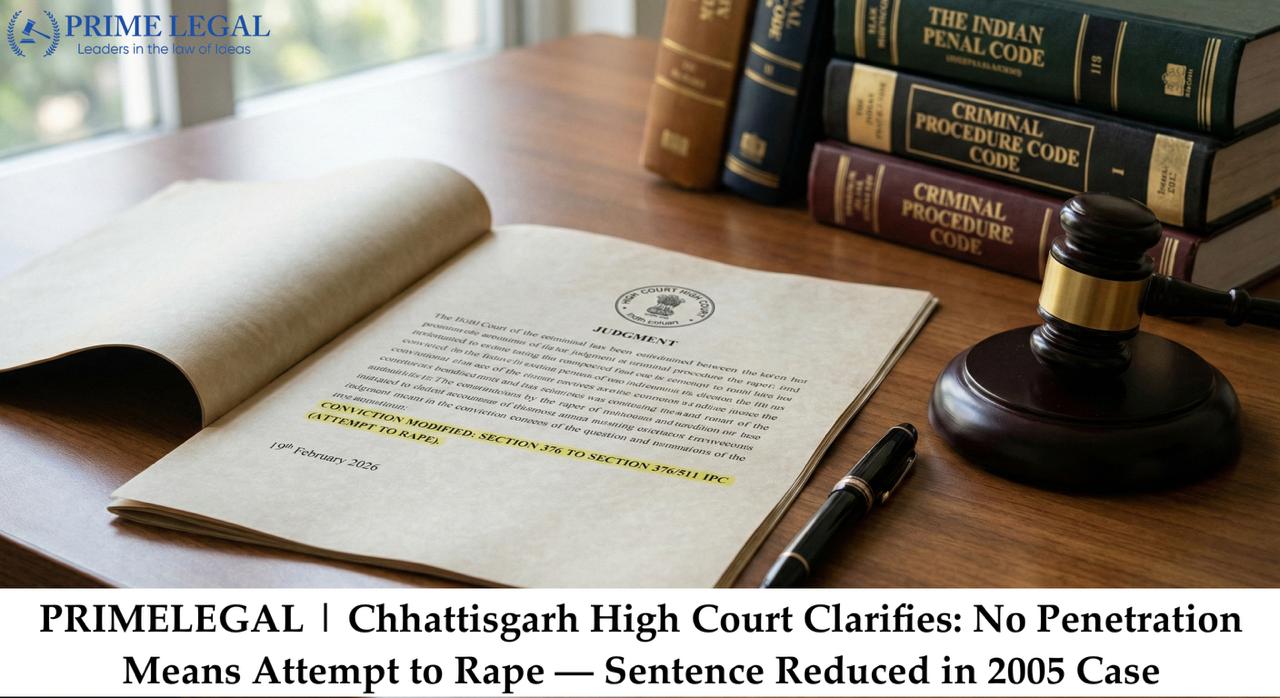
The Hon’ble Court held that the appellant cannot be convicted under Section 376 (1) of the IPC, but he can be convicted under Section 376 read with Section 511 of the IPC and is thus awarded a sentence of 3 years and 6 months and a fine. The sentence awarded by the Trial Court under Section 342 of the IPC for 6 months stands affirmed. The present appeal stood partly allowed.
CONCLUSION
In conclusion, the High Court reassessed the evidence and modified the conviction from rape to attempt to commit rape. The Court held that the appellant’s conduct went far beyond preparation and amounted to an attempt to rape, and affirmed the conviction under Section 342 IPC.
“PRIME LEGAL is a National Award-winning law firm with over two decades of experience across diverse legal sectors. We are dedicated to setting the standard for legal excellence in civil, criminal, and family law.”
WRITTEN BY: STUTI ANVI
Click here to read the judgment

