
ABSTRACT
Newspapers, magazines, judges’ orders, laws, and decisions are published in media, digital and print, whereupon they are transformed into public knowledge and understanding. Though these and other forms of legal journalization have been consistently linked to the quest for justice, the same are undeniably admissible proof, thus arousing the spectre of the haunting stalker-search engine, hacker, or political disenfranchisement-that enshrouds a person who is nosy of a case. This tussle between the rights of privacy and erasure of Article 21 with the closed gates to justice, the transparency of judges’ order pages, and the revelation of the ‘public’ mandate for accountability has been not disdained on Indian judges’ doorsteps with decisions in K.S. Puttaswamy, Zulfiqar Ahman Khan, Jorawer Singh Mundy, and the unfolding Right to be Forgotten, HC, Delhi ‘Right to be Forgotten in Judicial Records’ on the right of an individual to be forgotten in deliberations.
INTRODUCTION
Open Justice is part of the Indian system of law. The general rule that the court proceedings are open, and the open judgments of the courts are given and open to argument. Open justice seeks to enable the judiciary’s individual accountability, predictability, the rule of law, and public confidence, and enables lawyers, journalists, academics, and the general population to observe how decisions are made.
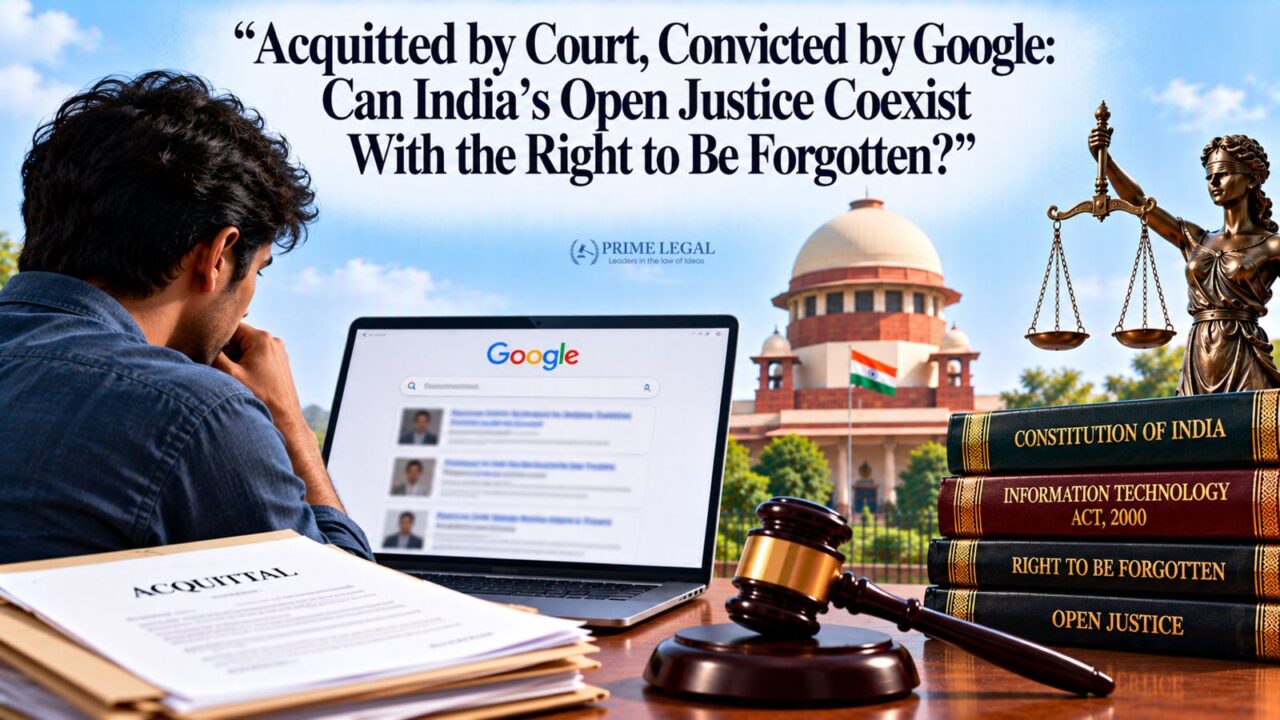
Digital technology has changed the substance of publishing a judgment. It once was a print appearance in a physical archive and a reputable legal publication; now it could be a court website, legal database, or search engine. Once a person’s innocence was found on an archive; now a person’s name yields a decades-old criminal case. The law’s mistake has not been erased, but it can live a long tail digital life.
This is what the right to be forgotten is striving for. It is not about erasing history or destroying government archives it is asking whether it is in the public interest to maintain a person’s name on the internet. The debate is between competing interests of individuals’ ‘digital rights’ and ‘open justice’.
PRIVACY, DIGNITY AND ARTICLE 21
The right to be forgotten has a constitutional basis in the right to privacy enshrined under Article 21 In the case of Justice K.S. Puttaswamy v. Union of India, the Supreme Court laid down that informational privacy is part of the fundamental right to privacy in India. The Court also observed that informational privacy is derived from the right of individual autonomy and human dignity.
Certainly, it would be over-simplifying to think that an individual can merely shoot down every warning bell in public minds. There is never, as we have seen, complete privacy and it must be balanced with Article 19(1)(a), (b), (c) – the right of freedom of speech and expression, the right of to be informed, the media’s rights to report proceedings and open justice. Nevertheless, information that is no longer relevant, false or unnecessarily harmful for no proportionate public benefit should, perhaps, be closed down by the State and private sector organisations.
For the foreseeable future, then, the right to be forgotten is better characterized as a limited right of informational self-determination. That is, it can be used to remove, de-list or block material that would not otherwise have to be available to the public online.
OPEN JUSTICE AND JUDICIAL RECORDS
It means that court procedures are to be held in open court and that judgments are published. So that the parties and the general public can see what the court has decided; so that the reasons of the judgement can be analysed by others.
The right to be forgotten thus generally cannot include orders or judgments in official court records. Since a judgment involves not only personal data concerning the parties, but also a statement of the state, accepted by the public, of the case, including the necessity for the application of the law, and the facts established and the law applied, the wholesale destruction or distortion of such orders and judgements would be destructive of the record of the development of the law.
JUDICIAL ATTITUDE IN INDIA
Indian courts have been more cautious in addressing this issue. In Zulfiqar Ahman Khan v. Quintillion Business Media Pvt. Ltd., the Delhi High Court invoked the right to be forgotten and right to be left alone as resulting from the right to privacy and restrained the republication of articles that made baseless allegations about the plaintiff. Despite media articles and not a court record, the court reasoned that republication in digital media can tarnish reputation even if the allegations are false.
In Jorawer Singh Mundy v. Union of India, the Delhi High Court directed Google and India Kanoon to remove references of old judgments from ranks, in which the petitioner had been acquitted. Even the petitioner in this case sought deletion of an old judgment in search rankings. The Court found that there is no justification for allowing the criminal case of an acquitted individual to be constantly available online.
The most developed version of the right to be forgotten was laid out by the Delhi High Court in Laksh Vir Singh Yadav v. Union of India. In this decision, the court held that the right to be forgotten is a component of informational privacy right under Article 21.
A WORKABLE BALANCE
There must be a nuanced argument as to (a) whether the court records are There, (b) whether they are (cherry) discoverable and (c) whether they are (at least,). Discoverable. The judgment still has to be there in the collection. The Court, the parties, the counsel, the scholar, the researcher and the public with a bona fide stakeholder needs to reach it. But there can be cut down it unqualified, name-based digital-hype if there are no social usefulness.
The protection from erasure/de-indexing should therefore be strongest in those cases where, for example, a criminal prosecution resulted in (a) acquittals, (b) discharge, quashing or closure, (c) unwelcome, old or uncensored information, (d) private or personal issues such as divorce and marriage. In these cases, there is minimal public interest in indefinite retrievability through name-searching, and the shame and damage to reputation can only go.
CONCLUSION
Open justice and the right to be forgotten do not operate as no-go areas. Open justice translates into a requirement that judicial processes not be fully recorded, disseminated and reviewed. It does not translate into a requirement that the totality of an individual’s record of former legal disputes should be forever in evidence every time the individual’s name is input into a search engine. Our jurisprudence has veered in this direction; what is necessary is that the judgment remains in repositories, but not duplicated and reproduced through search engines.
“PRIME LEGAL is a National Award-winning law firm with over two decades of experience across diverse legal sectors. We are dedicated to setting the standard for legal excellence in civil, criminal, and family law.”
WRITTEN BY: AASTHA KEDIA

