
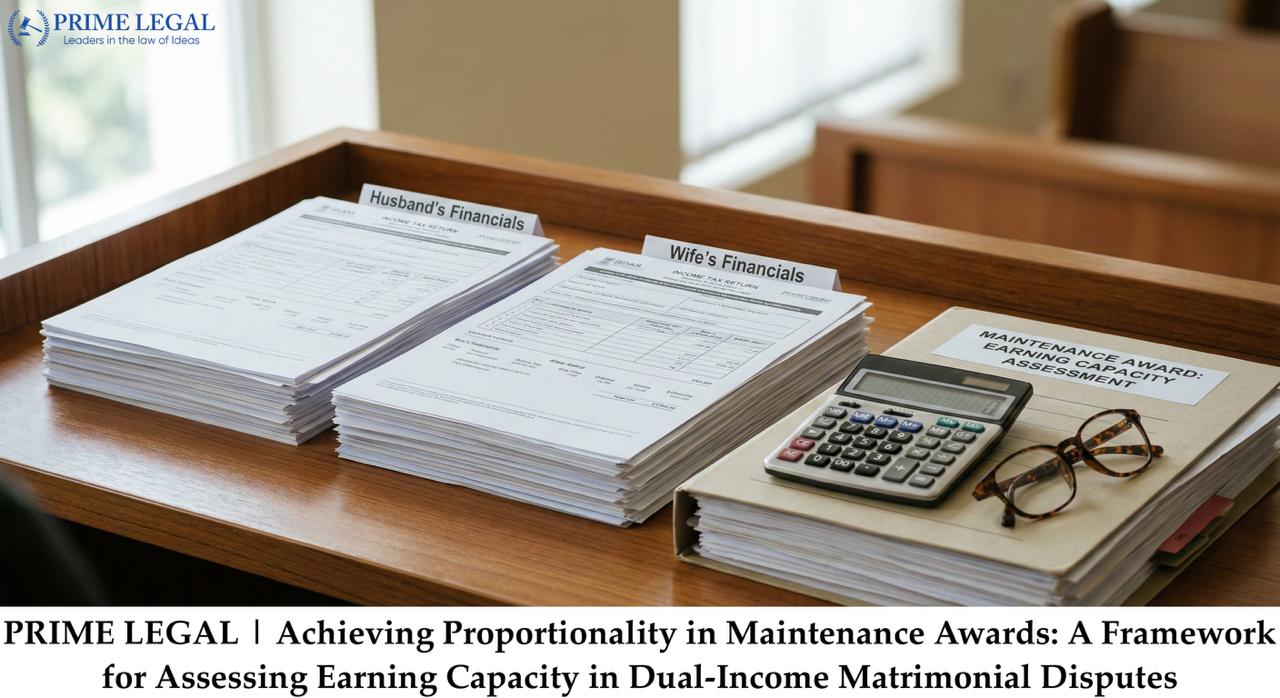
ABSTRACT:
Indian maintenance law was conceived in order to avoid destitution arising out of economic asymmetry between husband and wife. However, the increasing occurrence of dual incomes of married couples are challenging the traditional presumption of dependency. Courts come to decide more and more claims by professionally qualified, employable spouses seeking maintenance. Analysing the Section 144 of Bharatiya Nagarik Suraksha Sanhita, 2023 with those of matrimonial laws, the Protection of Women from Domestic Violence Act, 2005 and the new judicial authorities, this article postulates that the jurisprudence relating to maintenance is experiencing a subtle, yet a major, doctrinal shift. Unless that earning capacity is integrated systematically into quantification standards, risks of maintenance drifting away from justice of protection, towards unintended equalisation. The legitimacy of spousal support relies on principled proportionality based on the constitution and equality.
KEYWORDS: Maintenance, Earning Capacity, BNSS 2023, Proportionality, Social Justice, Spousal Support Reform
INTRODUCTION: The Erosion of Suppose Repeat of Dependence
Maintenance law in India was developed in the socio-economic environment in which financial dependency in marriage was embedded in society on a structural basis. The statutory objective was simple – prevent destitution. That factual premise, however, is no longer true of the world at large.
Contemporary matrimonial litigation increasingly concerns spouses that are: Professionally qualified, Previously employed, and Capable of being economically self-supporting.
The problem of doctrine is thus formed very sharply:
When dependency is no longer structural, how then should entitlement be determined?
Maintenance will not and cannot be tied down to assumptions about a world which hardly attests to the lived realities of economics today.
Statutory Framework After the BNSS Reform
Maintenance currently exists on several legal fronts: Section 144, Bharatiya Nagarik Suraksha Sanhita, 2023. Interim and permanent alimony provisions of matrimonial statutes
Monetary relief in the protection of women from domestic violence act, 2005
Section 144 BNSS is a continuation of the central goal of its predecessor – to avoid economic hardship.
In Rajnesh v Neha MANU/SC/0833/2020, the Supreme Court defined maintenance as a step towards social justice and ordered for a uniform financial disclosure affidavit. The emphasis here applied was procedural discipline, transparency and avoidance of inconsistent awards from forum to forum.
However, while Rajnesh rationalised the procedure, it did not address the deeper question from a theoretical perspective: Is maintenance purely protective, or is it a more and more economic equalisation?
Theoretical Anchor: The Social Justice – Protective Jurisprudence
Indian maintenance law has a historical foundation also from social justice theory – to prevent economic vulnerability in the wake of marital breakdown. The Supreme Court has always referred to the maintenance as a welfare-oriented remedy. Yet social justice does not mean redistribution.
Protective justice is one that addresses demonstrable disadvantages. Redistribution, by contrast, is aiming at being equal. The actual words of the statute throughout the maintenance regimes is emphasising “sufficient means” and “support,” not economic equalisation.
When marital lifestyle is upheld by courts with no consideration of respective contribution or capacity to provide post-separation support, adjudication has a potential for moving from protection to parity with no legislative direction. A doctrinal recalibration is needed therefore.
Judicial Engagement Earning Capacity
The Supreme Court in the case of Kiran Jyot Maini vs Anish Pramod Patel (2022) 14 SCC 737 explained that educational qualification is not automatically disentitling a spouse to maintenance. Nevertheless, earning capacity is relevant as it concerns determination of quantum.
Earlier, in the case of Shailja v Khobbanna (2018) 12 SCC 199, the Court differentiated between being “capable of earning” and “actually earning” and cautioned against mechanical denial of relief.
More recently, the Delhi High Court in Manish Jain v Akanksha Jain 2023 SCC OnLine Del 532, has emphasised that the determination of maintenance had to consider realistic employability and income disclosures and not speculative assumptions. The Court reiterated that quantification should be based on evidence and not presumption. The doctrinal orientation is becoming quite clear: Employability does not kill entitlement. But it cannot be irrelevant for quantification.
Voluntary Unemployment and Scrutiny by Evidentiary
A recurring feature in modern day disputes is resignation or diminution in employment preceding litigation. Courts have responded by adding extra scrutiny to the evidence by means of structured financial affidavits. The mechanism that has been introduced in Rajnesh vs Neha is a big bane on concealment and exaggeration.
However, inconsistency still exists in the assessment of voluntary unemployment. Some decisions do not deal with earning capacity robustly; others weigh it so heavily.
Within a principled framework it would be necessary to make distinctions between: Structural disadvantage because of marital sacrifice, Temporary Economic dislocation of , and Retreating from Jobs as a Strategy. Without this differentiation, the outcome is still left in the air.
Equality of the Constitution & Neutral Application
Article 14 requires non-arbitrary adjudication. Maintenance cannot function on inherited presumptions of dependency. While the underlying causes of structural gender inequality continue to affect women socially, modern adjudication to determine if there exists in fact financial imbalance has to be judged on mere evidence. No one weakens the legitimacy of protective remedy by maintaining a position of neutrality. The grading down from presumption to proof is constitutionally, not only jurisprudentially, consistent.
The Need for Organization Reforms
India does not have any statutory quantification of spousal support. Judicial discretion, even with its flexibility, creates variance and also provides incentives for forum choice.
Reform should incorporate: Statutory codification of structured financial disclosure under BNSS,
Clear standards for an assessment of earning capacity, Recognition of the rehabilitative or transitional maintenance in suitable cases, and Harmonisation of statutory forums.
Absent such reform, maintenance jurisprudence will continue altering by fragmented judicial hand and not reflective legislative design.
CONCLUSION:
Proportionality is the Future of Maintenance Law Maintenance law is at a jurisprudential intersection. To disregard earning capacity would risk the system incentivising economic inactivity. If employability is given too much importance, true vulnerability could be refused any protection. So the answer is the proportionality of evidence based proportions.
Maintenance must be made to prevent destitution. It may be compensatory of demonstrable disadvantage. But it cannot and will not silently evolve into wealth equalisation without leg monthly command. Where protection turns into parity enforcement, the doctrinal basis underlying that becomes flimflam. The legitimacy of maintenance jurisprudence is dependent on its core protection, while adapting to newer economic realities in present times.
“PRIME LEGAL is a full-service law firm that has won a National Award and has more than 20 years of experience in an array of sectors and practice areas. Prime legal falls into the category of best law firm, best lawyer, best family lawyer, best divorce lawyer, best divorce law firm, best criminal lawyer, best criminal law firm, best consumer lawyer, best civil lawyer.”
WRITTEN BY: TANUSH RAJ

