
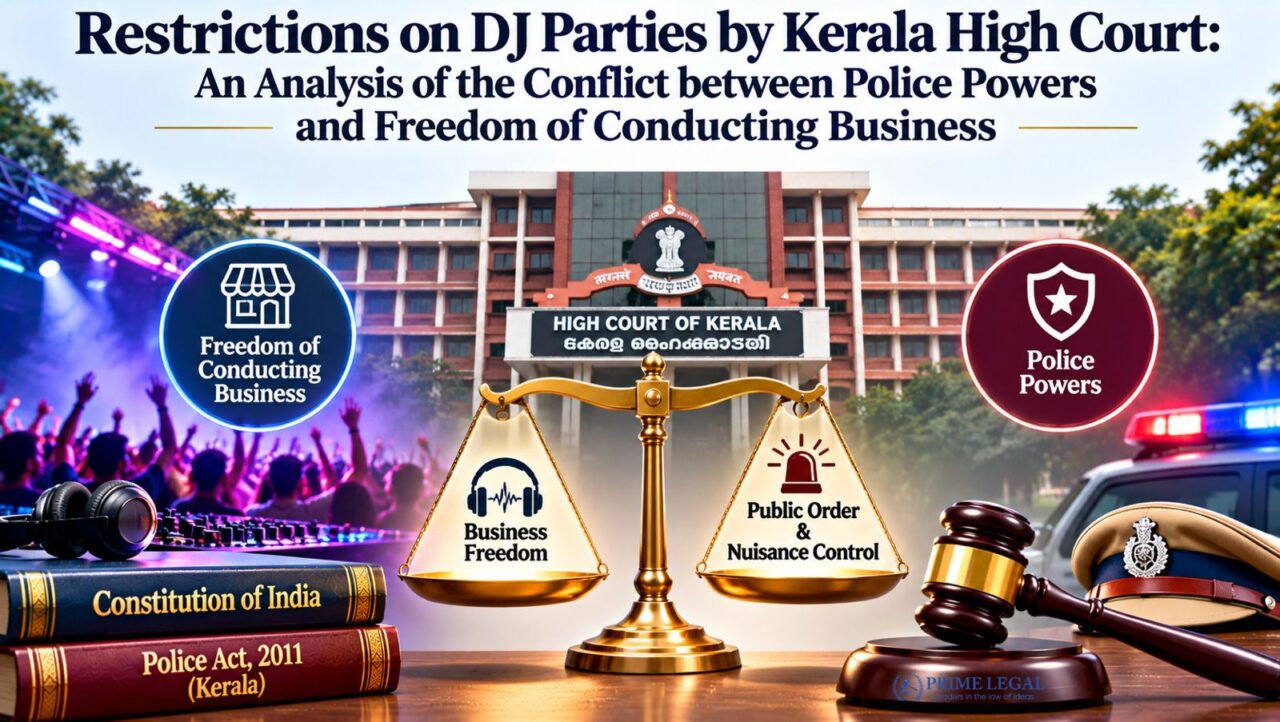
Introduction
In the course of hearing the case regarding the ban on DJ parties at Radisson Blu Hotel, Kochi, the Kerala High Court sought explanations from the police as to how they linked DJ parties with drug abuse and criminal activities. According to the division bench, the police cannot conduct themselves in accordance with stereotyping, generalisations and assumptions. The problem started when the police imposed bans on the hotel beyond midnight hours as well as on DJ parties after 11 PM, whereas the hotel had been permitted to operate till 3 AM. The Court pointed out that while preventing any crime associated with drugs and ensuring public peace are legal duties of the police, these can be carried out under the limitations of the law. It also raised doubts about whether DJ parties need different licences and according to which laws did the police have the authority to impose these restrictions.
Background of the Case
The controversy arose due to the issuance of notices limiting the functioning of Radisson Blu Hotel in Kochi after midnight and banning DJ parties after 11 PM. The hotel held an FL-3 bar license and had also received permission from the Deputy Excise Commissioner for extending its operating hours till 3 AM for which it paid ₹5 lakh. However, police defended the notices, saying they were concerned about drug use, violence and public disturbances at late night entertainment events. The hotel had challenged the notices before the Kerala High Court, stating that the notices were invalid as the hotel had already been granted the necessary permits. On 10 November 2026, Judge Murali Purushothaman quashed the notices as the apprehension of criminal activities alone cannot form the grounds to curtail the operations of the hotel. The State filed an appeal in a Division Bench against the order. The Bench on 16 November 2026 expressed some doubts regarding the assumption of the State that DJ parties involved the use of drugs.
Key points:
- The court clearly stated that it is not correct for the police to assume that all DJ parties are linked to the use of drugs or other illegal activities.
- Any restriction on entertainment activities should have the backing of law and cannot be arbitrary.
- The hotel had got permission from the Excise Department to run up to 3 AM.
- It cannot be that permission for running a licensed premises cannot be arbitrarily restricted by the police without any justification in law.
- The police need to differentiate between entertainment activities that are legal and actual criminal activities.
- There has to be preventive policing but that should not lead to undue restrictions on individual liberties and rights of businesses.
- The right to peaceful assembly is protected by Article 19(1)(b).
- The right to carry on business is protected by Article 19(1)(g) of the Constitution subject to reasonable restrictions.
- Strict measures should be taken by the police against drug-related offenses and not against all DJ parties.
- The Court raised the question whether DJ parties needed permission or licenses separately.
- There needs to be a balance between public safety, the right of the residents to live in peace and the right to conduct entertainment activities.
Legal Analysis
The case brings into play the constitutionally mandated balance between rights of individuals and the obligation of the State to uphold law and order. Article 19(1)(b) safeguards peaceful assembly whereas Article 19(1)(g) guarantees the freedom to carry on with profession or any other occupation, trade or business. These rights are, however, subject to reasonable restrictions under Articles 19(3) and 19(6) respectively. In the instant case, the hotel management contended that the imposition of restraint in spite of having valid permissions would infringe upon its business rights. The arguments made by the police force were based on Sections 77, 78 and 79 of the Kerala Police Act, 2011. The Single Judge has also applied Article 21 and held that residents staying near such entertainment outlets have the right to live in absence of noise pollution. More importantly, the Court differentiated between prevention of illegal activity and restraining all types of entertainment activity on presumption. In other words, it is open to the police authorities to act against consumption of drugs, violence and noise pollution but such actions should have a sound legal base.
Conclusion
The observations made by the Kerala High Court are in line with the idea that preserving the public order should not serve as grounds for making any arbitrary limitations on the lawful activity. The case shows that while the police are obliged to stop any drug offences, violence, and public disturbances, there should be certain legal limitations for their actions. It is not correct to assume that all DJ parties are associated with some criminal activity, which could lead to unnecessary interference with individual freedoms and business interests. In turn, entertainment venues should observe the relevant licensing requirements, noise restrictions, and public safety measures. The ruling draws attention to the necessity to develop some regulatory measures concerning late night entertainment activities to protect both business and public safety interests. All in all, the case shows that good policing should be aimed at prevention and dealing with any unlawful actions but not at limitation of lawful activities based on any stereotypes. It is necessary to note, however, that the observations made by the Division Bench on 16 November were oral ones and the decision was still pending.
“PRIME LEGAL is a National Award-winning law firm with over two decades of experience across diverse legal sectors. We are dedicated to setting the standard for legal excellence in civil, criminal, and family law.”
Written by – Krittika Sengupta

