
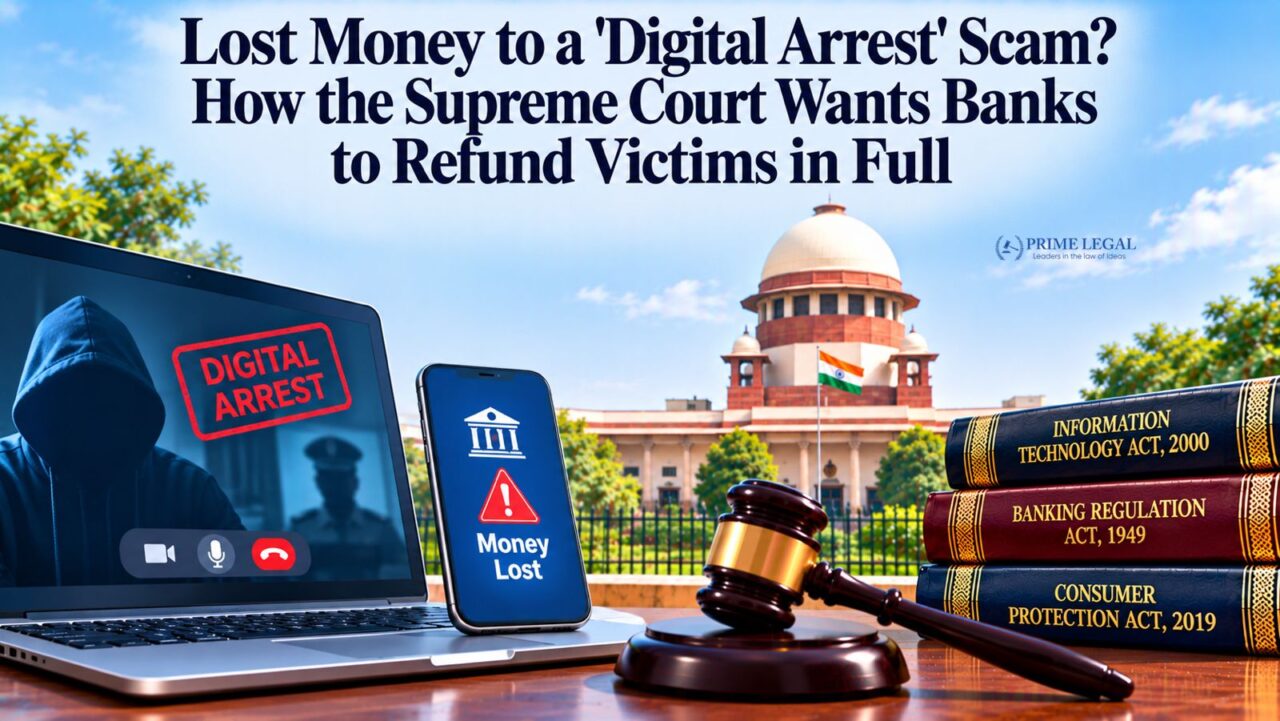
INTRODUCTION
With cyber fraud increasing all over India, the Supreme Court has come down heavily on making banks responsible for the losses in cases of “digital arrest” scam. On October 29, a three-judge bench of the Supreme Court led by chief justice of India Surya Kant directed the Reserve Bank of India (RBI) to insert a provision in the proposed rules to make banks liable to pay compensation to a victim where the alleged digitised fraud has been committed due to the bank’s lack of due diligence.
BACKGROUND
Online arrest scams are one of the commonest crimes on the internet in the country. In cases of these scams, one is approached by a person who pretends to be a police, CBI, customs or other government officer, through a video or phone call. Fake arrest warrants or legal notices are shown to the victim and money is extorted.
The scam spread so quickly that thousands of complaints had to be registered on the portal, with losses totalling hundreds of crores. Bank officials have largely maintained that customers had been complicit in the transfer of funds, even though they were forced into it. The Supreme Court took Suo motu cognisance of the scam and asked the question banks were avoiding – why couldn’t they prevent such suspicious transactions?
KEY POINTS
The decision was announced by a bench of three judges, Chief Justice of India Surya Kant and Justices Joymalya Bagchi and V. Mohana.
The Court directed that the rules formulated by the RBI should ensure the victims of digital arrest, and other instances of cyber fraud are compensated in case the loss is caused by a financial institution failing to exercise due diligence and the amount of loss should be compensated at a minimum.
The bench proposed that transactions not consistent with the normal pattern of banking should be put on hold temporarily, automatically reported to the concerned police station, and physically cross-checked before its release.
In addition, the Court indicated that the bank officers who committed the fraud were guilty of complicity and could be made subject to proceedings personally.
The regulation was said to be in the process of being formulated by the RBI, the MeitY and the DoT and was said to be slated for launch in December, Attorney General R. Venkataramani.
The bench also directed WhatsApp and other messaging platforms to explore technological solutions in this direction.
ANALYSIS
This holds the key to a revolutionary shift in the way the burden for the cyber-frauds could be otherwise shared. Till now the banks were able to assert that the perpetrator had himself been the party responsible for the transfer, and hence the loss should be borne by the customer. Now on the other hand, the banks cannot feign ignorance if the victim receives the transfer due to poor verification, lax monitoring, use of unregulated mule accounts.
Bankers’ liability will only change under a new provision if a bank is negligent (for example, another bank passes through a suspicious transfer without further checks). The move is set to put more pressure on banks to see suspect transactions and efforts to prevent fraud and enhance security as part of their offering.
CONCLUSION
The Court can force banks to stop being complaisant and start fighting digital arrest fraud. The Supreme Court can use compensation and hold them liable as a bridge; to force that proper diligence and fraud interception can happen at the time of fraud.
“PRIME LEGAL is a National Award-winning law firm with over two decades of experience across diverse legal sectors. We are dedicated to setting the standard for legal excellence in civil, criminal, and family law.”
WRITTEN BY: AASTHA KEDIA

