
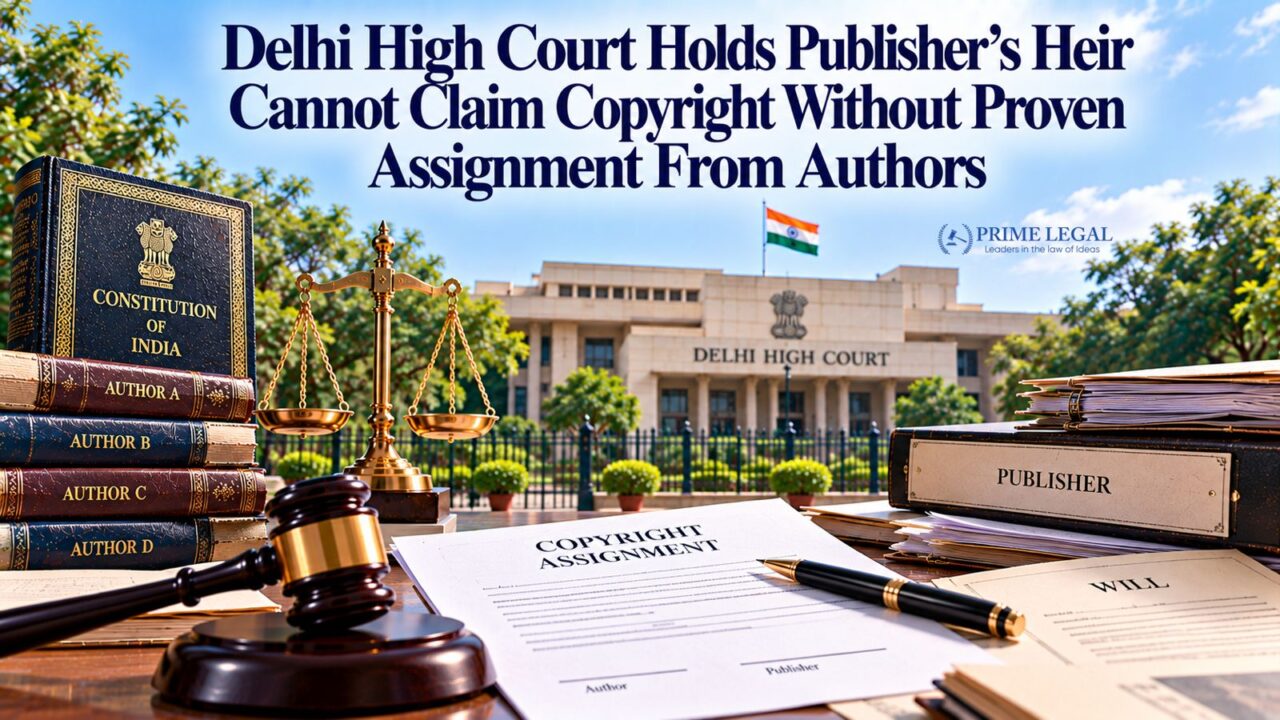
Case Name: Mrs Shakti Sagar v. The Delhi Law House and Ors
Case Number: CS(COMM) 492/2024
Date: Wednesday, 7th October, 2026
Court: High Court of Delhi at New Delhi
Quorum: Hon’ble Mr Justice Purushaindra Kumar Kaurav
FACTS
In accordance with the provisions set out in Order XXXIX, Rules 1 and 2 of the Code of Civil Procedure, the plaintiff filed an application which claimed an ex parte ad interim injunction restraining the defendants from the plaintiff, who is a widow of the deceased Sh. Subhash Sagar and daughter-in-law of the late Sh. R.G. The plaintiff asserted that she has been the owner of each of the titles due to an uninterrupted chain of title which began in 1962 with a certificate issued to her father-in-law, Sh. R.G. Sagar, and followed by a will made in 1995, and then a will made by her husband in 2021. The defendant, who is a relation of the plaintiff, formed a partnership firm under the name “The Delhi Law House”, similar to the name of an original family business “, Delhi Law House”. The plaintiff accused the defendant of publishing the titles and enjoying the profits without her consent. The defendant challenged the ownership of the plaintiff by stating that she is not the author and did not provide any proper written assignment from the original authors.
LEGAL ISSUES
- Whether the plaintiff had established a prima facie case to ask for an interim injunction against the defendant in respect of the copyrights claimed by the plaintiff.
- The issue was whether the balance of convenience and irreparable injury favouring the granting of the injunction had been established.
LEGAL PROVISIONS
- Sections 17 (First Owner), 18, 19 (modes of assignment), 21, 52(1)(q) and 55(2) (presumptions as to authorship) of the Copyright Act 1957.
- Order 39, Rules 1 and 2 of the Code of Civil Procedure, 1908 (and injunctions).
- Section 12A of the Commercial Courts Act, 2015 (pre-institution mediation).
ARGUMENTS
PETITIONER – The plaintiff claimed that the 1962 certificate established her title and subsequently drafted Wills. Citing Midas Hygiene Indus. (P) Ltd. v. Sudhir Bhatia, (2004) 3 SCC 90 (Ind.), the plaintiff maintained that an injunction usually has to be issued in copyright infringement cases. To counter the objections based on Section 12A of the Commercial Courts Act, the plaintiff also quoted Novenco Bldg. & Indus. A/S v. Xero Energy Eng’g Sols. (P) Ltd., 2025 SCC OnLine SC 2278, Yamini Manohar v. T.K.D. Keerthi, (2024) 5 SCC 815, Dhanbad Fuels (P) Ltd. v. Union of India, (2025) 9 SCC 424, and Chandra Kishore Chaurasia v. R.A. Perfumery Works (P) Ltd., 2022 SCC OnLine Del 3529, and argued that continuous infringement means that the relief must be urgent.
RESPONDENT – The defendants stated that the original authors were the writers and not the plaintiff. They maintained that there were no legal written contracts that had been executed by the authors going. The wills which were depended upon were not appropriately registered, which gives rise to serious questions on their legitimacy. In this case, the defendants relied on Yamini Manohar v. T.K.D. Keerthi (2024) 5 SCC 815. The defendants also argued regarding the matter of Section 12A and with respect to Rashiklal & Co. v. CIT (1998) 2 SCC 49, as well as influences from Dahiben v. Arvindbhai Kalyanji Bhanusali (2020) 7 SCC 366, and State of U.P. v. Ram Sukhi Devi (2005) 9 SCC 733 to put forth how the conclusion is hardly possible at the interim stage.
ANALYSIS
The Court applied the trinity test of interim injunctions developed in Shruti Manav Sharma v. Sunanina Singh, 2026 SCC OnLine SC 1549, Wander Ltd. v. Antox India (P) Ltd., 1990 Supp SCC 727, and Dalpat Kumar v. Prahlad Singh, (1992) 1 SCC 719. As per the provisions under section 17 of the Copyright Act, the work is the property of the originator, while under section 19, it is essential that the assignments are executed in writing.
The Court cited Indian Performing Right Society Ltd. v. E. India Motion Pictures Association, (1977) 2 SCC 820 for laying down the principle of valid assignment of copyright by stating that it must be in writing signed by the assignor.
Further, the case of Tech Plus Media (P) Ltd. v. Jyoti Janda, CS(OS) 119/2010 was cited for the observation of the Court that the plaintiff, if not the author, must disclose the identity of the author, as well as the assignment document. The Court stated that according to Najma Heptulla v. Orient Longman Ltd., AIR 1989 Del 63, a legatee inherits what the testator had. The Court distinguished the case of Acad. of Gen. Educ., Manipal v. B. Malini Mallya, (2009) 4 SCC 256, as the testator in that case was the actual author of the work and did not produce highly disputed titles in the current case.
The distinction was made by the Court in the reliance of the plaintiff on Midas Hygiene, as it was clarified that an injunction in matters of infringement comes into play only after the concept of copyright ownership is established, which is not the situation in this case. Finally, the Court relied on Shruti Manav Sharma and Evans Marshall & Co. Ltd. v. Bertola SA, saying that the revenue loss in question can be quantified and hence does not constitute irreparable damage.
JUDGEMENT
The High Court denied the motion for a temporary injunction. The Court stated that the plaintiff was not able to prove that it had a prima facie right to the copyright. In addition, the Court ruled that the plaintiff did not meet the balance of convenience requirement, and the financial harm it claims can be compensated with damages after the accounting is performed.
CONCLUSION
The Delhi High Court elaborated that a party applying for an injunction must prove an unbroken chain of title back to the original author in copyright infringement cases. The disputed documents must be accompanied by evidence of valid written assignments from the original authors for the party to secure urgent relief.
“PRIME LEGAL is a National Award-winning law firm with over two decades of experience across diverse legal sectors. We are dedicated to setting the standard for legal excellence in civil, criminal, and family law.”
WRITTEN BY: SWETHA DUTTA
Read the Judgment copy below : Mrs. Shakti Sagar v. The Delhi Law House and Ors

