
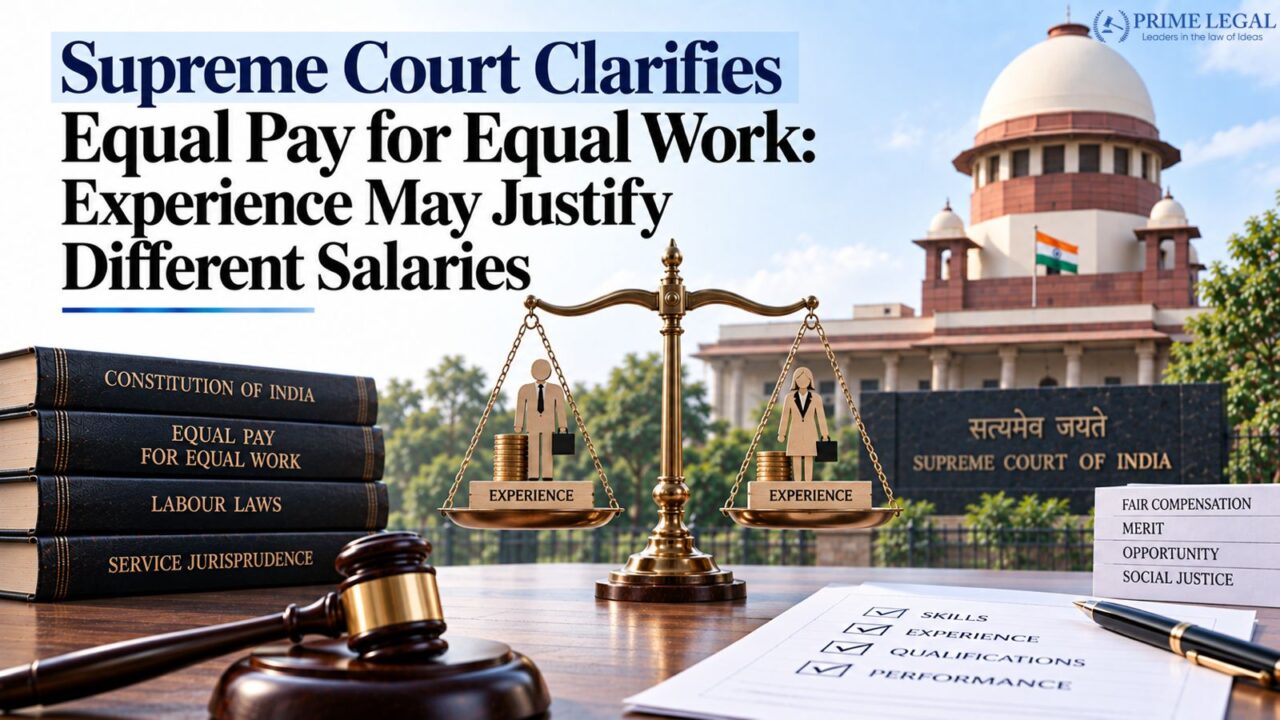
PRIMELEGAL | Supreme Court Clarifies Equal Pay for Equal Work: Experience May Justify Different Salaries
INTRODUCTION
The Supreme Court has held that the doctrine of “equal pay for equal work” cannot be applied mechanically merely because two categories of employees perform similar or identical duties. In the case of G.P. Sangeetha & Ors. v. State of Kerala & Ors., 2026 INSC 1004, delivered on 8th September 2026, it was made clear that the elements such as experience, qualifications, mode of recruitment, responsibility and accountability too have to be kept in mind when determining whether the employees deserve to have equal pay for equal work.
BACKGROUND
This matter related to the class of “Higher Secondary School Teachers, Junior (HSST, Jr.).” The petitioners were those HSST, Jr. who were recruited by way of direct recruitment, whereas there was another category of HSST, Jr. who had been promoted or transferred into this cadre after working for some time as teachers.
While doing essentially similar work, having similar qualifications, and carrying out similar responsibilities within this cadre, the promoted or transferred teachers were being paid at a higher pay scale. The direct recruits challenged this disparity contending that they violated Article 14 of the Constitution read with Article 39(d).
This decision was approved by the Supreme Court, which ruled that the previous experience and service of the promoted or transferred teachers amounted to an essential distinction which would justify the disparity in pay.
KEY POINTS
-
- Equal work does not necessarily equate to equal remuneration: It was held by the Court that similar duties are not sufficient per se; qualifications, experience, mode of selection and functions have to be taken into consideration. State Bank of India v. M.R. Ganesh Babu, (2002) 4 SCC 556.
- Past experience can be a valid reason for unequal remuneration: Past experience and past services could be the reasonable ground for different pay scales. State of Haryana v. Charanjit Singh, (2006) 9 SCC 321.
- The principle of equal pay is a principle that is subject to qualification in the Constitution: In Randhir Singh v. Union of India, (1982) 1 SCC 618, though Article 14 and 39(d) laid down the doctrine of equality of pay for equality of work, later cases have ruled that the said doctrine is not to be applied alone. State of Haryana v. Tilak Raj, (2003) 6 SCC 123.
- Classification is permissible if reasonable The criterion set by Article 14 for classification requires that there must be an intelligible differentia and reasonable relationship between such differentia and the objective of classification.
RECENT DEVELOPMENTS
The Supreme Court dismissed the appeals and affirmed the judgement of the Kerala High Court, ruling that the disparity in previous experience of teachers recruited directly compared to those transferred/promoted was the reason for having different salary structures. The court also referred to State of West Bengal vs Anirban Ghosha, and ruled that the conflicting views in this case were not in agreement with the binding precedent set by the Supreme Court. The Court further clarified that dismissal of an SLP does not necessarily amount to approval of the judgment challenged before it.
CONCLUSION
According to the judgment in G.P. Sangeetha & Ors. v. State of Kerala & Ors., 2026 INSC 1004, equal pay for equal work should not be mechanically applied. It is not unreasonable to differentiate between individuals regarding pay on account of experience, qualification, mode of recruitment, and responsibility, based on Article 14 of the Constitution.
“PRIME LEGAL is a National Award-winning law firm with over two decades of experience across diverse legal sectors. We are dedicated to setting the standard for legal excellence in civil, criminal, and family law.”
WRITTEN BY: KHWAISH SACHDEVA

