
INTRODUCTION
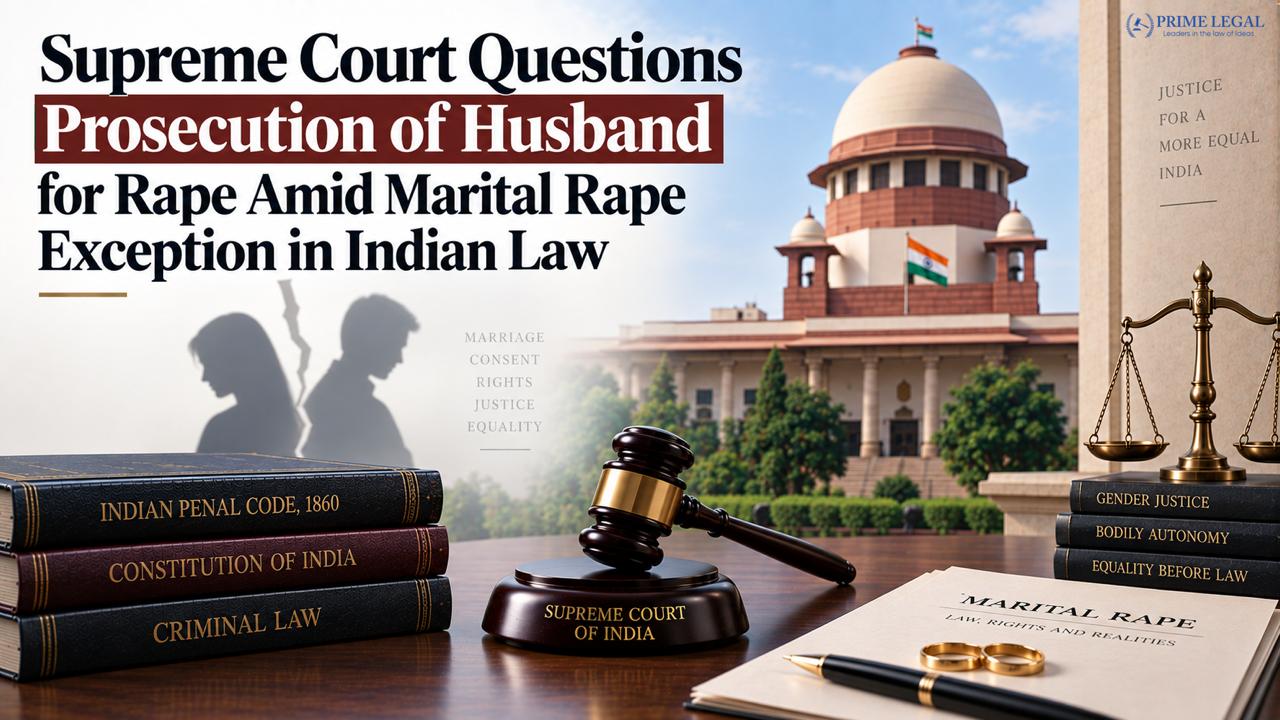
The Supreme Court has reopened one of Indian criminal law’s most contested questions: can a husband be prosecuted for rape while the marital rape exception still stands on the statute book? Hearing a batch of pleas on September 9, a bench led by CJI Surya Kant, along with Justice Joymalya Bagchi and Justice V Mohana, posed pointed queries on whether prosecutions can proceed under Section 376 IPC / 64 BNS before the court rules on the constitutional validity of Exception 2 to Section 375 IPC, now Section 63 of the Bharatiya Nyaya Sanhita. The matter has been posted for final hearing, with the date to be notified shortly.
BACKGROUND
Exception 2 to Section 375 IPC has, since colonial times, excluded non-consensual intercourse by a husband with his wife, provided she is not a minor, from the definition of rape, and this immunity was carried forward almost verbatim into Section 63 BNS. The issue reached the Supreme Court through multiple routes: an appeal against the Delhi High Court’s 2022 split verdict (RIT Foundation v. Union of India, 2022 SCC OnLine Del 1404) in which Justice Rajiv Shakdher struck down the exception as unconstitutional while Justice C. Hari Shankar upheld it; separate PILs challenging the provision; and, notably, an appeal arising from a Karnataka High Court (Hrishikesh Sahoo v. State of Karnataka SLP(CRL) NO. 4063-4064/2022) ruling that sustained rape charges against a husband, holding the exception was not absolute. This case of Hrishikesh Sahoo, will now anchor the Supreme Court’s final hearing.
KEY POINTS
The bench clarified that it will examine two distinct questions together, and several sharp observations emerged during the hearing:
- Whether a prosecution for marital rape can be sustained even while the marital rape exception legally survives on the statute.
- Whether the exception itself is constitutionally valid, or must be struck down or read down.
- Justice Bagchi questioned whether a husband can be prosecuted for marital rape while the statutory exemption still stands, cautioning that doing so before the court rules on its validity risks punishing him for conduct the law does not yet clearly criminalise, a concern rooted in the accused’s Article 20 protection against retrospective criminal liability, which the bench said must be weighed against the wife’s Article 21 right to safety and dignity.
- Senior Advocate Karuna Nundy argued that criminalising marital rape would not create a new offence, since rape is already defined in law and only a class of persons has been carved out; Justice Bagchi disagreed, saying constitutional questions cannot be viewed “in silos.”
- A query from the CJI on whether unnatural sexual acts by a husband against his wife could attract prosecution, which was denied, citing the court’s own precedent that carnal intercourse between spouses cannot be termed “unnatural.”
RECENT DEVELOPMENT
Appearing for the wife in the Karnataka appeal, Senior Advocate Indira Jaising confined her submissions to sustaining the prosecution on facts, without addressing the exception’s constitutional validity, framing it instead as a question of interpretation. Senior Advocate NS Nappinai maintained that a woman subjected to involuntary intercourse in marriage is a “victim,” regardless of how the State chooses to characterise the offence. Solicitor General Tushar Mehta, representing the Union, reiterated that criminalisation is a matter of legislative policy, not judicial pronouncement, pointing to the government’s 2024 affidavit which argued that existing remedies already protect married women and that treating marital rape as “rape” could be “excessively harsh.” The CJI assured all sides that the court would hear arguments on both reading down and striking down the exception, and the bench directed that the final hearings begin with the Karnataka SLP, represented by Senior Advocate Siddharth Dave, before moving to the broader constitutional challenge.
CONCLUSION
By posting the matter for final hearing and directly probing whether prosecutions can proceed under an unsettled exception, the Supreme Court has signaled it intends to resolve both the interpretive and constitutional dimensions of the marital rape exception together, rather than deferring one to the other. The outcome will determine not just the fate of individual prosecutions like the Karnataka case, but the broader question of how far constitutional courts can go in filling a gap Parliament has repeatedly chosen not to close, and what protection married women can expect from India’s rape law in the meantime.
“PRIME LEGAL is a National Award-winning law firm with over two decades of experience across diverse legal sectors. We are dedicated to setting the standard for legal excellence in civil, criminal, and family law.”
WRITTEN BY : HARSHMEET KAUR SUDAN

