
INTRODUCTION
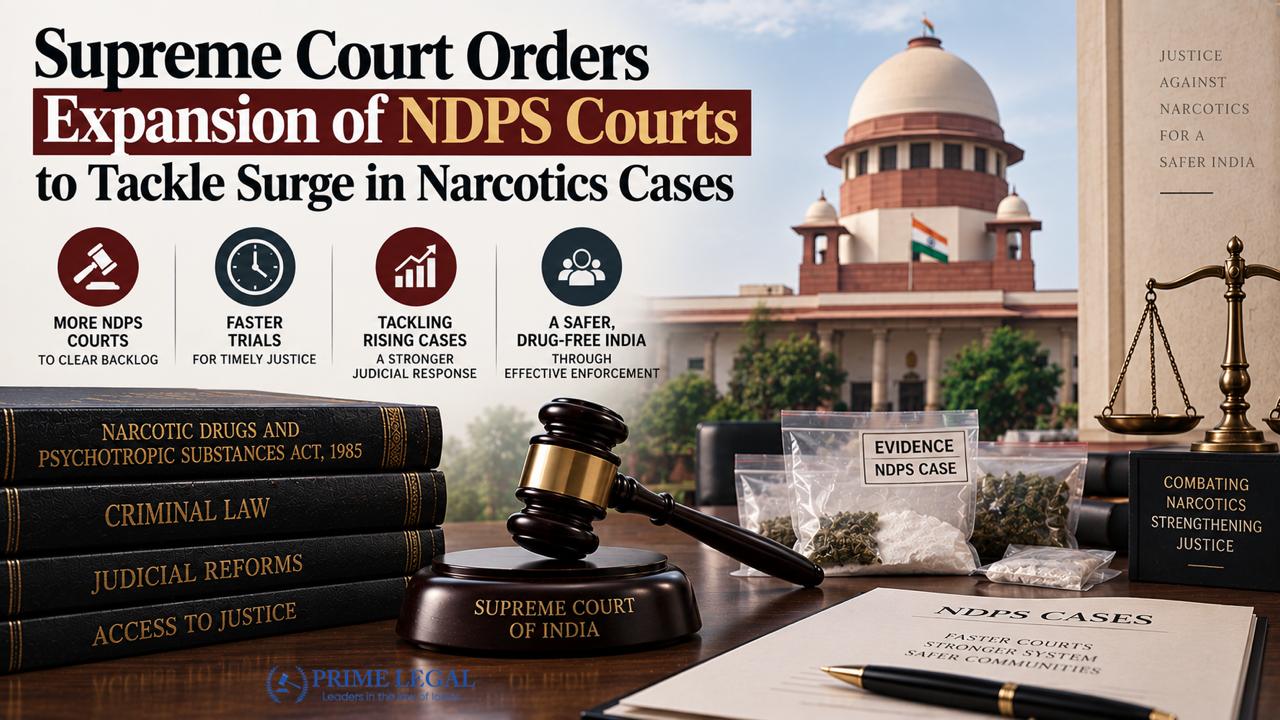
The Supreme Court of India has ordered the Central Government, States and Union Territories to make efforts forthwith towards establishment of exclusive Special Courts to deal with cases arising out of the Narcotic Drugs and Psychotropic Substances Act, 1985 (NDPS Act), in the wake of the steep rise in the number of offences in this regard and pending matters under the said Act.It came to the notice of the Supreme Court that 449 exclusive courts of NDPS are required all over India but only 176 such courts have so far been set up. In this background, the Supreme Court emphasized on the fact that the relevant infrastructure and judicial and administrative manpower should be made available to start functioning of the remaining courts preferably within six weeks.The case is one among those cases taken up by the Supreme Court suo motu in relation to the establishment of special and exclusive courts for expeditious disposal of cases under special criminal laws including NDPS Act, National Investigation Agency (NIA) Act, the Unlawful Activities (Prevention) Act (UAPA) and the Maharashtra Control of Organised Crime Act (MCOCA).
BACKGROUND
NDPS Act, 1985 is the main Indian law that deals with offenses related to narcotic drugs and psychotropic substances. Given the nature of NDPS offenses, speedy trial is very important since these offenses are serious and usually entail bail restrictions and severe penalties. But effective enforcement of the said law would require not only investigation and prosecution, but also efficient trial by the courts. It turns out that during its proceedings, the Supreme Court found an important deficiency in respect of the number of courts which could conduct such a trial, that is, of the courts exclusively empowered for such trial. Earlier, the requirement in the number of such courts stood at 394. But this requirement was later revised upwards to 449 courts. Meanwhile, the number of functioning courts rose from 113 to 176. In other words, while the number of courts has increased, a considerable gap still exists between the required number of courts and those functioning. The Supreme Court therefore considered it necessary to intervene and push the authorities to create the required judicial infrastructure.
KEY POINTS
- 449 Exclusive NDPS Courts Required
The Supreme Court instructed the Centre, States and Union Territories to set up 449 exclusive courts for NDPS Act, 1985 cases due to the growing numbers of narcotics cases.
- Only 176 Courts Established
449 courts have to be constituted out of which so far only 176 exclusive courts have been set up but that is a marked improvement on the earlier figure of 113 courts. The Court instructed the concerned authorities to set up infrastructure and personnel for the other 273 courts.
- Focus on Speedy Trials
The Supreme Court was worried over the rise in NDPS Act offences and hence the pending cases. The exclusive courts are set up to facilitate speedy disposal of NDPS Act cases.
- Wider Judicial Initiative
This order is a part of the Court’s suo motu cases concerning fast-track trials in special laws such as the NDPS Act, NIA Act, UAPA, and MCOCA. It was also brought to the notice of
the Court that 22 NIA courts have been constituted exclusively.
RECENT DEVELOPMENTS
On 7 September 2026, the Supreme Court asked the Centre, States, and UTs to set up the required exclusive NDPS courts, stating that out of 449 required NDPS courts, 176 are currently working. It has also been stated that there has been an improvement in NIA courts, which have been increased in numbers up to 22.
Relevance: The current development has importance in the sense that the increasing trend and pendency of NDPS cases may result in lengthy proceedings. The setting up of exclusive courts, with sufficient infrastructure, and judicial and administrative personnel is aimed at making sure of speedy trials.
CONCLUSION
Establishing 449 exclusive NDPS courts as directed by the Supreme Court is one of the ways of tackling the increasing backlog of narcotics cases. Ensuring proper staffing of the courts will make the proceedings swift and ensure the successful implementation of the NDPS Act. The development signifies the fact that the proper implementation of stringent laws not only involves formulating strict laws but also having efficient courts.
“PRIME LEGAL is a National Award-winning law firm with over two decades of experience across diverse legal sectors. We are dedicated to setting the standard for legal excellence in civil, criminal, and family law.”
WRITTEN BY: KHWAISH SACHDEVA

