
CASE NAME: xxxx v. xxxx
CASE NUMBER: Family Court Appeal Nos. 202 and 229 of 2017
COURT: High Court for the State of Telangana at Hyderabad
DATE: 06 August, 2026
QUORUM: Hon’ble Sri Justice K. Lakshman and Hon’ble Smt Justice K. Sujan
FACTS
The parties married on 05.02.2009 in an arranged marriage and had a daughter on 26.11.2009. The husband filed O.P No. 270 of 2011 under Section 13(1)(ia) of Hindu Marriage Act, 1955 seeking divorce on the ground of cruelty. He alleged that the wife repeatedly left for her parental home without notice, insisted on living apart from his parents, assaulted him and his mother, abused his father, suffered from psychological disorders, threatened to falsely implicate his family and eventually left the matrimonial home with the child on 15.08.2010. He also relied on a criminal case registered against him and his family on the wife’s complaint, in which he and his father were arrested and later acquitted. The wife filed O.P. No.1888 of 2013 under Section 9 of the Act seeking restitution of conjugal rights. In her counter, she denied the allegations and claimed that she was branded a “psycho” without basis, was denied food in front of the family, was kept isolated from her parents, was pressured to abort her pregnancy, and was driven out of the house on 15.08.2010 after a dowry dispute involving a further demand of Rs.2,00,000/-. The Family Court, on the evidence led, dismissed the wife’s restitution petition and granted the husband a divorce decree, holding that long separation itself amounted to mental cruelty and that the marriage had irretrievably broken down.
ISSUES
- Whether the husband discharged the burden of proving cruelty as pleaded, particularly the allegation that the wife suffered from a psychiatric disorder.
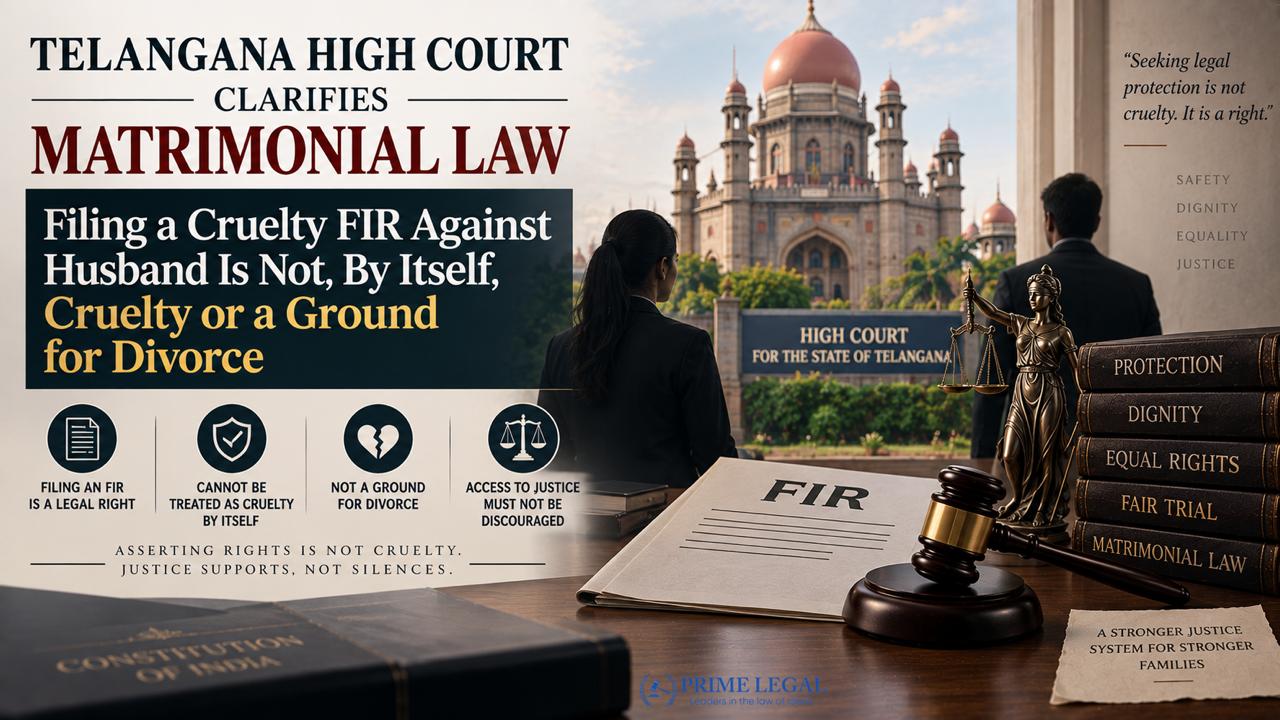
- Whether mere lodging of a criminal complaint under Section 498-A IPC/86 BNS and Sections 3 and 4 of the Dowry Prohibition Act, which ended in acquittal, amounts to cruelty justifying divorce.
- Whether a Family Court, or the High Court in appeal, may grant divorce on the standalone ground of “irretrievable breakdown of marriage” when that ground is not recognised under Section 13 of the Act.
- Whether the Family Court’s Common Order was a reasoned order warranting confirmation, or was liable to be set aside for failure to consider material evidence.
LEGAL PROVISIONS
- Section 13(1)(ia) and Section 9 of the Hindu Marriage Act, 1955, and Section 19 of the Act (appellate jurisdiction).
- Section 125 CrPC / Section 144 BNSS (maintenance).
- Section 498-A IPC / 86 BNS and Sections 3 and 4 of the Dowry Prohibition Act, 1961.
- Case laws relied upon: Samar Ghosh v. Jaya Ghosh, (2007) 4 SCC 511; Rakesh Raman v. Smt. Kavita, AIR 2023 SC 2144; Naveen Kohli v. Neelu Kohli, (2006) 4 SCC 558.
ARGUMENTS
APPELLANT : The wife’s counsel submitted that the husband had made a serious allegation branding her a psychiatric patient but never proved it through any witness or medical record. It was argued that the criminal case under Section 498-A IPC/86 BNS ended in acquittal and could not, by itself, constitute cruelty. Counsel also pointed out that the Family Court had ignored the wife’s plea regarding dowry demands, denial of food, restriction on contact with her parents, and pressure to terminate her pregnancy. It was also submitted that the wife and daughter were willing to live with the husband which showed that the marriage had not been dissolved by her choice.
RESPONDENT: In his case the sole witness examined was the husband. He placed reliance on the wedding invitation, the FIR in Crime No.375 of 2010 and the final report to prove the criminal proceedings initiated against him and his family. He contended that the wife’s repeated visits to her parental home without informing him, her alleged assault on him and his mother, her abuse of his father, and her institution of the criminal complaint together amounted to a course of conduct causing him cruelty. He also argued that continuous separation since 15.08.2010 left no scope for reconciliation.
ANALYSIS
The High Court found that the husband had levelled a grave allegation that the wife was a “psycho and hysteria” patient but had neither examined any witness nor filed any document to substantiate it, and had not even elicited the point during cross-examination of the wife or her father. The Court held this allegation to be false for want of proof, and noted that the husband’s own father and the wife’s father were colleagues who lived in the same colony, a fact the Family Court had overlooked. The Bench reiterated that cruelty has no fixed definition, varies with the background and sensitivities of the parties, and must be assessed on the totality of evidence, drawing on the principles in the cases of Samar Ghosh, Rakesh Raman and Naveen Kohli. On the criminal case, the Court held that mere lodging of a complaint under Section 498-A IPC and the Dowry Prohibition Act, without more, does not amount to cruelty, especially where the husband led no evidence beyond his own testimony to prove the other allegations. Most significantly, the Court held that the Family Court had impermissibly granted divorce on the ground of “irretrievable breakdown of marriage,” a ground not available under the Act to either the trial court or the High Court. The Bench also noted that the husband, despite admitting during cross-examination that he wanted custody of his daughter, had never filed any application for custody or visitation, and that he admitted he was uninterested in resuming marital life, factors the Family Court failed to weigh.
JUDGMENT
The High Court allowed F.C.A. No.229 of 2017 and set aside the divorce decree granted in O.P. No.270 of 2011, holding the Family Court’s order unreasoned on the material aspects of proof. F.C.A. No.202 of 2017, filed by the wife for restitution of conjugal rights, was disposed of in view of the long separation since 15.08.2010, with liberty granted to her to file a fresh petition for restitution and enhancement of maintenance. No order as to costs was made.
CONCLUSION
The judgment reaffirms two settled principles of matrimonial law: first, that a party alleging cruelty, including allegations of mental illness or criminal misconduct, must prove such allegations through cogent evidence and cannot rest on unproved assertions; and second, that “irretrievable breakdown of marriage” remains a ground outside the statutory scheme of Section 13 of the Hindu Marriage Act and cannot be invoked by trial courts or High Courts to dissolve a marriage, however long the parties may have lived apart. The ruling also underscores that acquittal in a criminal case arising from matrimonial discord weakens, rather than strengthens, a cruelty claim founded on that very complaint.
“PRIME LEGAL is a National Award-winning law firm with over two decades of experience across diverse legal sectors. We are dedicated to setting the standard for legal excellence in civil, criminal and family law.”
WRITTEN BY: HARSHMEET KAUR SUDAN

