
CASE NAME: Sahab Singh alias Sat Pal v. State of Haryana
CASE NUMBER: Criminal Appeal No. 4158 of 2026 (@ SLP (Crl.) No. 3710 of 2026)
COURT: Supreme Court of India
DATE: 2 September 2026
QUORUM: Justice Sanjay Kumar and Justice Sanjeev Sachdeva
FACTS
Gaurav, a child aged six years, participated in a wedding party in Kakru village on the night of 11th March 2007. Since he did not come back to his house, his family members tried looking for him all night. In the morning of 12th March 2007, his slippers were seen near the post office of the village, while his body was recovered from an abandoned well near the post office. Cause of death was found to be asphyxia by smothering and spinal injury of cervical spine on post-mortem examination.
The prosecution case relied purely on the principle of circumstantial evidence. The prosecution accused Sahab Singh, who also went by the name Sat Pal, of taking the boy along with him after buying a packet of namkeen and two tablets for the cold from a shop. As per the prosecution, the appellant had sexually assaulted the boy, choked him to death and thrown his dead body in the well. It was additionally claimed that on 14th March 2007, the appellant made extra judicial confession in front of Shiv Chand, the village Sarpanch.
Appellant was found guilty by the Trial Court under Section 302, 201 and 377 IPC (103, 238 of BNS respectively) and he was punished with life imprisonment for murder, five years’ rigorous imprisonment for causing disappearance of evidence and ten years’ rigorous imprisonment under Section 377 IPC and all the sentences were concurrent. The conviction of the appellant was upheld by the Punjab & Haryana High Court on 18 October 2022. At the time when the case was presented before the Supreme Court, the appellant had completed 16 years and 7 months of imprisonment.
ISSUES
- If the prosecution had been able to prove the ‘last seen theory’ beyond reasonable doubt.
- Whether the extra judicial confession made to the Village Sarpanch was reliable enough to prove his guilt.
- If the statement and the demarcation of the appellant would amount to evidence as per section 27 of the Indian Evidence Act, 1872 ( Proviso to Section 23(2) of BSA,2023)
- Whether the recovery of the Namkeen Packet was circumstantial evidence to establish the guilt of the accused.
- Whether semen evidence proved the connection of the appellant in the crime.
- Whether the chain of circumstantial evidence was proved beyond reasonable doubt.
LEGAL PROVISIONS
- Section 302 IPC – Punishment for murder ,Section 103(1) BNS.
- Section 201 IPC – Causing disappearance of evidence of offence ,Section 238 BNS.
- Section 377 IPC – Unnatural offences ,No direct BNS provision.
- Section 27, Indian Evidence Act, 1872 – Discovery of facts pursuant to information received from an accused in police custody, Proviso to Section 23(2), Bharatiya Sakshya Adhiniyam, 2023.
- Circumstantial Evidence – Every circumstance must be proved and form a complete chain pointing towards guilt.
- Extra-Judicial Confession – A weak piece of evidence requiring careful scrutiny and reliable corroboration ,Case Law: Sahadevan & Anr. v. State of Tamil Nadu, (2012) 6 SCC 403.
ARGUMENTS
APPELLANT:
It has been stated that the prosecution did not prove the complete chain of circumstances. Witness No. 7, the shopkeeper, did not mention in his examination-in-chief that the accused Gaurav accompanied the appellant while buying the namkeen and the tablets. The namkeen packet, which was found at the place where the incident occurred, was a common packet available in bulk and there was no connection between the accused and the said packet. Witness No. 8 brought out the fact about the presence of the child along with the appellant only during cross-examination but not during his police statement. In respect of the extra-judicial confession, it has been stated that it is doubtful as evidence suggests that he was arrested by the police on 12 March 2007 whereas the confession is said to have happened on 14 March 2007. Moreover, he argued that the disclosure statement could not be considered as the body and other places were already known to the police. Lastly, even though semen was found on his underwear and on the rectal swab of the deceased, no DNA test was done for linking the two.
RESPONDENTS:
As per the State, the conviction in this case was based on the total impact of circumstances proved against the appellant. The State placed reliance on the last seen evidence, the purchase of namkeen and cold tablets, extra judicial confession made to the Sarpanch, the statement of disclosure and demarcation, and the medical and forensic evidence. As per the prosecution, these circumstances taken in totality form an unbroken chain of circumstances leading to the guilt of the appellant.
ANALYSIS
A number of gaps in the prosecution case were identified by the Supreme Court. Firstly, the packet of namkeen, which was recovered from the spot, was a common packet available in large quantities and there was nothing to link it to the packet which was purchased by the appellant according to the prosecution version. Secondly, the theory of last seen was not conclusively established since PW7 did not state in her testimony that Gaurav was with the appellant and PW8 mentioned that fact for the first time in cross-examination but not in his police statement. Thirdly, there were serious contradictions in regard to the extra-judicial confession since evidence indicated that the appellant was in the custody of police at that time.
Moreover, it was ruled that the disclosure statement was inadmissible since it did not disclose any new fact and it could not be admitted as per the provision of Section 27(Proviso to Section 23(2), BSA) as the body was recovered and the relevant spots were known to the police with the help of the map even before the disclosure statement was recorded. The Court observed that extra-judicial confession was a very unreliable piece of evidence and needed corroboration.
The forensic evidence did not form the chain as well. While there was semen found on the underpants of the appellant and on the rectal swab of the deceased, the DNA test was not able to determine whether the two samples came from one individual. Therefore, there was no proof provided by the prosecution as to how the appellant was connected to the deceased, how the deceased was with the appellant at the material time, or how the appellant was connected with the place of the crime.
JUDGMENT
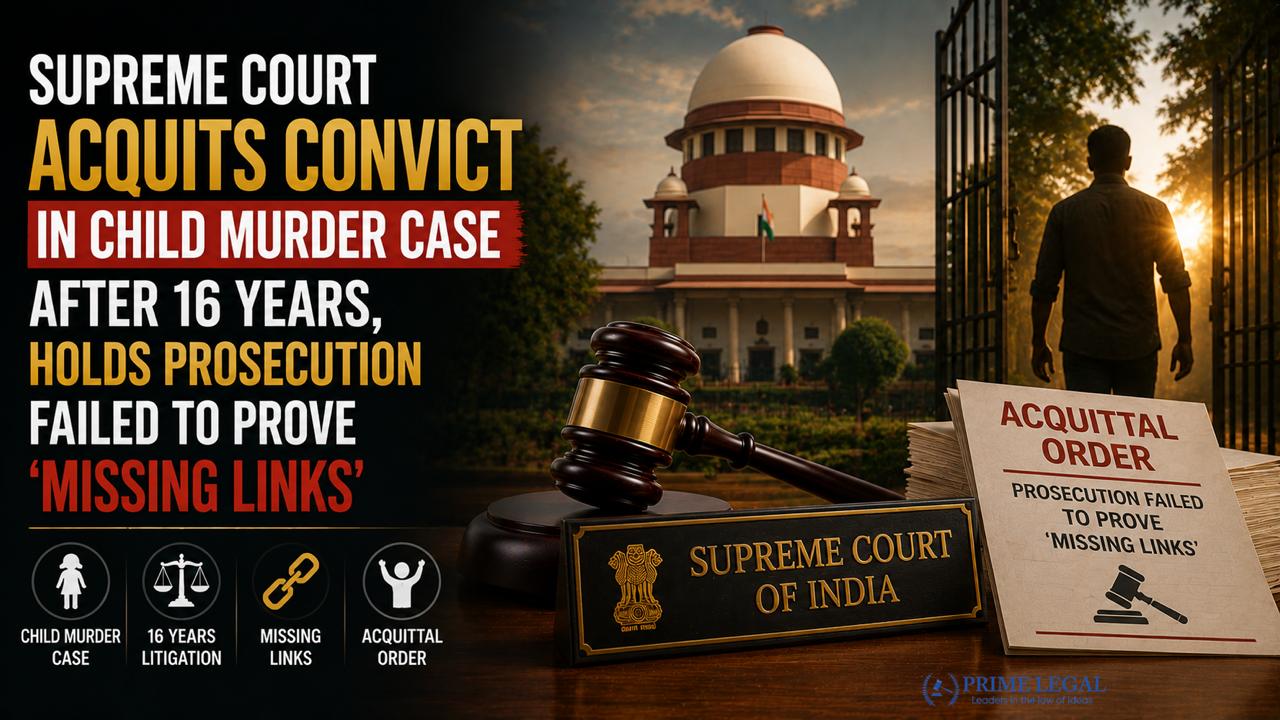
The Supreme Court ruled that the prosecution did not prove the guilt of the accused beyond reasonable doubt. The court observed that the circumstantial evidence formed a broken link chain, hence cannot be used to prove the case against the accused. The Supreme Court quashed the judgement of the Punjab & Haryana High Court dated 18 October 2022, and the judgement of conviction and order of sentence passed by the Trial Court. The appeal was allowed and the benefit of doubt was given to the accused.
CONCLUSION
This ruling reiterates that when a criminal case is founded purely on circumstantial evidence, each of the circumstances shall be proved beyond a reasonable doubt and shall constitute a chain of circumstances pointing solely to the culpability of the accused. An unproved theory of last seen, an extra-judicial confession which is not proven, a disclosure statement without any new finding, and inconclusive forensic evidence do not amount to proof. Because the prosecution could not prove these basic links, the Supreme Court gave the benefit of doubt to the accused and acquitted him.
“PRIME LEGAL is a National Award-winning law firm with over two decades of experience
across diverse legal sectors. We are dedicated to setting the standard for legal excellence in
civil, criminal, and family law.”
WRITTEN BY: KHWAISH SACHDEVA

