
INTRODUCTION
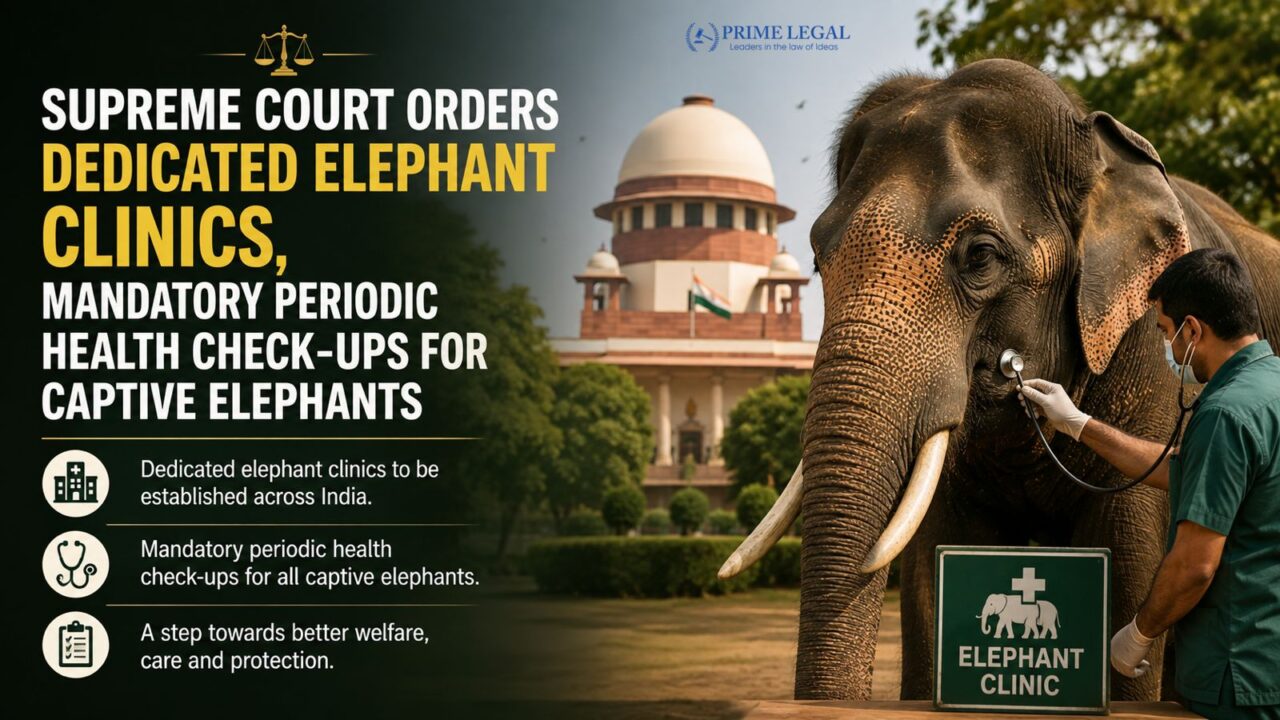
On 18 August 2026, the Supreme Court, in Wildlife Rescue and Rehabilitation Centre and Ors. v. Union of India and Ors., W.P.(C) No. 743/2014, issued a comprehensive set of directions to strengthen the health, welfare and regulatory oversight of captive elephants across India. A Bench comprising Chief Justice of India Surya Kant, Justice Joymalya Bagchi and Justice V Mohana directed the Union Government to frame mandatory guidelines for the establishment of specialised elephant clinics, where periodic health check-ups would be compulsory for every captive elephant, along with the maintenance of individual medical records.
BACKGROUND
The directions arose out of a 2014 public interest litigation concerning the captivity, trafficking, treatment and rehabilitation of elephants in India. Senior Advocate Aparna Bhat, appearing for the petitioner, informed the Court that a 2018 census had recorded 2,675 captive elephants, and sought a fresh survey along with a bar on bringing any new elephant into captivity. Additional Solicitor General Aishwarya Bhati, representing the Union, apprised the Court that a completed census placed the number at 2,725 elephants across 27 states, of which 1,678 were with private persons, 768 with forest departments, 332 in rehabilitation centres, 96 with temples, 63 in zoos, and 47 with circuses. The Court noted that its immediate concern was not ownership as such but the health, well-being and upkeep of the animals.
KEY POINTS
The Court directed the Union to issue mandatory guidelines and coordinate with States to establish elephant clinics with specialised facilities, making periodic health check-ups compulsory for all owners of captive elephants, with medical records maintained for each animal. It directed the Captive Elephant Health and Welfare Committee, constituted under Project Elephant by the Ministry of Environment, Forest and Climate Change, to ensure regular treatment, lay down minimum housing and upkeep standards, and file a status report on implementation. The Bench ordered a mechanism for periodic renewal of Ownership Certificates, during which an elephant’s complete data would be revisited, and directed disclosure on whether DNA profiling of captive elephants has been completed and uploaded on the Gajah Suchna App. The Court clarified that no ownership or transfer of a captive elephant may happen without compliance with applicable rules and clear documentation of the transferor, transferee and purpose of transfer, and observed that an Ownership Certificate does not confer ownership of the animal itself, since elephants remain a natural resource vested in the State. The Bench refused to direct a blanket ban on captive elephants, reasoning that such a step could leave existing elephants abandoned and without care.
RECENT DEVELOPMENTS
During the hearing, the Court drew a distinction between religious and commercial use, noting that any use of elephants in temple processions must be regulated in terms of duration and conditions, while expressing greater concern over private ownership and circus elephants, given the profit-driven nature. Justice Bagchi remarked that reverence shown to elephants in temple traditions must be matched with responsibility for their welfare, adding that an elephant ought to be treated “like a deity, not a servant.” Counsel for an elephant owners’ association countered that Kerala already follows a robust regulatory regime, including radio-tagging of elephants, and urged the Court not to generalise isolated lapses across all private and temple ownership. The Committee has now been directed to file a status report indicating the measures undertaken pursuant to these directions.
CONCLUSION
The order reinforces judicial recognition that welfare-oriented regulation of captive elephants cannot rest on ownership certificates alone, but requires continuous monitoring of health, housing and treatment through dedicated infrastructure. By mandating elephant clinics, compulsory check-ups and medical record-keeping, while leaving broader ownership and rehabilitation questions open for further hearing, the Supreme Court has signalled a calibrated approach that balances existing possessory rights, whether religious, commercial or private, against the constitutional duty to ensure humane treatment of captive wildlife.
“PRIME LEGAL is a National Award-winning law firm with over two decades of experience across diverse legal sectors. We are dedicated to setting the standard for legal excellence in civil, criminal, and family law.”
WRITTEN BY: GAURAV VIBHU RANJAN

