
ABSTRACT
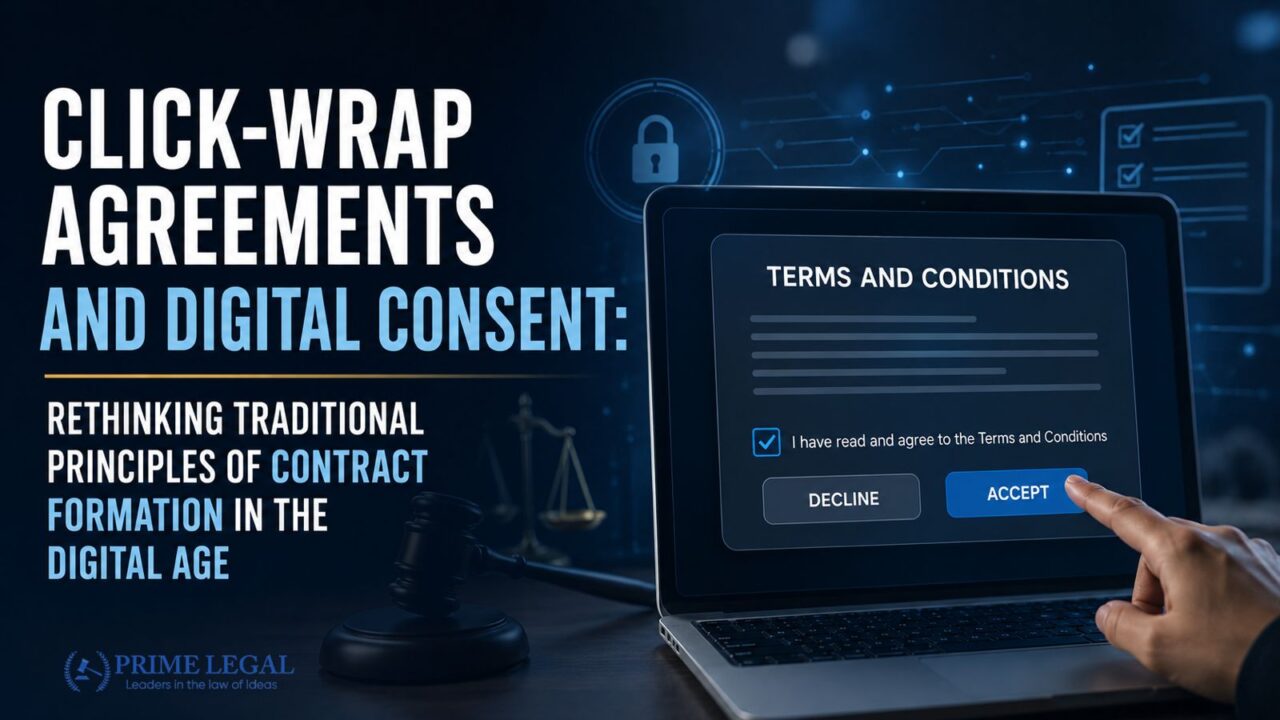
The click-wrap agreements, seen in the form of an “I Agree” check box which a user is required to tick prior to being allowed access to a website or application, have emerged as the most popular form of recording consent to contract in India’s digital economy. While there is judicial and regulatory recognition of clicks as sufficient for consent to have been made, there arises the problem of whether the mere clicking on the check box can be seen as true consent in light of the increasing length, complexity and imbalance of these agreements. This paper analyses the doctrinal validity of the enforceability of click-wrapped contracts under the Contract Act and the Information Technology Act, 2000 and looks at the judicial attitude towards boilerplate contracts and unconscionable terms, along with the emerging standards of consent from the Consumer Protection Act,2019 and E-commerce Rules.
KEYWORDS:
Click-Wrap Agreements, Free Consent, Indian Contract Act 1872, Information Technology Act 2000, Unconscionable Contracts, Standard Form Contracts, Consumer Protection (E-Commerce) Rules 2020.
INTRODUCTION
The modern digital transactions that occur in India today, whether it be the downloading of a mobile application or creating an account on the internet, begin in much the same way: a screen of text scrolling past and a button reading “I Agree.” This is known as the click-wrap agreement, so called because consent is given through a simple click of a button or tap on a screen instead of signing one’s name to a piece of paper. The advantages of such an agreement are obvious: a service provider can sign thousands of contracts within a minute, and a user is able to utilize a certain service in a matter of seconds instead of days. However, the same efficiency poses a problem. In comparison to a negotiated contract, a click-wrap agreement is drafted solely by one side, is not even read entirely, and does not give the other party the chance to amend anything in the agreement, the only option is either to accept the whole contract or refuse the service provided.
THE LEGAL FOUNDATION: CONSENT UNDER THE INDIAN CONTRACT ACT
According to Section 10 of the Indian Contract Act, 1872, there must be an agreement between competent parties made freely in order for the agreement to become valid. Section 13 explains that consent means an agreement between two or more parties upon the same matter in the same way, and Section 14 provides that consent is not “free” if it was caused by coercion, undue influence, fraud, misrepresentation or mistake. By its literal meaning, clicking on “I Agree” fulfills the requirements of Section 13: the user expresses his or her agreement on what is shown to him or her. However, it is difficult to apply Section 14. Click-wrap agreements are rarely read by users, are written in complicated legal terms and are offered to them on a take it or leave it basis, so the question arises if this kind of consent can be called informed one or just a mere procedure resulting from unequal bargaining positions of parties. Indian courts have not created their own concept of “digital consent,” therefore have applied the usual rules of creation of contract without regard to the digital nature of it.
STATUTORY RECOGNITION UNDER THE INFORMATION TECHNOLOGY ACT, 2000
The Information Technology Act of 2000 provides the legal link needed for making an electronic “click” equivalent to a written signature on paper. Section 10A, added by the 2008 amendment, says that a contract shall not be considered voidable just because the contract was made through electronic communications, including proposals, acceptances, and revocations. In conjunction with the Contract Act, this means that click-wrap agreements are not per se void due to the lack of a written signature. However, Section 10A does not waive the essential need of consent, and simply strips away the formal objection of the impossibility of an electronic contract. The question of whether a deal was fair is decided under the provisions of the Contract Act, including the principle of construction of ambiguous terms in favour of a consumer who was provided with the terms of an agreement in a standard form.
JUDICIAL SCRUTINY: UNCONSCIONABILITY AND UNEQUAL BARGAINING POWER
Even though no case law relating to a click-wrap agreement exists yet before the Supreme Court, the principles laid down by the Supreme Court with regard to the interpretation of standard form contracts serve as the guidelines which the court will most likely follow. In Central Inland Water Transport Corporation Ltd. v. Brojo Nath Ganguly, (1986) 3 SCC 156, the Supreme Court held that an unreasonable term in a standard form contract can be deemed contrary to public policy and thereby declared void under Section 23 of the Contract Act only if it was unconscionable and one party had no choice but to agree with the terms. In LIC of India v. Consumer Education & Research Centre, (1995) 5 SCC 482, the Supreme Court stated that an entity providing a contract to another on a take it or leave it basis owes an obligation to formulate the terms reasonably, especially if there is inequality between parties in terms of bargaining power. In the online scenario, therefore, the term of a click-wrap agreement cannot automatically be enforced even though the user clicked “I Agree” if the terms are unreasonable or unfair.
THE CONSUMER PROTECTION FRAMEWORK: EXPLICIT CONSENT AND UNFAIR TRADE PRACTICES
The most direct regulatory reaction to the issue of consent is neither from contract laws nor tort laws but rather comes from consumer laws. For instance, the Consumer Protection (E-Commerce) Rules, 2020 made under the Consumer Protection Act, 2019 makes it mandatory that the consent of a consumer for an electronic transaction should be clearly obtained by making a check on his box as a requirement. The new rules signify a move away from the traditional approach of considering any click as consent towards obtaining consent which should be active, informed and related to the transaction being consented. When read together with the unfair trade practice prohibition in the act, the rule enables a consumer to challenge a mechanism which obtains consent in a manner that could make the agreement unconscionable.
CONCLUSION
However, click-wrap contracts are here to stay, and Indian courts have wisely chosen not to take the electronic nature of the contract as an obstacle to enforceability. However, the fact that such contracts are easy to enter into must not be taken as evidence that there exists consent. Indeed, the need for free consent as per the Contract Act, the judiciary’s readiness to strike down unconscionable standard form contracts, and the Consumer Protection Rules’ requirement that the user must explicitly consent and not pre-tick any options all indicate that the standard is higher than that, i.e., a click constitutes consent, but it does not constitute proof of understanding and consenting to the terms. Businessmen drafting click-wrap terms would be wise to highlight important terms, including those dealing with liability, arbitration, and data protection, rather than hiding them behind the scroll box, as this is the trend in both consumer protection and contract law.
“PRIME LEGAL is a National Award-winning law firm with over two decades of experience across diverse legal sectors. We are dedicated to setting the standard for legal excellence in civil, criminal, and family law.”
WRITTEN BY: DRISHTITA BANIK

