
INTRODUCTION:
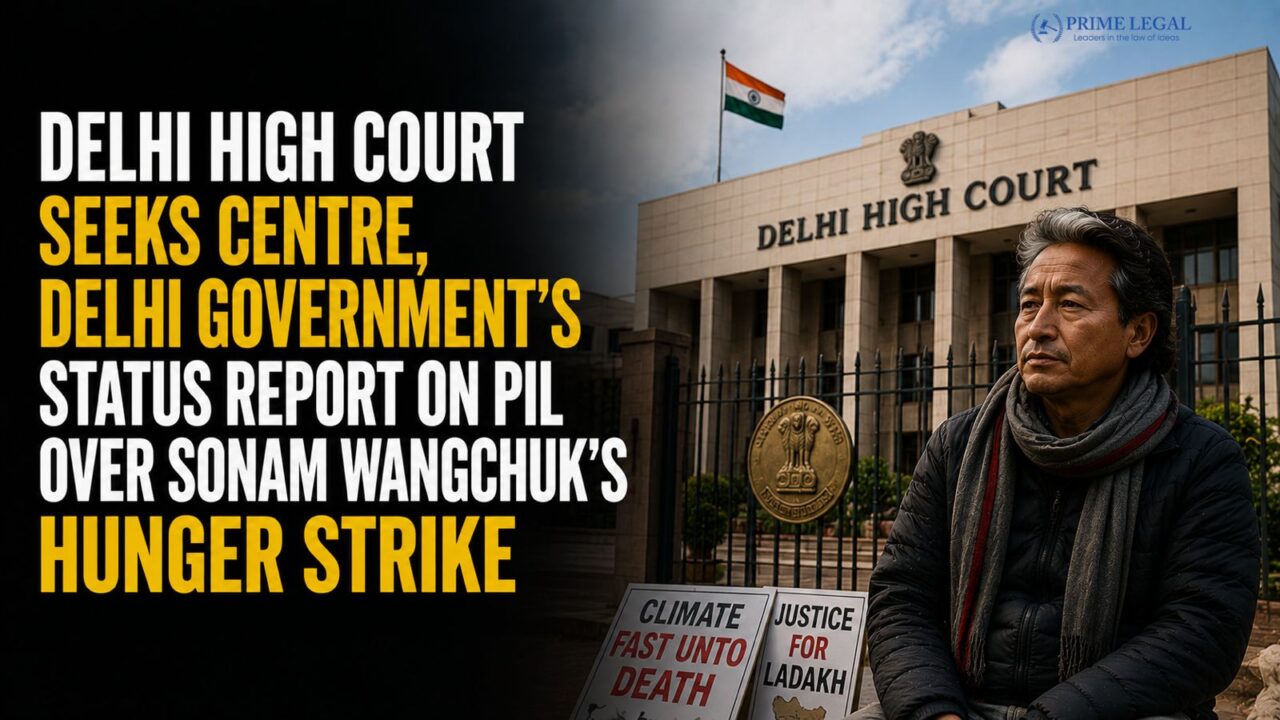
The Delhi High Court emphasized on the right to life while considering a Public Interest Litigation (PIL) filed in connection to the indefinite hunger strike of activist Sonam Wangchuk. The bench comprising Chief Justice Devendra Kumar Upadhyaya and Justice Tushar Rao remarked, “Every life is precious,” while giving directives to the Central Government and Delhi Government regarding the health of Sonam Wangchuk. The Court followed a balanced approach in the matter concerning the right to protest of an individual and the duty of the State to protect the life of people.
BACKGROUND:
A PIL was filed concerning the critical health condition of Sonam Wangchuk after being reportedly on a hunger strike for almost three weeks at Jantar Mantar, Delhi. The petition mentioned that, during this period, Wangchuk has lost more than 8 kgs of weight and that if he continued to fast, he could face irreversible damage to internal organs. The petition sought intervention from the central government and the government of Delhi for the hospitalization and continuous medical treatment of Wangchuk and even force feeding in case of medical emergency. The petitioner mentioned that what Wangchuk is doing is a non-violent form of protest protected under the Indian Constitution.
Tushar Mehta, Union Government’s Solicitor General, informed the court that government physicians will conduct daily medical examinations of Wangchuk, and that any medical intervention, if required by doctors, would be given immediately. Noting the assurances given, the Court advised that Mr Wangchuk’s health to be monitored continuously as every life is precious.
KEY POINTS:
- A Public Interest Litigation was brought before the Delhi High Court in order to seek urgent medical intervention for Sonam Wangchuk in the wake of his ongoing hunger strike.
- The petitioner prayed for medical intervention for Sonam Wangchuk and even forced feeding in case of medical emergency.
- The solicitor General assured the court that daily health checks would be conducted by government doctors on Mr. Sonam Wangchuk and every necessary medical care will be taken.
- The court commented that “every life is precious” and ordered the officials to monitor him daily for his medical condition.
ANALYSIS:
The decision highlights a balance between the right to peacefully assemble protected under Articles 19(1)(a) and 19(1)(b) and the affirmative duty of the State to safeguard life as enshrined in Article 21. The court ensured that medical assistance is provided by the government for Sonam Wangchuk and necessary steps are taken, if his condition is endangered. The approach demonstrates the harmonious existence of fundamental rights.
Further, the Court focused on the necessity of medical treatment and opinion of medical practitioners before taking any action. This highlighted the courts balancing approach towards respecting autonomy of the protestor and ensuring that the State does not let preventable deaths happen. This ruling portrays the principles of judicial restraint where the Court prefers supervision instead of imposing orders indicating that protecting life is a constitutional obligation.
CONCLUSION:
In the ruling, the Delhi High Court has put forward a pragmatic approach in situations of hunger strikes. This decision highlighted the constitutional right to protest, while also ensuring that the authorities remain diligent in safeguarding the activist’s life through medical supervision. By stating that “every life is precious,” the Court has reiterated that the State has a duty to protect life. The decision remains significant in achieving balance between civil rights and the duty of the State with regard to the preservation of life.
“PRIME LEGAL is a National Award-winning law firm with over two decades of experience across diverse legal sectors. We are dedicated to setting the standard for legal excellence in civil, criminal, and family law.”
WRITTEN BY: SOMSUTA PAUL.

