
INTRODUCTION
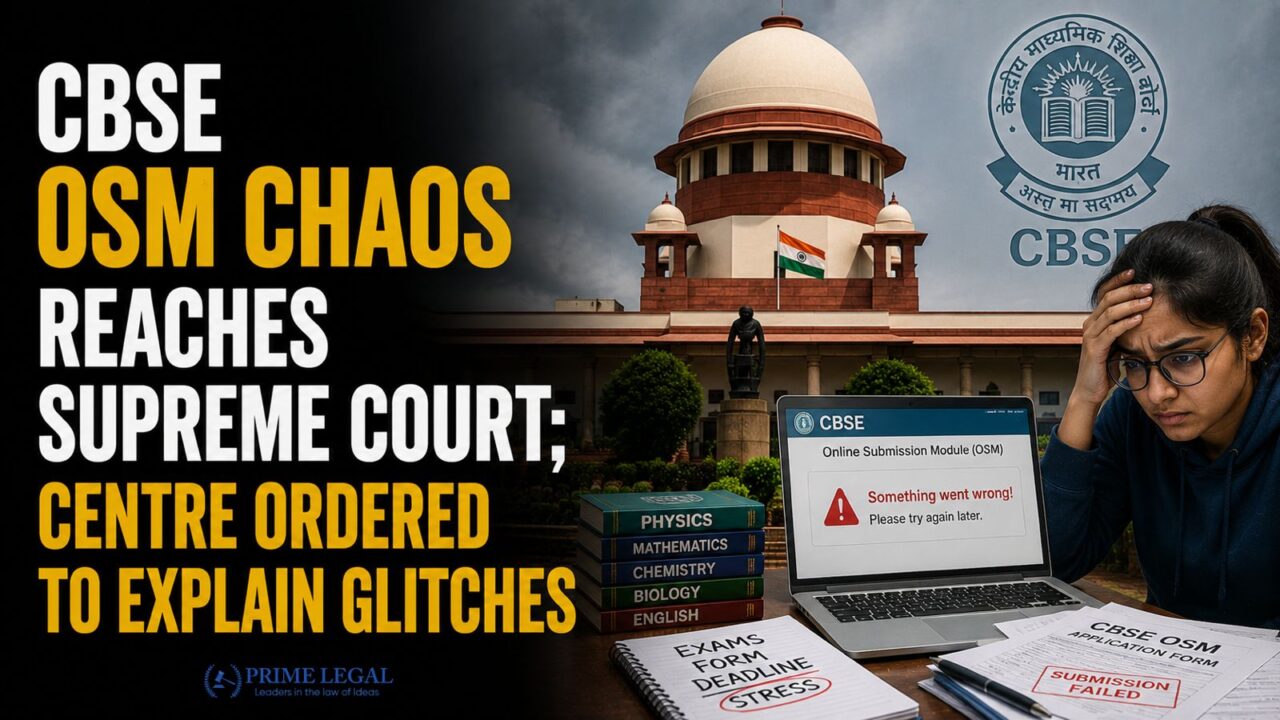
In 2026, students faced issues due to irregularities and failures in the On-Screen Marking (OSM) system of the Central Board of Secondary Education (CBSE) for Class 12th board exams, prompting the Supreme Court of India to consider the matter. The Court had formally asked the Union government to give it a status report on the work of a one-member committee headed by senior advocate Pratesh Meghnish that had been set up to investigate the technical failures. In this context, the Chief Justice of India, Surya Kant, pointed out that the government should consider it and make it better.
BACKGROUND
Advocate Laxmikant Matadan Shukla, appearing for petitioner Rakesh Binjola sought a fair investigation of “patent irregularities” in the OSM evaluation process. The petition requested all those students who have suffered due to deficiencies in CBSE both in India as well as abroad, numbering more than 29,000 in India and 257 in 25 other countries, to be answered.
Mr. Shukla pointed out that more than 17 lakh students appeared for the Class 12 exams in May 2026, his son’s answer sheet of which could not be uploaded on to the CBSE website. The petitioner’s case was taken up by the Chauhan panel, which had been constituted on 2nd June, 2026, and a response by the Centre, represented by solicitor general Tushar Mehta, said that this specific issue was settled, while the panel is still working on the larger issues. This committee is headed by Chairperson, S. Radha Chauhan, who is a retired Indian Administrative Service (IAS) officer and Chairperson of the Capacity Building Commission.
KEY POINTS
- The Supreme Court emphasized on the level of frustration of the young students who are getting allotted CBSE exams from an improper system known as OSM in CBSE.
- Chief Justice Surya Kant has urged Solicitor General Tushar Mehta to explain what measures have been taken towards solving the issues that have arisen till now.
- Justice Joymalya Bagchi said this during the judgment that the Centre can prepare the OSM policy but ascertaining from the facts, the Centre has acknowledged if there were implementation irregularities, which is obvious when dealing with the said policy.
- The Court explained that it wanted to help the government make improvements in order to implement it seamlessly, but was not adversarial.
- The Solicitor General accepted the request for the status report at the next set date of July 24.
- The petition pointed to many of the issues, including ‘Illegible “scanning appraisal of answer papers” and ‘Unchecked answers’ etc., noting that these constitute a form of ‘systematic negligence/failure to fulfil a duty of care’.’
- The irregularity was blamed on the sharp drop in overall pass percentage from 86.3% to 85.2%, the lowest that the secondary students have achieved in the last seven years and a drop of 3.19 percentage points from the previous year.
- The petitioner said that the OSM System has been put in place without proper training of evaluators.
ANALYSIS
The Supreme Court’s decision highlights the need for ensuring that policies are not only designed but also have a tangible impact in the real world, especially when the fate of millions of students hangs in the balance.
The bench recognised that the theoretical and the practical of the OSM system did not align, noting the “teething problems” of having the new evaluation technologies implemented and the resultant damage. The very high number of fail grades and specific technical problems (eg. notes unchecked, answers not adhered to, bad scans) indicate that there is a serious matter of breach of the duty of care towards the students.
The Court’s collaborative rather than adversarial spirit in seeking a status report, is intended to facilitate a speedy institutional remedy and accountability for these pervasive administrative shortcomings.
CONCLUSION
The Supreme Court’s demand for a status report of the glitches of the CBSE OSM stands testimony to the strong judicial commitment towards the academic future of students. The Court has markedly ushered in a period of accountability in government while preserving the policy-making autonomy without stifling the response of the student community as they grappled with terrible anguish. The results of the S Radha chauhan committee and the government action thereafter will play an important role in re-establishing the integrity and credibility of the national examination assessment system.
“PRIME LEGAL is a National Award-winning law firm with over two decades of experience across diverse legal sectors. We are dedicated to setting the standard for legal excellence in civil, criminal, and family law.”
WRITTEN BY: SHEEN.

