
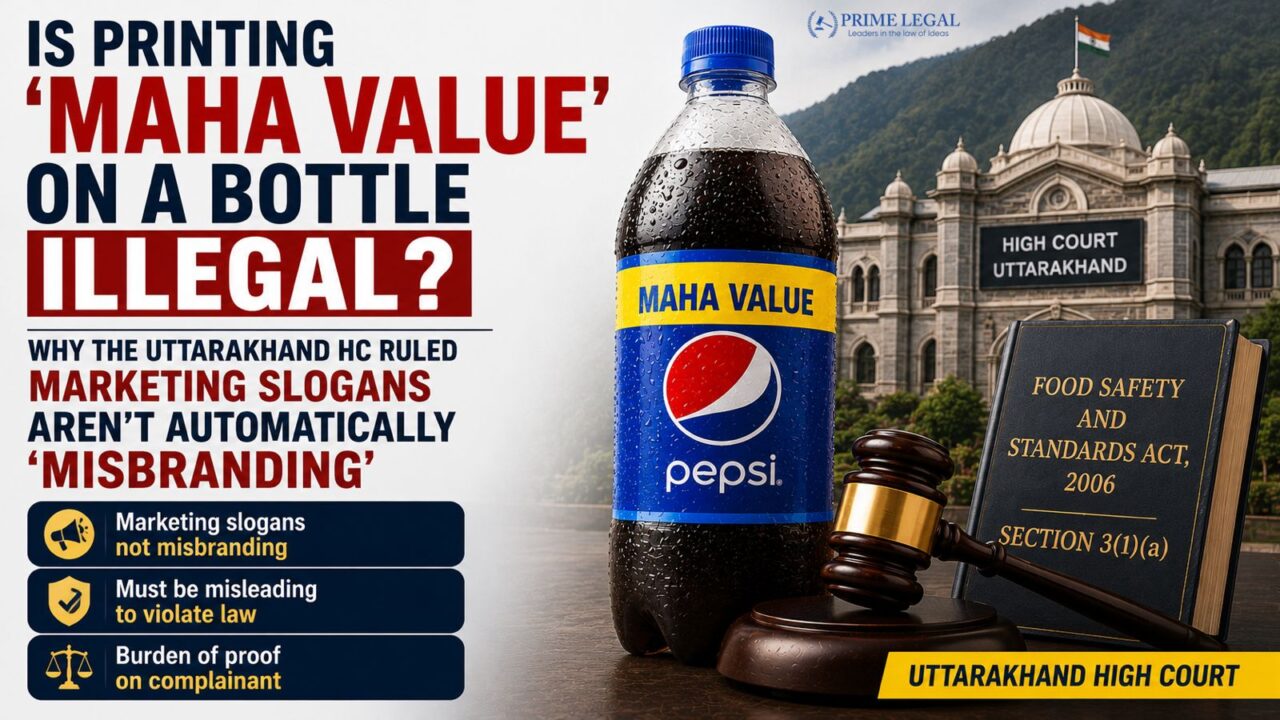
CASE NAME: PepsiCo India Holdings Private Limited v. State of Uttarakhand and another
CASE NUMBER: Appeal From Order No.305 of 2024
COURT: High Court of Uttarakhand at Nainital
DATE: 18 June, 2026
QUORUM: Hon’ble Mr. Justice Ravindra Maithani
FACTS
In Srinagar, Pauri Garhwal, on 08 June 2015, a Food Safety Officer inspected a store named M/s. N.S. Enterprise bought 4 packets of the subject item “Lahar Aloo Bhujia” for analysis at a food lab. The Food Analyst concluded that the subject food product was misbranded based solely on the fact that the packet had the words “Maha Value” on it in the corner. The Adjudicating Officer imposed a penalty of Rs. 1.5 Lakhs each on the appellant and M/s Bikanerwala Food Products Pvt Ltd on 21 December 2018, based on the aforementioned report, while completely exonerating the storekeeper. This penalty of Rs. 1.5 lakhs on the appellant was upheld in an appeal judgment issued by the Food Safety Appellate Tribunal, Dehradun, on 31 May 2024. Consequently, the appellant commenced the present appeal before the High Court to challenge these concurrent orders.
ISSUES
- Whether the phrase “Maha Value” on a food package label constitutes “misbranding” under the Food Safety and Standards Act, 2006.
- Whether a Food Analyst’s report, which is lacking specific reasoning or explanation, can legally establish a case of “misbranding” to justify a penalty.
LEGAL PROVISIONS
- Sec. 3(1)(zf)(A)(i)(a) defining “misbranded food,” and Sec 23 concerning packaging and labelling requirements, and Section 52 regarding penalties of the Food Safety and Standards Act, 2006 (FSS Act)
- Regulation 2.3.1.5 of Food Safety and Standards (Packaging and Labelling) Regulations, 2011.
- The Legal Metrology Act, 2009 and Rule 12- Declaration of quantity of The Metrology (Packaged Commodity) Rules, 2011.
- Case Laws: Bal Kishan Thapar Vs. Municipal Corporation of Delhi, (1979)2 SCC 459; Parakh Foods Limited Vs. State of Andhra Pradesh and another, (2008)4 SCC 584; Sterling Agro Industrial Ltd. and another Vs. State of Uttarakhand, 2014 SCC OnLine Utt 147; Pepsico India Holdings Pvt. Ltd. and another Vs. State of Madhya Pradesh, M.C.R.C. No.6848/2011 decided on 18.06.2019; Glaxo India Ltd. Vs. State of Assam and others, (2003) 1 Gauhati Law Reports 407.
ARGUMENTS
APPELLANT:
The appellant contended that “Maha Value” is intended to refer to both the amount of the item in the retail package as well as to its value, and therefore meets both the Legal Metrology Act and its associated Rules because the term does not relate to the nutritional value of the item. Furthermore, they asserted that the Food Analyst’s report was legally inadequate because it does not provide any explanation as to why the product was improperly labelled or what specific aspects were untrue. The appellant also relied on several rulings from both the Supreme Court and High Court, including Bal Kishan Thapar, Parakh Foods Limited and Glaxo India Limited, indicating that simply putting something or a photograph on a package does not constitute the product being misbranded, provided that it does not make any assertion that would inflate the quality of the item.
RESPONDENTS:
The State claimed that the words “Maha Value” on the label of the “Lahar Aloo Bhujia” constituted misbranding and qualified as a direct violation of the requirements of the FSS Act and the 2011 Regulations
ANALYSIS
The Food Analyst’s Report was examined by the Court and contained little or no rationale for the conclusions reached. The Analyst relied only on the cited provisions that is Section 3(1)(zf)(A)(i) in relation to the Food Safety Standards Act, but did not share any detail about what on the label was false or misleading. The Court found that the Tribunal had wrongly placed the burden of establishing the justification of the label on the appellant, rather than requiring the prosecution to provide evidence on how the label misled the consumer, as the law provides. The Court additionally found that both the Adjudicating and Tribunal had failed to address the Appellants’ main defence, that it was a declaration of quantity permitted under the Legal Metrology Act, and, thus, was a proper declaration.
JUDGMENT
The High Court ruled in favour of the appellant in this matter and set aside both the Adjudicatory Authority’s ruling dated December 21, 2018, and the Food Tribunal’s decision rendered on May 31, 2024. In doing so, the High Court ultimately found that the Prosecution had utterly failed to establish that the Appellant had breached the FSS Act in any way.
CONCLUSION
The High Court held that a public analyst’s report must contain substantial reasons for a public analyst to find that something was misbranded. Therefore, a mere statutory reference to a statute without further explanation of how that statutorily prohibited labelling would mislead consumers, and is legally insufficient. In addition, the High Court held that the burden of proof to establish that a product’s labelling is false or misleading shall be borne entirely by the Prosecution, and the mere use of terminology related to quantity or value for an item under another valid law shall not automatically be construed as being misleading.
“PRIME LEGAL is a National Award-winning law firm with over two decades of experience across diverse legal sectors. We are dedicated to setting the standard for legal excellence in civil, criminal, and family law.”
WRITTEN BY: VINEET SEERVI
Read the judgment copy below:
PepsiCo India Holdings Private Limited v. State of Uttarakhand

