
INTRODUCTION
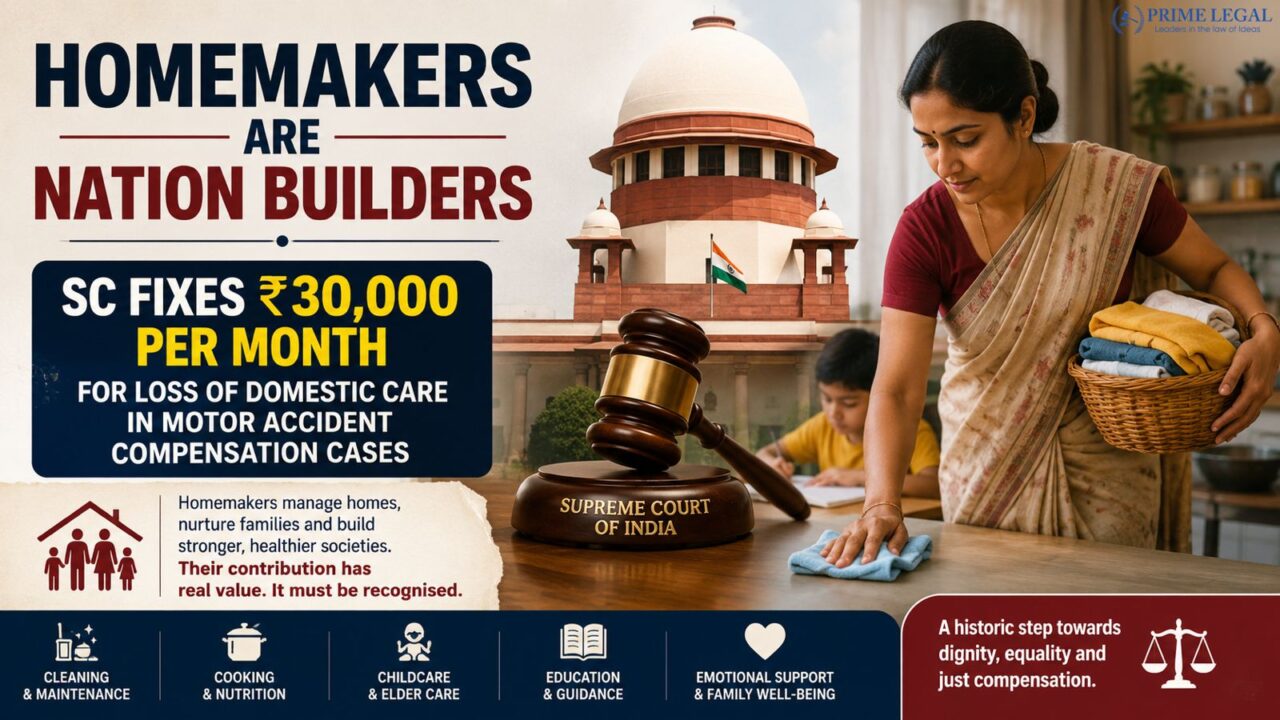
On 11 June 2026, a Division Bench of the Supreme Court of India, consisting of Justices Sanjay Karol and N. Kotiswar Singh granted a unique status to homemakers as “Nation Builders” and introduced a new set of head of compensation called “Loss of Domestic Care” in a motor accident claim. The order in Shishu Pal @ Shish Ram & Ors. v. Surjeet & Ors. (2026 INSC 634) issued a new direction to all Motor Accident Claims Tribunal, High Courts and Supreme Court that when death of a homemaker is in doubt, there should be a minimum addition of Rs. 30,000/- per month under this head in every Motor Accident Claims Tribunal, High Court and Supreme Court. The sum is to be increased by 10% every three years as per the rate of inflation and shall be given in addition to, and not in lieu of, all other heads provided under the scheme in National Insurance Company Ltd. v. Pranay Sethi, (2017) 16 SCC 680.
BACKGROUND
The case stemmed from a motor vehicle accident (MVA) which occurred on 25 November 2001 on the Sirsa – Fatehabad road in Punjab where the deceased homemaker Reshma died as a result of rash and negligent driving of the offending vehicle. In 2003, the Motor Accident Claims Tribunal Sirsa had awarded a paltry sum of ₹2.42 lakh. The case continued for more than 20 years, as court records were destroyed in a fire. In 2024, the Punjab and Haryana High Court upped the compensation to ₹8.43 lakh, but that was still not sufficient to reflect the economic value of the domestic contribution of the deceased. The Supreme Court took this opportunity to relook the compensation system and addressed a systemic underpayment of unpaid domestic labour.
KEY POINTS
- The Court added a new category of “Loss of Domestic Care” as a composite, standalone head of compensation for the three separate aspects of domestic care: the homemaker’s role in maintaining the smooth functioning of the household; the loss of support for the family’s minor children; and the loss of support for the adult children or the decedent’s own children.
- The ₹30,000 number is valid only if all three dimensions are faced with facts. The new head is clearly different from “loss of consortium” as explained in Pranay Sethi (2017), Rajesh v. Rajbir Singh (2013) and Magma General Insurance Co. Ltd. v. Nanu Ram (2018).
- The precedents cover cases of emotional and companionship loss, while this ruling covers the systematic under valuation of the economy of domestic labour.
- The Court took references from the precedents that acknowledged the economic value of the homemaker services: Arun Kumar Agrawal v. National Insurance Co. Ltd. (2010), which opined that a wife’s unpaid work cannot be equated with the work of a domestic servant; and Kirti v. Oriental Insurance Co. Ltd. (2021), which discussed the disparity between the valuation of unpaid domestic work and paid domestic work on gender basis.
- The Court, after taking into account the facts, arrived at the total compensation of ₹62.77 lakh, which is almost eight times more than the award made by the High Court. The calculation assumed a baseline income of ₹30,000 per month (₹3,60,000 per year), included a 40% increase for future income, took the multiplier to be 16 and subtracted one-fourth from the base amount to account for personal expenses, while conventional deductions were made for loss of consortium, loss of estate and funeral expenses.
- Systemic directions were issued by the Bench to cure chronic delay in the MACT proceedings, emphasizing that the very object of Motor Vehicles Act’s ‘just compensation’ was defeated by delay.
RECENT DEVELOPMENTS
The decision is in keeping with a judicial trend. A three-judge bench had approved the multiplier method in Lata Wadhwa v. State of Bihar since 2001 and had given a notional income of ₹3,000 per month to the deceased housewives. In 2010, Arun Kumar Agrawal raised this argument, dismissing the domestic servant analogy. The present judgment builds on this logic by introducing a whole new category of compensation – one which is not subject to the ups and downs of notional-income debates and which is uniform across fora. Academic debate regarding gender and labour economics has long been where it is fair to say that GDP measures and tort law both structurally undervalue the contribution of unpaid care work, and that this undervaluation skews the burden towards women. The Court’s explicit instruction to change the term ‘housewife’ in future use to ‘Nation Builder’ indicates an active attempt to reformulate social perspectives as well as legal discourses. The built-in 10% triennial revision has been welcomed by legal scholars as a very useful mechanism for “inflation proofing” in the future, since it will save litigants from having to relitigate quantum.
CONCLUSION
The Supreme Court’s acknowledgment of the importance of unpaid domestic work to the family, and hence to the country, gives a long overdue recognition to a gap in compensation law which has been left unnoticed for long. The new head of “Loss of Domestic Care” at ₹30,000 per month, along with the periodic revision, is an important addition which brings predictability and equity to thousands of pending and future MACT claims in respect of homemakers. The Court’s message is clear: the invisible hand is not the only one that can’t be seen.
“PRIME LEGAL is a National Award-winning law firm with over two decades of experience across diverse legal sectors. We are dedicated to setting the standard for legal excellence in civil, criminal, and family law.”
WRITTEN BY: ARNAV NAIK

