
INTRODUCTION
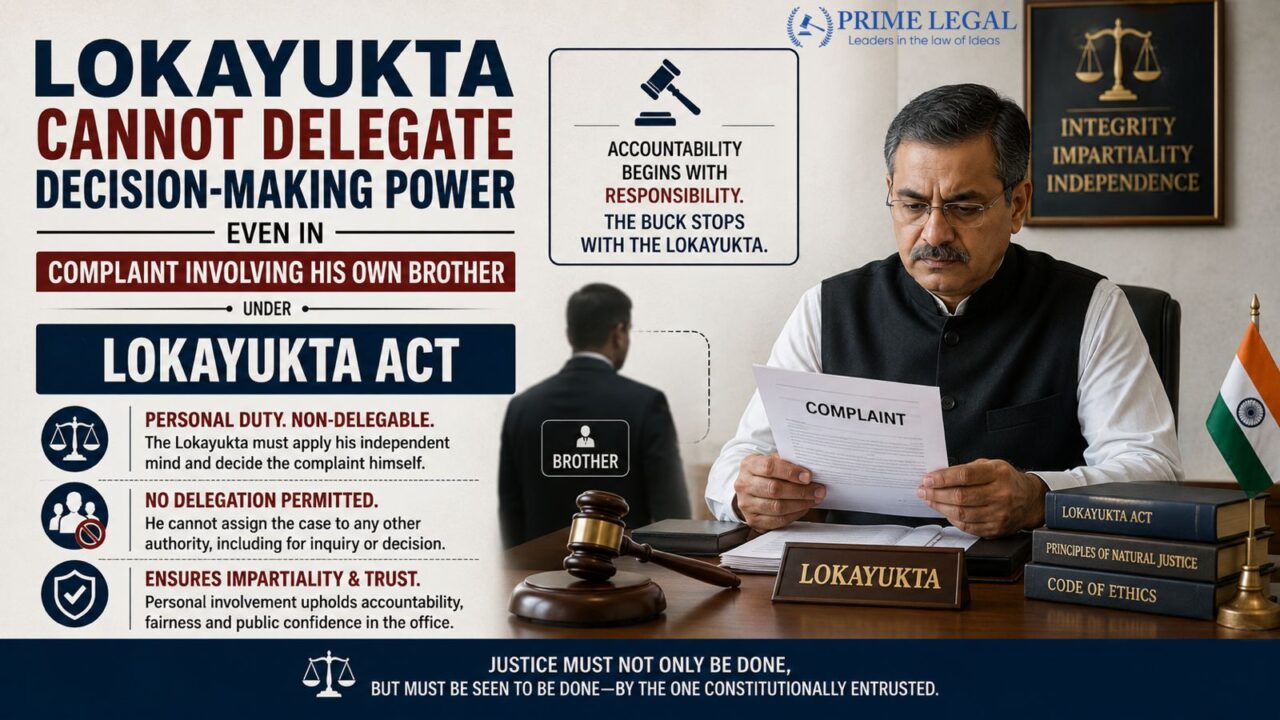
The Jharkhand High Court made a landmark judgment concerning the operational scope of single-member statutory agencies, ruling that the Lokayukta cannot delegate its core adjudicative functions, even where the subject matter is the Lokayukta’s own family. In delivering his judgment in this case, the Hon. Justice Sanjay Kumar Dwivedi relied on the Doctrine of Necessity to uphold an Order of the Last Lokayukta, Hon. Justice (Retd.) Amreshwar Sahay, made in 2012, which dismissed an allegation of bias against Justice Sahay. The judgment emphasises the importance of being impartial to others, but also requires those who are acting impartially to do so, to the extent possible in accordance with the real world and statutory limitations that an agency is obliged to follow, when there are no provisions for sub-delegating the final determination authority of an agency.
BACKGROUND
The conflict began when Satyadeo Roy, a Ranchi University audit officer from 2003, made a complaint to the Lokayukta about large-scale financial irregularities and embezzlement of University Grants Commission (UGC) funds. In response, he asked the Lokayukta for a CBI or Accountant General investigation of the matter. The Lokayukta’s investigation identifies Jyoti Kumar as one of those accused of wrongdoing, and he is the brother of the Lokayukta at that time.
On April 30, 2012, the Lokayukta dismissed the complaint because the central agencies being sought out were outside of his jurisdiction, and there was already a police investigation. Roy then filed a writ petition asking the High Court to rule that the Lokayukta committed a breach of duty by deciding the case where there was a conflict of interest (his brother was involved).
KEY POINTS
- In evaluating the provisions of this Act, the Court concluded that Section 19 of the Jharkhand Lokayukta Act 2001, which imposes restrictions on delegating the final authority (Non-Delegation of adjudicatory powers) of the Lokayukta to determine, dispose of and find against, must be applied only in circumstances where the administering functions have been delegated. The only area where the delegation of powers is allowed is for administrative purposes to reduce the workload of the officer.
- The Court applied the “Doctrine of Necessity”, which states that when determining an issue where there is an absence of an alternative adjudicator or member to make that determination, although the adjudicator may have a real or perceived conflict of interest, that adjudicator must therefore proceed to make the determination.
- Under the provisions of the Act, the Lokayukta can only seek assistance from or to the officers or agents of the state government, and has no authority under statute to give any direction to an authority at the national level (e.g., CBI, AG).
- Section 8(1)(a) states that no investigation shall be conducted by the Lokayukta if the police are currently conducting or have completed a police investigation with respect to the same incident. As a police investigation into the same matter had already been initiated, and an FIR had been lodged at the time of the Lokayukta’s request for an investigation, it was correct for the Lokayukta not to proceed to investigate.
- The Court found that the order, dated in 2012, was lawful, that it was made solely based on statutory provisions, and that it was not made for the benefit of the brother of the Lokayukta alone.
RECENT DEVELOPMENTS
Ultimately, the High Court held the writ petition to be sound law and dismissed all present interlocutory applications, affirming that the Lokayukta’s original determination regarding legal principle was legally sound. This decision has given the entire legal profession what is required to properly evaluate the limits of the impartiality of administrative decision-making in relation to specialised bodies and establishes that no sub-delegation of core powers will be permitted unless expressly authorised by the legislature, thereby preventing the collapse of grievance redress procedures because of overburdening due to conflicts in procedure.
CONCLUSION
According to the decision made by the Jharkhand High Court on this case, it strengthens the structural soundness of the lone authority of the Lokayuka. It is also an expression of the balance between the ethical requirement of impartiality and the legal restrictions found in the “doctrine of necessity,” recognising that sometimes the requirement of functional continuity must take precedence over the need for judicial propriety where no alternative forum exists. Additionally, this ruling establishes an important precedent that requires statutory bodies to conduct themselves within their legislated limitations, despite allegations of conflict of interest.
“PRIME LEGAL is a National Award-winning law firm with over two decades of experience across diverse legal sectors. We are dedicated to setting the standard for legal excellence in civil, criminal, and family law.”
WRITTEN BY: VINEET SEERVI

