
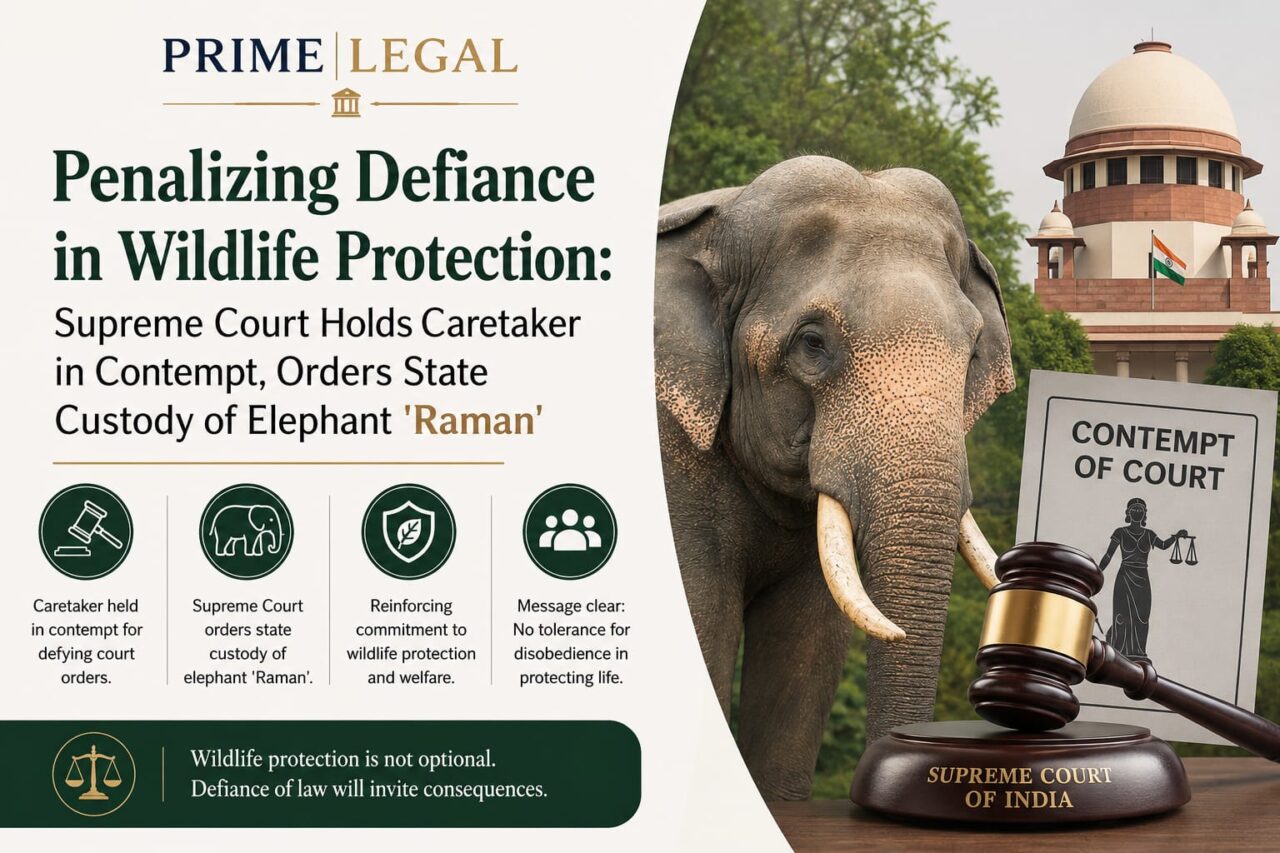
CASE NAME: Jayakrishna Menon v. Krishnankutty & Ors.
CASE NUMBER: Contempt Petition (Civil) Nos. 59-60 of 2026 in Criminal Appeal No.4836-4837 of 2024
COURT: Supreme Court of India
DATE: June 09, 2026
QUORUM: Justice Satish Chandra Sharma
FACTS:
The conflict is over ‘Raman’, the tallest captive elephant in Kerala, who is taken care of by the Tamil Nadu Forest Department.The kerfuffle is about the custody and ownership of ‘Raman’, the tallest elephant in captivity in Kerala, who is being looked after by the Tamil Nadu Forest Department. According to the Contempt Petitioner, (Jayakrishna Menon in the name of Mata Amritanandamayi Mutt), Raman was handed over to Respondent No. 1 (Krishnankutty) for his upkeep and care, and was later wrongfully detained by him on the basis of so-called forged gift deeds dated 18.02.2017 and 28.02.2017. A criminal case (Crime No. 1000 of 2023) was filed against Respondent No. 1 under Sections 406 and 420 IPC for “Illegal retention” and “Maltreatment”. An application was filed under Section 451 CrPC for an interim custody of Raman. It went through a Trial Court, the High Court of Kerala and then to the Supreme Court in Criminal Appeal Nos. 4836-4837 of 2024. On 22.01.2024, the Supreme Court gave the status quo in custody case, extended from time to time. A further application (Crl. was filed after the welfare of Raman and allegations that he was being used during temple festivals came into question. M.P. No. 168885 of 2025) in July 2025. On 06.08.2025, the Court directed the Principal Chief Conservator of Forest to inspect the elephant and made it clear that Raman would not be used for any commercial or temple purpose by Respondent No. 1 by giving an undertaking for the same. Yet, the petitioner claimed that Raman continued to be used in the temple festivals and processions, based on photographs, social media posts, publicity material, etc.
ISSUES:
- Whether Respondent No. 1 intentionally breached the undertaking made by him before the Supreme Court on 06.08.2025 by permitting Raman to carry on the activities of the temple/commercial outlets.
- If the elephant was in musth, whether the State Authorities (Respondents 2-9) deliberately failed to follow the Court’s order to conduct a close-up inspection of the elephant following the musth period.
- What interim relief shall be granted with regard to elephant’s custody and welfare, till the final adjudication?
LEGAL PROVISIONS
- Section 420, IPC – Criminal breach of trust. Cheating and dishonestly inducing delivery of property.
- Section 451 of CrPC – Order for the custody and disposal of property until trial.
- Civil Contempt of Courts Act, 1971 – Contempt of Court is committed when a person “wilfully disobeys” any order or undertaking made by a Court.
- Article 142, Constitution of India – Inherent powers to pass any order for doing complete justice.
ARGUMENTS
PETITIONER
Respondent No. 1 grossly breached the undertaking by participating in the temple festivals and public processions with Raman as documented in photographs, social media and advertising materials. The State Authorities also neglected to do the medical inspection after the conclusion of the musth period as per the order dated 21.08.2025 which amounted to wilful disobedience of the said order.
RESPONDENT
The petitioner’s evidence is largely outdated and predates the order of the court, or is self-published by the temple committees themselves. Raman was only taken to the temple one time, which was thought to be on veterinary advice for a walk, but only because an alternative elephant was ill. It was not a commercial exploit and an unconditional apology was given. No intentional or intentional wrongdoing.
LEGAL ANALYSIS
The Court pointed out that for a finding of civil contempt under Contempt of Courts Act, it is essential to show wilful disobedience of a court order or an undertaking made by the court. An undertaking made by counsel is an undertaking on the part of the party for whom it is made. In its own written response, Respondent No. 1 acknowledged that Raman was taken to a temple, and that the ceremonial procession took place; contrary to the undertaking made. It was not considered sufficient to justify a breach of this nature as an explanation of veterinary advice for ‘walks’ and/or religious necessity. The report of the inspection by the State, dated 03.02.2026, itself records that the elephant was brought to Chavakkad for a temple festival and hence the violation was established. On the State’s compliance, the Court determined that an attempt was made to inspect on 11.11.2025 but not allowed due to the continuous musth and that inspection was made on 03.02.2026; a copy of the inspection report is attached.In regard to the State’s compliance, the Court noted that it attempted an inspection on 11.11.2025 but was not permitted because of the continuous musth, and then conducted an inspection on 03.02.2026 and a copy of the inspection report is attached. This was not deliberate non-compliance but delayed. The Court therefore dismissed Respondents 2-9. When it came to the question of the elephant’s welfare, the Court invoked its parens patriae jurisdiction and its constitutional duty to protect voiceless beings, by stating that it would be failing in its duty if it did not pay attention to the defiance that it faced in matters concerning animal welfare.
JUDGMENT
The Supreme Court (Dipankar Datta and Satish Chandra Sharma, JJ) found Respondent No.1 guilty of committing civil contempt for failing to obey the undertaking given on 06.08.2025. The Court has ordered a fine of ₹2,000 to be deposited in the Registry within four weeks. In the interest of Raman’s welfare, the State of Kerala was directed to immediately take over temporary custody of the elephant and house it in an appropriate rescue/rehabilitation centre. This was a temporary and provisional application pending summary final orders in the underlying appeals. The State was also permitted to temporarily care for the elephant at its own expense and pass appropriate administrative orders under the Wildlife (Protection) Act, 1972. Respondents 2–9 (State Authorities) were freed from contempt charges.
CONCLUSION
This verdict is an affirmation that the undertakings recorded before the Supreme Court are binding and that failure to abide by the same amounts to civil contempt of court whatever the reason for the failure. The courts’ willingness to step in to the side of a captive animal is an example of how animal welfare has become a constitutional issue in the eyes of the courts. Although it is a temporary arrangement, the transfer of custody to the State is an important measure of protection, not just for Raman, but because it gives him a chance to stay physically safe while the dispute between the private parties continues, pending final adjudication.
“PRIME LEGAL is a National Award-winning law firm with over two decades of experience across diverse legal sectors. We are dedicated to setting the standard for legal excellence in civil, criminal, and family law.”
WRITTEN BY : ARNAV NAIK
Read the judgment copy below:

