
INTRODUCTION
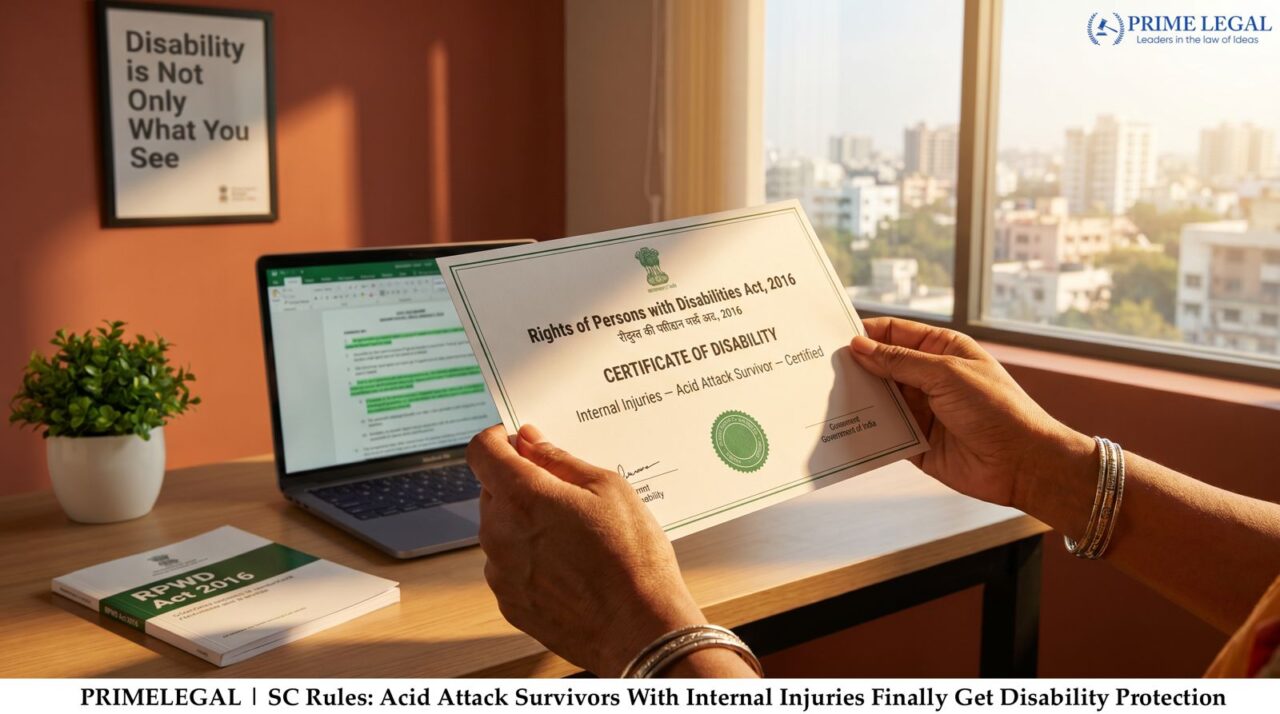
The Supreme Court has addressed a long-standing legislative dispute that excluded a vulnerable category of acid attack survivors from state assistance. Historically, disability benefits for acid attack were given to only those with visible physical “disfigurement”. However, in the recent ruling by the SC the persons who were forcibly made to ingest acid or those who suffered extreme internal organ damage without any external scar must also be recognised as “acid attack victims”. This judgement has highlighted that disability is not merely a matter of visibility but of functional impairment and loss of dignity.
BACKGROUND
The Rights of People with Disabilities Act (RPwD), 2016, originally defined an acid attack victim as a person “disfigured due to violent assaults by throwing acids or similar corrosive substances”. This definition was somewhat narrowing down the scope of state assistance and support for such victims and created a “disability hierarchy”, where survivors with internal injuries (such as damage to esophagus, respiratory system etc) were denied disability certificates and accompanying benefits.
The issue came to the front through a petition filed by survivor and activist Shaheen Malik, who highlighted cases where acid was forcibly administered (ingested) rather than thrown. In such instances, the external skin might remain intact, but the internal devastation is often permanent and life-altering, yet these victims remain legally “invisible” to the welfare state.
KEY POINTS
- The Court used its extraordinary powers to amend the schedule attached to the RPwD Act, 2016 to include those who have suffered internal injuries due to acid attack or have been subjected to forced acid indigestion.
- Crucially, the Court directed that this clarification shall apply retrospectively from 2016. This will make sure that the survivors who have been struggling for a decade can now apply for the state benefits.
- The Bench further analysed that the magnitude of the acid attack lies in the “extreme agony” and functional loss it causes. By removing the mandatory requirement of visual disfigurement, the Court has taken a more pragmatic view.
- The Court has also raised concerns about the “alarming increase” in such cases and suggested that illegal sellers should be held vicariously liable, with their assets attached to compensate the victims.
RECENT DEVELOPMENT
In the case of Shaheen Malik v. Union of India Supreme Court PIL (Writ Petition (Civil) No. 1112/2025), a Bench comprising CJI Surya Kant and Justice Joymalya Bagchi issued a series of “omnibus directions” on May 4, 2026.
The Bench noted that the current definition in the RPwD Act, 2016 was “under-inclusive” and failed to account for the brutality of forced ingestion. The Court has now directed the Union Ministry of Social Justice and Empowerment to formally notify this amendment within two weeks. Until such a notification is issued, the Court’s order stands as a binding “deemed amendment” allowing medical boards across India to issue disability certificates to survivors based on internal injuries.
CONCLUSION
This landmark ruling marks a transition from purely “narrow” understanding of disability to a “human-rights based” approach. By acknowledging that internal scars are as extreme as external ones, the Supreme Court has ensured that no survivor is left behind due to the technicalities of language. This judgement not only provides financial and professional lifeline to hundreds of survivors but also reaffirms the constitutional promise that the state’s duty to provide “reasonable accommodation” must be as broad as the trauma it seeks to address.
“PRIME LEGAL is a National Award-winning law firm with over two decades of experience across diverse legal sectors. We are dedicated to setting the standard for legal excellence in civil, criminal, and family law.”
WRITTEN BY: LISHIKA BATRA

