
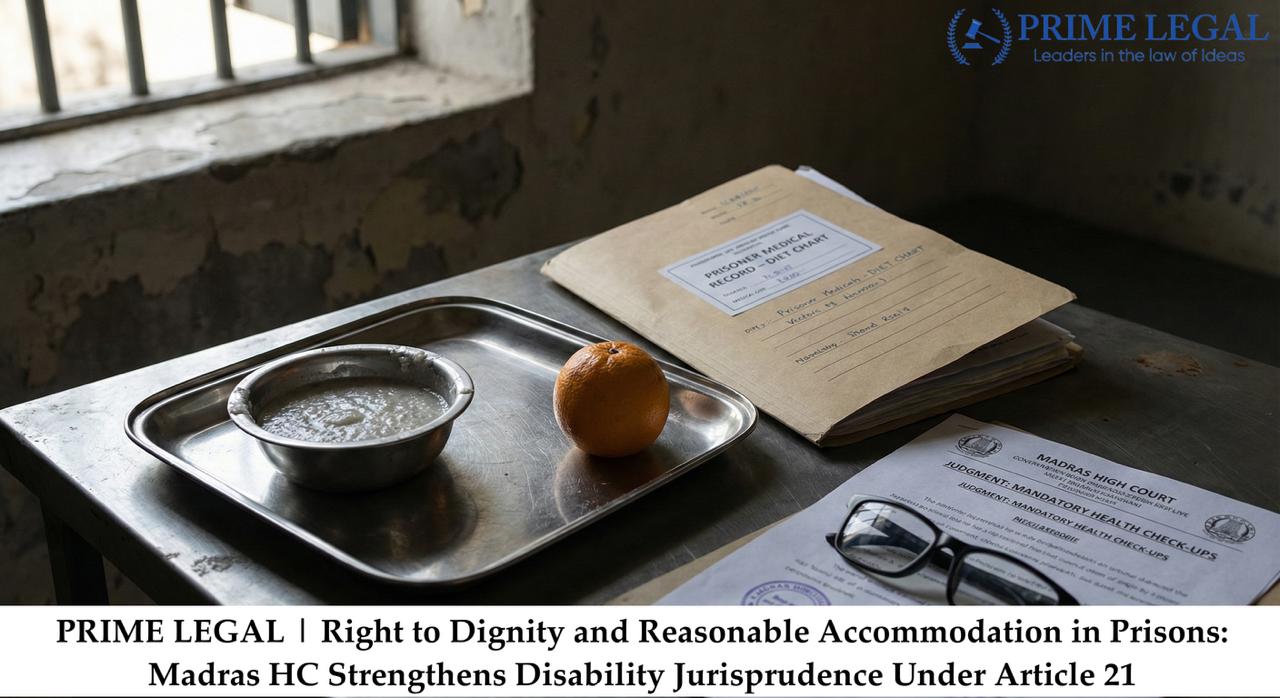
CASE NAME: M. Kalaiselvi Vs. The State of Tamil Nadu & Others
CASE NUMBER: W.P.Crl.(MD) No. 993 of 2026
COURT: Before the Madurai Bench of the Madras High Court
DATE: 23 February 2026
QUORUM: The Hon’ble Mr. Justice G.R. Swaminathan , The Hon’ble Mrs. Justice R. Kalaimathi
FACTS:
The petitioner is M. Kalaiselvi who had filed the Writ Petition under Article no 226 of the Constitution of India seeking a Writ of Mandamus to the order passed by the lower court in the first respondent that she may be granted 28 days ordinary leave without police escape to her father Murugesan who is serving life imprisonment in Central Prison, Palayamkottai. The convict had been in prison for over six years and had had his right leg amputated because of diabetes and complications from the same. The petitioner relied upon Rules 20, 22 (3), 40 of the Tamil Nadu Suspension of Sentence Rules, 1982. The grievance was that despite his serious medical condition and disability, proper consideration had not been given to his application for ordinary leave and reasonable accommodation for him in prison.
ISSUES:
- Whether a convict-prisoner who suffered amputation while in prison was entitled to 28 days ordinary leave without escort under applicable rules.
- Whether the prison authorities had to make reasonable accommodation and medical provision for prisoners with disabilities.
- Whether denial or restriction of such facilities would amount to violation of Article 21 in the Constitution of India?
LEGAL PROVISIONS:
- Article 226 of the Constitution of India
Invoked by the petitioner, for seeking the issuance of a Writ of Mandamus for directing the modification of the impugned order and grant of ordinary leave.
- Article 21 of the Constitution of India
Relied upon by the Court to confirm that every prisoner has a right to dignity, health and periodical medical check-up as a part of the right to life.
- Tamil Nadu Suspension Of Sentence Rules, 1982 (Rules 20 & 22(3) & 40)
Invoked as a means of justifying the right of the convict to ordinary leave.
- Rights of Persons with Disabilities Act, 2016 (Section 40, 45, 89)
Considered in view of Supreme Court orders for reasonable accommodation in prison systems.
- Supreme Court Judgments:
- Muruganantham v. State of Tamil Nadu 2025 SCC OnLine SC 1444
Sathyan Naravoor v. Union of India (2025 LiveLaw (SC) 1176)
These cases ordered States to guarantee disability-friendly infrastructure of prisons, medical audits in regular intervals, assistive devices, accessible prisons and grievance redressal mechanisms.
ARGUMENTS
PETITIONER:
The petitioner argued that as an amputee and diabetic prisoner, her father urgently needed medical attention and reasonable accommodation. It was argued denial of 28 days ordinary leave without escort was unjustified considering his medical condition. She relied upon the Tamil Nadu Suspension of Sentence Rules and the guarantees provided by the constitution to make claims of entitlement.
RESPONDENTS:
The state was represented by the Additional Public Prosecutor. The Court observed that the prison authorities were to comply with the Supreme Court’s direction of prisoners suffering from disability. The respondents had to justify their administrative decision within the framework of prison regulations and constitution mandating the burden.
ANALYSIS:
The Court laid great emphasis on the directions of the Supreme Court in L. Muruganantham and Sathyan Naravoor which laid emphasis on the fact that reasonable accommodation to prisoners suffering from disabilities is not optional but mandatory. The Bench took note of the fact that the petitioner’s father had undergone amputation in jail as a consequence of diabetes, which a proper diagnosis and diet could have prevented.
The Court considered that a prisoner is still a “person” under the Constitution and is entitled to dignity and humane treatment. It directed that master health check-ups have to be made once in two years for all prisoners. Special dietary needs of diabetic inmates must be taken care of, taking sugar-free beverages where necessary.
Specific directions were issued as to provide the petitioner’s father with:
A cot
A table for essential items
Western Toilet or Commode facility
Periodic medical check-ups
Assisting devices, like wheelchair or crutches
Counselling and Rehabilitation Support
The Court further ordered the Dean of Government Medical College, Tirunelveli to arrange for a medical camp to identify the diabetic prisoners and provide necessary treatment like insulin.
In the same case, the court held that periodical medical check-up comes within the scope of Article 21.
JUDGMENT:
The writ petition was permitted.
The Court ordered the second respondent to release Murugesan on 28 days ordinary leave without escort from 28.02.2026 to 27.03.2026 subject to certain reporting and compliance conditions. The convict was instructed to report before the Inspector of Police SIPCOT Police Station every Thursday during the leave period.
CONCLUSION:
This judgment is a major bolstering of the rights of prisoners jurisprudence. The Madurai bench of Madras High court has widened the ambit of Article 21 to expressly cover periodic medical care and reasonable accommodation to the disabled prisoners. The following ruling is an integration of constitutional guarantees, statutory protections (RPwD Act), and Supreme Court directions for very humane and dignified treatment in prison systems.
The decision is a clear judicial affirmation that incarceration is no extinguisher of fundamental rights, especially the right to dignity, health and reasonable accommodation.
“PRIME LEGAL is a National Award-winning law firm with over two decades of experience across diverse legal sectors. We are dedicated to setting the standard for legal excellence in civil, criminal, and family law and Bail matters.”
WRITTEN BY: TANUSH RAJ
Click here to read the judgment.

