
INTRODUCTION:
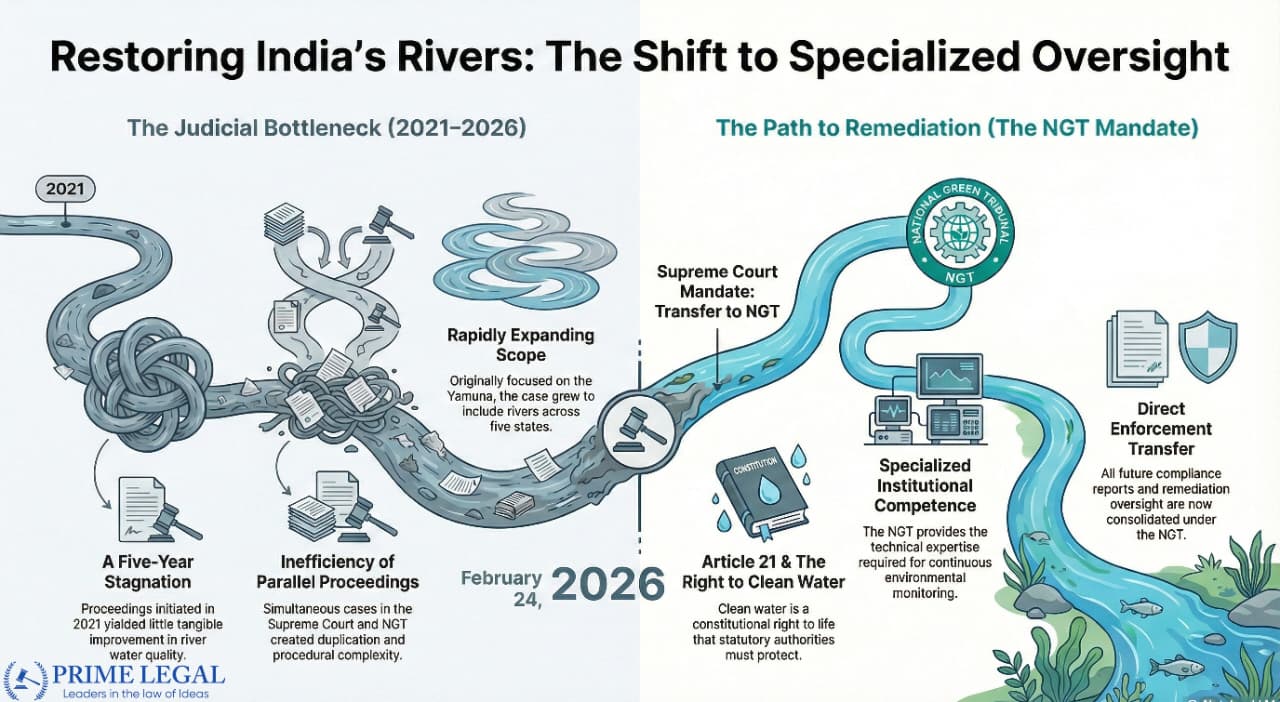
On 24th February 2026 around the closing of the Suo Motu proceedings with the Supreme Court of India titled, In Re: Remediation of Polluted Rivers (Suo Motu Writ Petition (Civil) No. 1/2021) it was directed that overall monitoring of the matter of river pollution be left to the National Green Tribunal (NGT). The Court was clear that environmental disputes concerning river pollution were within the specialized jurisdiction of the NGT under the National Green Tribunal Act, 2010, thus re-establishing the roles of the Tribunal with respect to environmental governance to the extent that it had been established under the Act.
BACKGROUND:
The Suo Motu proceedings were set in motion in January 2021 on being apprehended that there was serious pollution of the rivers, especially the Yamuna river by its contamination due to discharge of untreated sewage and industrial waste. The matter first held concerns over Delhi Jal Board and the inability of the authorities to stop the discharge of effluents.
Over a period of time, the scope of the case swelled to cover polluted rivers across a number of States including Delhi, Haryana, Uttar Pradesh, Uttarakhand and Himachal Pradesh. The Union of India, Ministry of Environment, Forest and Climate Change, Central Pollution Control Board (CPCB), and the various State Pollution Control Boards were asked to submit a report on the compliance.
Despite periodic hearings, the Court noted that long term monitoring of the situation through writ jurisdiction was not yielding the desired results and that multiple proceedings before different forums was adding to the overlap and complexity of procedure.
KEY POINTS:
- Special closure of Suo Motu Proceedings:
A Bench of Chief Justice of India Surya Kant and Justice Joymalya Bagchi finally decided to close the case 2021 suo motu in order for justice on 24 February 2026.
- Re-affirmation of the Jurisdiction of NGT:
The Court further pointed out that issues relating to abatement of pollution of the rivers and environmental compliance in terms of provisions of NGT Act, 2010 remain squarely within the purview of National Green Tribunal.
- Specialised Institutional competence:
The Bench observed that the NGT being a specialised tribunal of experts in environmental matters with technical competence is more amenable to continuous monitoring and enforcement of environmental compliance.
- Such parallel proceedings to be avoided:
Significant duplication and inconsistency of result of simultaneous proceedings before the Supreme Court and NGT was in the Court’s view. By consolidating the law before the Tribunal, uniformity is realized.
- Constitutional framework-Article 21 consideration:
The right to clean and pollution free water is part of the right to life under Article 21 of the Constitution and statutory authorities are duty bound to enforce environmental laws which includes Water (Prevention and Control of Pollution) Act, 1974.
RECENT DEVELOPMENTS:
In the last hearing 24th February, 2026, the Supreme Court noted that a long period of time (almost five years) since the initiation of the suomoto case and effective remediation requires continuing technical supervision. The Bench said that “much water has flowed” during the pendency of proceedings underlining lack of meaningful tangible improvement.
The Court ordered all the compliance reports as well as further monitoring to be placed in front of the National Green Tribunal. It made it clearer that though the appellate jurisdiction of the Supreme Court over NGT orders will continue, the major enforcement and supervision of NGT orders is to be taken up now by the Tribunal.
Accordingly, the present suo motu writ petition is disposed of and any further proceedings for abatement of pollution of rivers shall continue before the NGT in accordance with the statutory mandate.
CONCLUSION:
The order consequentially passed by the Supreme Court on 24th February 2026, affirms the statutory environment adjudication framework in an area of its specialized jurisdiction, which is pertinent to matters of river pollution. By closing its suo motu proceedings of 2021 and ordering of consolidation proceedings in front of NGT the Court has promoted institutional clearness; prevented parallel litigation and enhanced implementation of environmental laws. The Scheme reflects the fact that it remains the constitutional obligation to protect rivers emanating from the provisions of Article 21 and has to be put in place by proper means through law making.
“PRIME LEGAL is a full-service law firm that has won a National Award and has more than 20 years of experience in an array of sectors and practice areas. Prime legal falls into the category of best law firm, best lawyer, best family lawyer, best divorce lawyer, best divorce law firm, best criminal lawyer, best criminal law firm, best consumer lawyer, best civil lawyer.”
WRITTEN BY: TANUSH RAJ

