
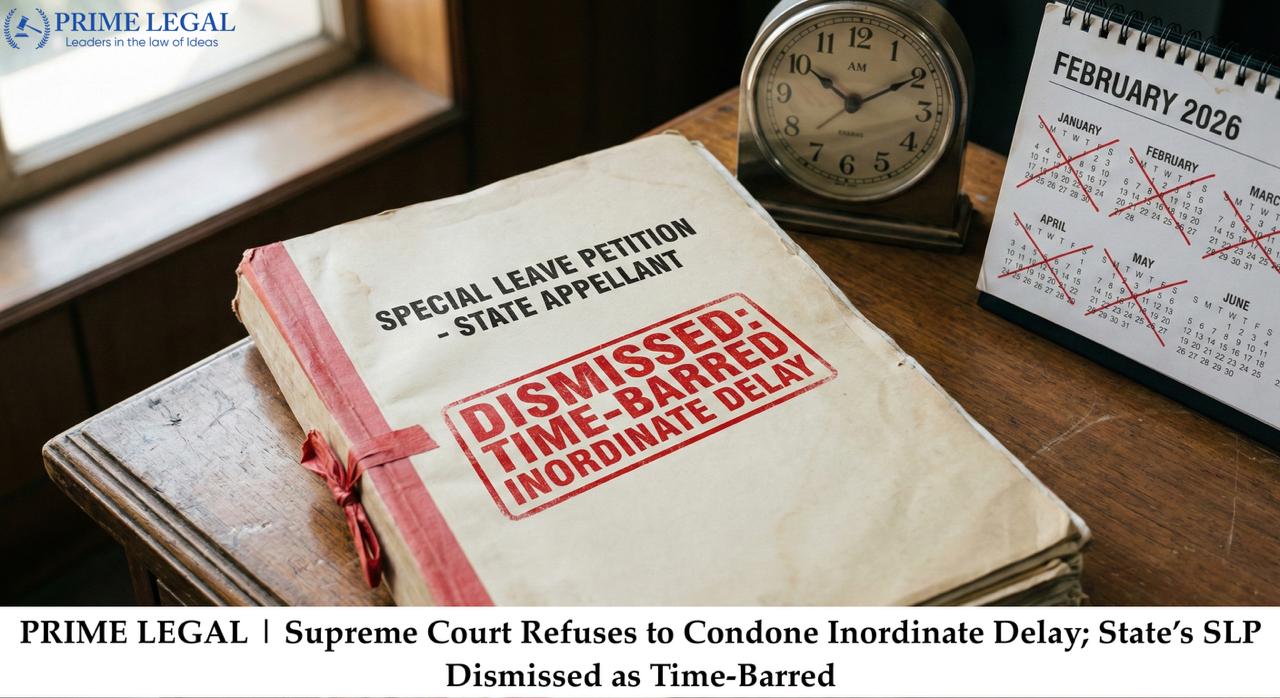
CASE NAME: State of Odisha & Others Versus Managing Committee of Namatara Girls High School
CASE NUMBER: Special Leave Petition (C) Diary No. 54941 of 2025
COURT: Supreme Court of India
DATE: 09 February 2026
QUORUM: Justice Dipankar Datta & Justice Satish Chandra Sharma
FACTS:
The Managing Committee of Namatara Girls’ High School approached the State Education Tribunal, Bhubaneswar under Section 24B of Odisha Education Act, 1969 for the grant-in-aid intended to be released from Section 24B. By order passed on 30th of December 2013, the Tribunal permitted the application and ordered the State of Odisha and the Director of Secondary Education to release grant-in-aid to the teaching and non-teaching staff. In view of the State the preferred appeal (FAO No. 582 of 2015) before High court of Orissa on 16th October 2015. However, the appeal was time barred and was not accompanied by a certified copy of the Tribunal’s order. For almost eight years, this defect remained unhealed by the State. As a result, by its order and date as of 26th April, 2023, the High Court has rejected the appeal. Thereafter, certified copy was received by the State only on 13th February, 2024 and an application for recall was filed with the application seeking condonation of delay of 291 days. On 21st February 2025, the High Court refused the application for condonation as it noted that the delay was above eleven years from the date of the original order. Aggrieved, the State filed a Special Leave Petition before the Supreme Court and it took 123 days to file and 96 days to re-file.
ISSUES:
- Whether the State of Odisha had demonstrated “sufficient cause” under Section 5 of Limitation Act, 1963 for condonation of delay?
- Whether a liberal approach should be followed in condoning delay in case the applicant is the State.
- Whether the High Court was right in rejecting the application to condone delay and dismissing the appeal as time barred.
LEGAL PROVISIONS:
- Section 24B.Odisha Education Act, 1969
Invoked by the Managing Committee before Tribunal for release of grant in-aid.
- Section 5, Limitation Act, 1963
Central to the dispute. The State depended on the elasticity of this expression “sufficient cause”, which allowed for condonation. The Court looked at whether the explanation given was a legally acceptable cause.
- Article 136 – Constitution of India
The Special Leave Petition against the judgment of the High Court refusing to condone delay was filed under this provision.
ARGUMENTS:
PETITIONER:
The State argued that the delay was procedural and it was due to administrative processes in getting permissions from the higher authorities. It relied on such precedents like the case of Collector, Land Acquisition, Anantnag v. Mst Katiji (1987) and G. Ramegowda v. Land Acquisition Officer(1988) which holds that a liberal approach should be adopted in condoning delay in case the State is the applicant. It was suggested that substantial justice should prevail over technical considerations and that the High Court should have revived the appeal for decision on merits.
RESPONDENT:
The respondent backed the judgement of the High Court which argued that the State’s conduct was lethargic and lacked diligence. The delay was not marginal but lasted for eleven years. The explanation given was routine and did not amount to “sufficient cause.” The respondent relied upon the principle that the limitation law binds the State equally and cannot be diluted to any extent.
ANALYSIS:
The Supreme Court made a diligent analysis of jurisprudence on condonation of delay. It followed the path of liberal approach taken in Katiji (1987) and Ramegowda (1988) which offered latitude to the governmental authorities having regard to bureaucracy. However the Court identified the move towards a harder test in subsequent decisions such as Postmaster General v. PlainPackage, Living Media India Ltd. of (2012), University of Delhi v. Union of India 2020, and Pathapati Subba Reddy Vs. Collector (LA) (2024).
The Court underlined that government functioning may process some amount of procedural delay, but after a certain point, judicial indulgence may not reach. It made a distinction between an actual “explanation” and an “excuse.” The State’s affidavit that was filed asserted that routine procedural delays and administrative approvals were to blame, which weren’t sufficient in this case, according to the Court. The Court noted that the State was “utterly lethargic, tardy and indolent,” in both cases before the High Court, and the Supreme Court.
Importantly, the Court reiterated that condonation of delay is a matter of discretion and not a matter of right. The elasticity of “sufficient cause” is no excuse for condoning gross negligence or institutional indifference.
JUDGMENT:
The Supreme Court denied the applications of condonation of delay in filing and re-filing the Special Leave Petition. It held that no sufficient cause has been proved as per the Limitation Act at Section 5. As a result, the Special Leave Petition was refused on the ground of being time barrelled. The Court upheld the proposition that not even the State has unlimited latitude in the guise of bureaucratic procedure.
CONCLUSION:
This judgment reinforces the principle of the equal application of limitation law to the State and private parties. While courts are allowed some leeway when considering appropriate cases of governmental delay, such leniency is not unlimited. The decision represents a strong affirmation of the fact that institutional indifference and long delays cannot be protected by the invocation of “procedural delay.” The decision enhances the prevailing tenets of discretion in adjudication regarding condonation of breaches which require balancing fairness and finality so as to uphold the integrity of limitation law and procedural discipline.
“PRIME LEGAL is a full-service law firm that has won a National Award and has more than 20 years of experience in an array of sectors and practice areas. Prime legal falls into the category of best law firm, best lawyer, best family lawyer, best divorce lawyer, best divorce law firm, best criminal lawyer, best criminal law firm, best consumer lawyer, best civil lawyer.”
WRITTEN BY: TANUSH RAJ
Click here to read the judgment.

