
INTRODUCTION:
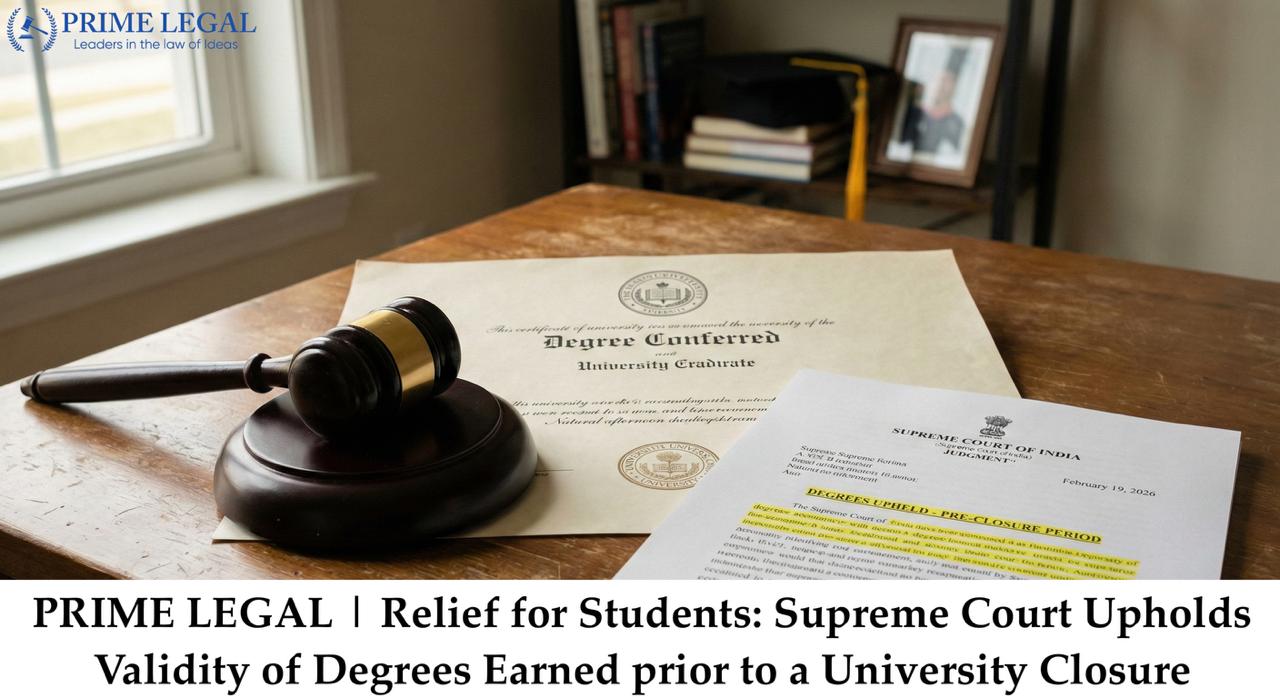
In a landmark judgement upholding the academic and professional rights and interests of students, the Supreme Court of India on 18th February 2026 in a civil case decided on Legal Validity of Degrees/Qualifications of University Students before deliverance of the University through Statutory Invalidation, established that validity of the university degrees has to be understood and considered from a broader perspective: the courts as well as the examining boards. The judgment adds a much-needed clarity to the legal consequences when striking down legislation under which private universities were set up.
By holding that qualifications obtained in the legitimate exercise of such institutions continue to be valid, the Court spared students and professionals the retrospective hardship of having to forfeit their qualifications. The decision strengthens the ideas of fairness, legal certainty and legitimate expectation in the constitutional jurisprudence.
BACKGROUND:
The case arose due to termination of services of some of the librarians in Bihar who had attained a degree of Bachelor of Library Science in the year 2004 from the University of Technology and Science, Raipur. The university had been established as per the Chhattisgarh Niji Kshetra Vishwavidyalaya Adhiniyam, 2002 which allowed the establishment of private universities in the State.
In 2005, Supreme Court in Prof. Yash Pal vs. State of Chhattisgarh made key provisions of 2002 Act inefficient against the laws of the state. As a corollary, a number of private universities set up under the Act stopped functioning.
It is important to note that the university failed not because the administrators failed in their duties to regulate or withdraw the regulations but because the parent statute itself was struck down by the Supreme Court. While students who were still pursuing their studies were allowed to migrate to recognised institutions, the issue of ambiguity remained in terms of degrees already awarded prior to invalidating the statute in question.
Years later the Degrees of the Librarians were struck down by the State authorities on the mere grounds that the enabling legislation had been declared unconstitutional. Patna High Court upheld termination of their services and the result was that an Appeal was filed in Supreme Court.
KEY POINTS:
- Judgment Downtoned 18th of February 2026:
On 18th February 2026, a bench sitting with Justice Rajesh Bindal and Justice Vijay Bishnoi gave the judgment in the case of Priyanka Kumari & Ors Vs. State of Bihar & Ors.
The Supreme Court categorically observed that degrees earned before the university came to be rendered defunct are valid and enforceable for the purposes of employment and otherwise.
- Validity of Degrees Earned Prior To Closure:
The Court explained that when the students finished their work and graduated, the university was operating on a valid statutory basis. Therefore the subsequent declaration of unconstitutionality of the parent Act does not retroactively invalidate those degrees.
The argument that everything done pursuant to the struck-down statute was automatically void ab initio was rejected by the bench. It emphasised here that the rights and qualifications that had crystallised during the period of lawful operation cannot be extinguished just on the ground that the statute came later to be invalid.
In simple words, the Court held that closure of a University, after the invalidation of the lawfulness of such closures, does not remove the degrees legally conferred prior to the closure of the closed.
- Good Faith, Constitutional Fairness:
A very important factor in the reason was that there was no allegation of fraud, misrepresentation or irregularity in the award of degrees. The students had enrolled, studied and graduated in good faith. Penalising them several years later would violate the principles of fairness, equality under Article 14 of the Constitution.
The Court recognised that the situation of those who rely upon a law while it is in force could not be disadvantaged retrospectively as a result of later constitutional adjudication.
- Relief Granted:
The Supreme Court ordered reinstatement of the appellants with continuity of service. However, it made clear that they would not be entitled to back wages for the period of their remaining out of employment. This type of balanced approach ensured justice to the employees while keeping the administrator fair.
RECENT DEVELOPMENTS:
The judgment given on 18th February 2026 ends all ambiguity in the Status of Degrees awarded before university closures in statutory invalidation. By reversing the ruling of the Patna High Court, the Supreme Court has brought enormous relief to the professionals, whose employment was being made a victim just because the parent legislation was struck down.
The ruling has wider implications for service jurisprudence and higher education regulation especially for dissolution of private institutions due to constitutional scrutiny. It indicates that constitutional invalidation of a statute will not automatically nullify vested academic rights acquired in good faith when it was in operation.
CONCLUSION:
The decision by the Supreme Court is an important reaffirmation of legal certainty in the jurisprudence of higher education and service. By affirming the validity of degrees coined before the university became defunct, the Court ensured that students avoid being unjustly retroactively penalized, and that it also affirmed the right to judicial invalidation of legislation to not be treated as automatic retroactive invalidation of finished academic qualifications.
The ruling boosts the credibility of academic qualifications and affirms the role of the judiciary towards making sure that constitutional review functions fairly and justly.
“PRIME LEGAL is a full-service law firm that has won a National Award and has more than 20 years of experience in an array of sectors and practice areas. Prime legal falls into the category of best law firm, best lawyer, best family lawyer, best divorce lawyer, best divorce law firm, best criminal lawyer, best criminal law firm, best consumer lawyer, best civil lawyer.”
WRITTEN BY: TANUSH RAJ

