
ABSTRACT
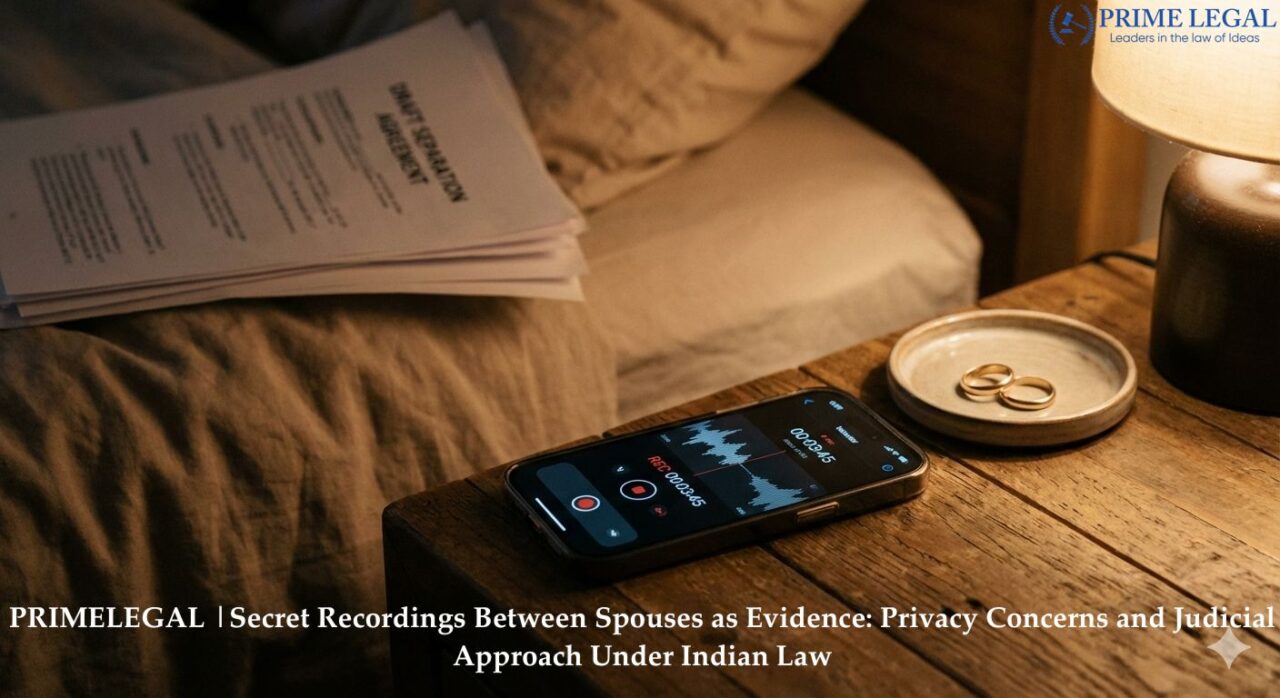
The rise of portable technology has increased the incidence of secret recordings in matrimonial disputes, and this has raised several concerns about marital privacy, admissibility of evidence, and child welfare. This paper will explore the conflict between privacy and truth-seeking through a comparative analysis of judicial responses to secret recordings in matrimonial disputes in India, the United Kingdom, and the United States.
KEYWORDS
Marital privacy, Secret recordings, Electronic evidence, Right to privacy, Matrimonial disputes, Admissibility of evidence
INTRODUCTION
The advent of portable technology has completely changed the landscape of matrimonial disputes. In a world where almost everyone owns a mobile phone, the capacity to secretly record a spouse or partner has become a ubiquitous, but highly dangerous, means of gathering evidence. The litigant may genuinely believe that the only way to prove “the other side” of a spouse’s personality or to prove the behaviours that occur behind closed doors and are later denied in court is to secretly record them. However, the use of such evidence is fraught with a complex interplay of the right to privacy, the rules of evidence, and the best interests of children.
THE FUNDAMENTAL CONFLICT: PRIVACY VS. TRUTH-SEEKING
The conflict at the heart of the debate about secret recordings is a conflict between two fundamental principles of law: the right to privacy and the pursuit of truth. In many countries, marriage is considered a relationship founded on trust and a shared right to privacy. The act of secretly recording a spouse is often considered a serious violation of trust and a possible right to privacy.
In India, for example, the historic case of Justice K.S. Puttaswamy has recognized the Right to Privacy as a fundamental right under Article 21 of the Indian Constitution. This has triggered a great deal of judicial controversy over whether evidence obtained in violation of this right, for example, a secretly recorded spouse, should be allowed to be admitted. On the other hand, the Indian Evidence Act, 1872, has emphasized the relevance of evidence to the facts of the case, traditionally taking the stance that relevant evidence is admissible regardless of improper means of obtaining it.
THE JUDICIAL PERSPECTIVE IN THE UNITED KINGDOM: DISCRETIONARY ADMISSIBILITY
In England and Wales, the Family Court does not favour the use of covert recordings, considering them unethical and not conducive to the aim of encouraging cooperation between the parties. These recordings are, in fact, hearsay evidence and are not automatically admissible until the court grants the parties permission to use them.
However, despite this cautious approach at the outset, the UK courts have been receptive to allowing recordings if they offer “illuminating” evidence that is “crucial” to a “just determination. For instance, in the case of Medway Council v A and Others (Learning Disability: Foster Placement) EWFC B66, the conversations of a foster carer were secretly recorded, which exposed the vicious verbal attacks that had been overlooked by professionals. The court held that without the recordings, it would have been impossible to gain a just and proper understanding of the case. In another case, Re F (EWHC 2149 (Fam)), a mother secretly recorded a consultation with an expert psychologist who was found to have made up direct quotes in his report, which led to severe criticism of the expert’s evidence.
THE INDIAN SCENARIO: CONSTITUTIONAL PROVISIONS AND KEY CASES
The admissibility of spousal recordings in India is a very highly complex issue, with like about 70% of spousal recordings being challenged on the basis of authenticity or relevance. While the Madras High Court has held that “spousal privacy” is a guaranteed right and that “snooping” will only result in the destruction of the marital life fabric, other decisions have taken a different turn.
A major change came with the case of Neha v. Vibhor Garg, SLP (C) No. 21195 of 2021. The Supreme Court of India held that secretly recorded conversations may be considered admissible in matrimonial disputes, including those related to allegations of cruelty. The Court held that a tape recorder is a “disinterested witness,” removing the recording from the ambit of the marital privilege, which is meant to safeguard communications in order to preserve the institution of marriage, rather than to protect the absolute privacy of the individual. Nevertheless, this decision has been widely criticized for weakening the constitutional protections within the home.
UNITED STATES JURISDICTIONAL VARIATIONS: CONSENT AND MONITORING
In the United States, the application of secret recordings is highly jurisdiction-dependent. In Florida, a “two-party consent” state, it is unlawful to record any oral communication unless all parties consent. The secretly recorded conversation of a spouse within a private residence, where a “reasonable expectation of privacy” exists, may result in criminal sanctions and the exclusion of the evidence from trial.
Michigan’s statute contains this odd “Sullivan anomaly.” Under the state’s eavesdropping act, recording or listening to a conversation is normally permissible if done by a party to the conversation themselves (participant monitoring). However, if a party permits a third party to record the conversation, that’s deemed to be consensual monitoring and is prohibited because the third party is the eavesdropper. Federal regulations (Title III) permit recording with one party’s consent, but Michigan attorneys should note that state law may be more stringent. Federal law (Title III) allows recording with one-party consent, although Michigan attorneys must remember that state law may be more restrictive.
THE EVIDENTIAL CHECKLIST: CRITERIA FOR ADMITTING A RECORDING
In most cases, when a party wants to admit a secret recording, the court will examine it using a tough checklist:
- Relevance: The recording must relate to a disputed issue, such as an admission of cruelty or financial impropriety.
- Reliability and Authenticity: The party must show that the recording is authentic and has not been altered, edited, or manipulated using software. In India, a Section 65B certificate is necessary to authenticate the origin and integrity of electronic evidence.
- Probative Value vs. Abusive Conduct: The court weighs the value of the evidence against the possible abuse of the recording method.
- Proportionality: The court will determine whether the cost of having experts listen to the recording is proportionate to the value of the evidence.
- Completeness: Editing or clipping the recording is not advisable. The party must offer the complete recording and transcript.
- Completeness: Partial recordings are not favoured, and recordings and transcripts must be made available in unedited form.
THE “NUCLEAR OPTION”: RECORDING CHILDREN AS EVIDENCE
The recording of children using hidden recording devices is a very serious issue and is almost always discouraged. Justice Jackson stated that using a recording device on a child is “almost always likely to be wrong.” This is often considered emotionally damaging because it creates secrets that can damage a child’s ability to trust others and can be considered a type of abuse.
When parents have used hidden recording devices on a child, the recordings are admitted into evidence only with great reluctance, and it is considered that the action itself can damage the parent’s own case as a parent. If a court believes that a parent has used a child as a means of obtaining evidence, this is considered evidence of a controlling or manipulative motive and can damage the parent’s suitability as a parent for child arrangements.
THE CREDIBILITY TRAP: WHEN RECORDING BACKFIRES
The use of secret recordings is a very risky tactic that can easily backfire. The courts often consider secret recordings to be evidence of bad faith, poor conduct, or controlling behaviour. Instead of revealing the other spouse’s shortcomings, the recording may inadvertently reveal the shortcomings of the person recording the evidence or indicate that “bad behaviour” was a two-way street. And if the person recording the evidence spends the dispute recording everything on camera while the child is present, instead of removing the child from the situation, the courts may question the person’s priorities.
PROCEDURAL HAZARDS AND LEGAL CONSEQUENCES
The path to using secret recordings is fraught with procedural hazards. In India, an erroneous transcript or the lack of the required Section 65B certificate will make the evidence impossible to use. In the UK, the use of recordings at the “extreme lateness” of a week before the hearing is considered to be in very poor taste, even if they are accepted as evidence. Additionally, using or distributing the recordings inappropriately may constitute a breach of data protection or privacy rights, potentially giving rise to civil claims or concurrent litigation.
CONCLUSION: A RULE OF CAUTION
Although secret recordings may occasionally prove to be the “smoking gun” that brings justice to the wronged spouse, especially in cases of hidden abuse, they are usually a last resort. Attorneys recommend exercising caution in the use of secret recordings. Parties are encouraged to consult with an attorney before making the recording, as other, less risky, and more reliable methods of gathering evidence are available, such as written statements, emails, text messages, or observations from objective third-party witnesses. In the end, the risk that the secret recording may damage the credibility of the party or result in high legal costs may very well outweigh the benefits of the evidence.
“PRIME LEGAL is a National Award-winning law firm with over two decades of experience across diverse legal sectors. We are dedicated to setting the standard for legal excellence in civil, criminal, and family law.”
WRITTEN BY: USIKA K

