
INTRODUCTION
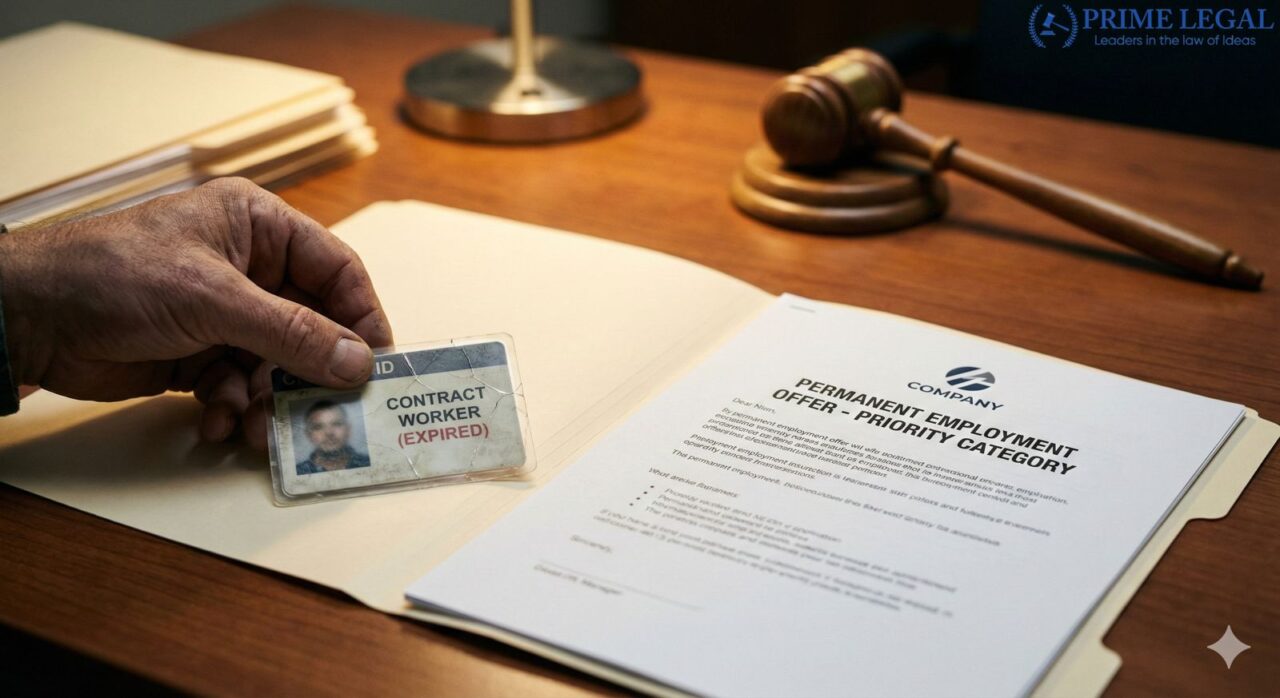
In a landmark decision on the contractual rights of contract workers, the Supreme Court of India has held that the principal employers are bound by law to give preference to the erstwhile contract workers while appointing regular workers for the work hitherto done by contract workers. While reaffirming that there is no automatic absorption of contract workers on the cessation of the contractual agreement, the Court held that the displaced contract workers cannot be ignored in favour of new entrants from the open market.
A Bench of Justice Pankaj Mithal and Justice S.V.N. Bhatti allowed the appeal against the interim relief granted by the Industrial Court and confirmed by the Bombay High Court under Section 33(1) of the Industrial Disputes Act, 1947 (ID Act). The Court held that the protection under Section 33(1) is available only after the employer-employee relationship is admitted or established. The decision reaffirms the principles laid down in Steel Authority of India Ltd. v. National Union Waterfront Workers (2001) 7 SCC 1.
BACKGROUND
The dispute arose from the Aurangabad plant of M/s Premium Transmission Private Limited, where 118 workers were employed through registered contractors for regular and continuous work since about 2018. In April 2020, the company terminated the contract labor employment and began hiring regular workers for similar work.
The aggrieved workers, through their union, filed an industrial dispute claiming unfair labor practices in contravention of the Industrial Disputes Act and the Maharashtra Recognition of Trade Unions and Prevention of Unfair Labour Practices Act, 1971. The case was referred as to the Industrial Court.
During this time, the workers filed Complaint (IT) No. 1 of 2022 under Section 33-A of the ID Act, claiming that the employer had changed the service conditions to their detriment during the pendency of the case without seeking prior permission, contrary to Section 33(1). On January 17, 2023, the Industrial Court ordered the company to provide work and pay salaries to the workers. The Bombay High Court rejected the employer’s appeal on March 21, 2023, and the appeal is now before the Supreme Court.
KEY POINTS
The Supreme Court allowed the appeal and held that Section 33(1) of the ID Act cannot be invoked at the interim stage, as the existence of the employer-employee relationship itself is in dispute. Otherwise, the interim reinstatement and payment of wages would amount to the grant of final relief. The Court drew a distinction between a genuine contract labour arrangement and a sham or camouflage contract. The court reiterated that if, on evidence, a contract is held to be a mere camouflage and the principal employer had exercised full control and supervision over the workers, the contract would be ignored, and the workers would be entitled to regularisation, continuity of service, and back wages.
In instances where the contract labour is validly discontinued, the Court held that there is no automatic absorption. After the SAIL judgment, it held that:
- If the principal employer decides to hire regular workers for the work previously done by contract labour, the latter contract workers should be given preference.
- The principal employer cannot appoint new workers from the open market while ignoring the contract workers who have been displaced.
- To give effect to the preference, relaxation in age and educational requirements, especially for non-technical positions, may be allowed.
RECENT DEVELOPMENTS
This decision assumes special importance in the context of the continued concerns about the insecurity of contract labour in India, which constitutes a large part of the industrial workforce. The decision seeks to discourage the tendency to displace experienced contract workers with new ones, while ensuring that interim relief is not used to forestall the determination of contentious employment relationships. Through the reaffirmation of the SAIL guidelines, the Court has clarified the contract workers’ remedies while maintaining the distinction between regulatory safeguards and automatic regularization.
CONCLUSION
In disregard of the interim orders of the Industrial Court and the Bombay High Court, the Supreme Court allowed the workers the liberty to seek appropriate relief in accordance with the settled legal position before the Industrial Court.
“PRIME LEGAL is a National Award-winning law firm with over two decades of experience across diverse legal sectors. We are dedicated to setting the standard for legal excellence in civil, criminal, and family law.”
WRITTEN BY: USIKA K

