
CASE NAME: Impresario Entertainment and Hospitality Pvt. Ltd. Vs M/S The Shake Social
CASE NUMBER: CS(COMM) 121/2025
COURT: The High Court of New Delhi
DATE: 09.01.2026
QUORUM: Hon’ble Mr Justice Tejas Karia
FACTS
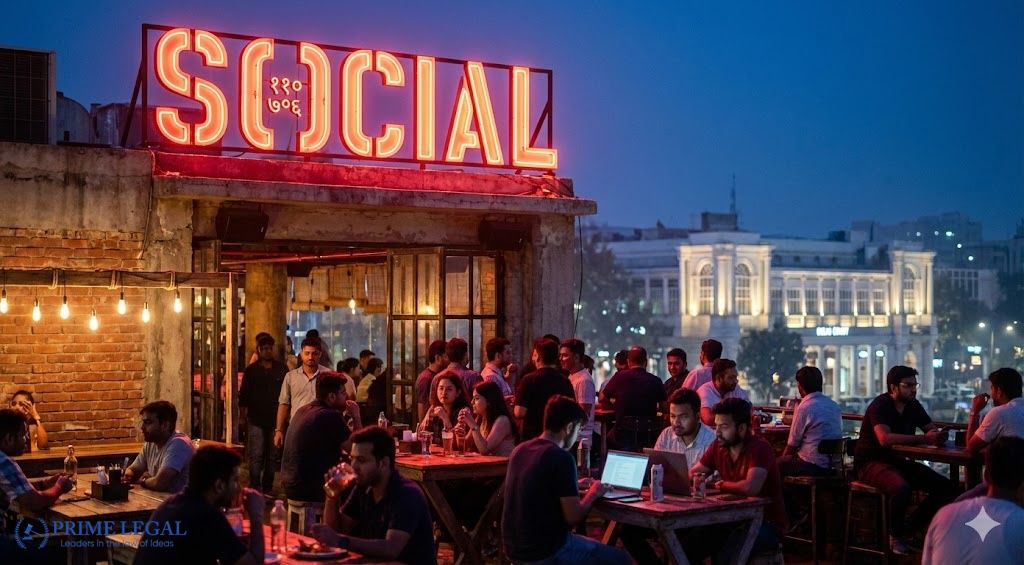
The plaintiff has filed this lawsuit seeking the grant of permanent and mandatory injunctions against alleged infringement of the “SOCIAL” trademark, copyright infringement, passing off, dilution, unfair competition, accounting, and damages. The Plaintiff operates a restaurant and hospitality service and chose the “SOCIAL” trademark for its unique café-workspace model. It opened its first outlet in Bengaluru in the year 2014. Currently, the Plaintiff has fifty-five restaurants and bars in India operating under the Plaintiff’s marks and has also developed substantial goodwill and reputation. The Plaintiff expanded its business across India by opening multiple outlets bearing the same mark, and often the name of the locality was prefixed to indicate geographical presence.
In August 2022, the Plaintiff came to know that the Defendant was running restaurants/cafes under the mark ‘THE SHAKE SOCIAL’ in Valsad and Navsari, Gujarat, and was marketing the same on platforms such as Zomato, Swiggy, Google Maps, Justdial, Facebook, and Instagram. The Defendant had also filed an application for trademark registration of the impugned mark in Class 43. In spite of cease-and-desist notices issued by the Plaintiff, the Defendant did not comply.
Procedurally, although the summons was served, the defendant neither appeared nor filed any written statement. Thereafter, the defendant was proceeded ex parte, and the right to file written statements was closed.
ISSUES
- Whether the Defendant infringed the Plaintiff’s registered trademarks and committed passing off.
- Whether the Defendant’s adoption of the challenged mark was likely to cause confusion and to dilute the Plaintiff’s goodwill.
- Whether plaintiff’s marks are “well-known marks” as defined under Section 2(1) (zg) of the Trade Marks Act, 1999.
- Whether the Plaintiff is entitled to the injunctive relief sought.
Legal Provisions
- Section 2(1)(zg), Trade Marks Act, 1999 – Definition of “well-known trademark”
- The Principles on trademark infringement, passing off, dilution, and consumer confusion
- Delhi High Court (Original Side) Rules, 2018, Rule 3 – Deemed admission of documents in the absence of affidavit of admission/denial
ARGUMENTS OF THE PLAINTIFF
The Plaintiff contended that it is the registered proprietor of the marks ‘SOCIAL’, which have been continuously and extensively used since 2014. The Plaintiff’s marks had acquired immense goodwill and reputation in the hospitality industry by reason of long-standing use, nationwide presence, substantial turnover, and high promotional expenditure.
It was contended that the Defendant belonged to the same trade and had used the impugned mark dishonestly to ride upon the Plaintiff’s reputation. The Plaintiff pointed out that the services of the Defendant were being advertised on the identical channels of trade that were likely to mislead customers. The Plaintiff submitted that the inferior quality of the services offered by the Defendant also diminished Plaintiff’s goodwill.
Moreover, the Plaintiff had contended that its marks met all statutory requirements under the Trade Marks Act to be declared well-known, backed by revenue figures, promotional expenses, and prior enforcement actions.
ARGUMENTS OF THE DEFENDANT
No such arguments were advanced by the Defendant. The Defendant never appeared before the Court and did not file any written statement. Hence, all the averments in the Plaint and the documents filed by the Plaintiff were deemed to be admitted.
ANALYSIS
The Court observed that, in the absence of the Defendant and due to his failure to contest the suit, the averments made in the Plaint stood admitted. From the pleadings and documents, the Court found that the Plaintiff was the registered proprietor of the trademarks and he had acquired considerable goodwill and reputation through long, continuous and nationwide use.
The Court held that the adoption of the impugned mark by the Defendant would result in a likelihood of confusion being caused in the minds of the public at large because the parties were operating within the same industry, offered identical services, and used similar trade channels to reach the same consumer base. It was held that the Defendant was passing off their goods by misappropriating the Plaintiff’s goodwill and therefore eroded consumer trust by diluting the brand.
On the question of the claim for well-known status, the Court did place reliance on continuous use by the plaintiff since 2014, substantial turnover, sufficient promotional expenditure, recognition in the industry, and continuous enforcement of trademark rights. Such factors ensured the satisfaction of the statutory requirement under Section 2(1) (zg).
JUDGMENT
The Court granted the reliefs sought by the Plaintiff in Paras 70(A) to (C) of the Plaint. It issued an injunction against the Defendant from infringing and passing off the Plaintiff’s trademarks. It also declared the Plaintiff’s marks “SOCIAL” as a well-known trademark under the Trade Marks Act, 1999. No order for costs or damages was made.
CONCLUSION
This judgment highlights the strong protection afforded by the courts to well-established trademarks in India, particularly in cases of malicious adoption and consumer confusion. The Court pointed out that extensive use, goodwill, and reputation throughout the country are necessary for a mark to be accorded well-known status. It also draws attention to the consequences when defendants fail to appear in intellectual property disputes.
“PRIME LEGAL is a full-service law firm that has won a National Award and has more than 20 years of experience in an array of sectors and practice areas. Prime legal falls into the category of best law firm, best lawyer, best family lawyer, best divorce lawyer, best divorce law firm, best criminal lawyer, best criminal law firm, best consumer lawyer, best civil lawyer.”
WRITTEN BY: USIKA K

