
INTRODUCTION
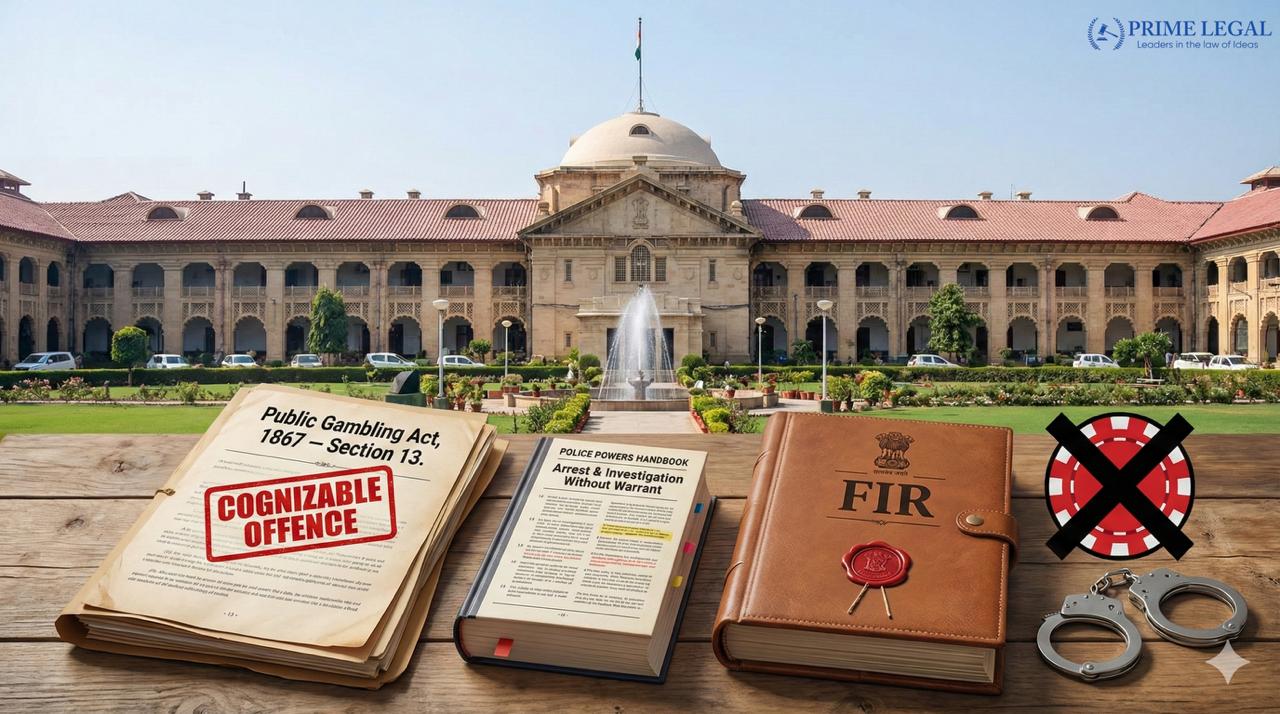
The Allahabad High Court has clarified that offences under Section 13 of the Public Gambling Act, 1867, are cognizable. In simpler terms, this gives the police the authority to file an FIR and arrest an accused without needing a court-issued warrant. The ruling finally clears up years of confusion about how much power the police truly have in tackling gambling-related offences. By linking Section 13 to the provisions of the Code of Criminal Procedure, 1973, the Court reaffirmed that gambling laws are built for swift enforcement—allowing police to act immediately and dismantle illegal operations before they grow.
BACKGROUND
The case hit the Allahabad High Court when the accused pushed back hard on Section 13 charges from the Public Gambling Act. They said it was non-cognizable, so cops couldn’t move without a court’s say-so first. The State hit back strongly, saying the cops were completely right—Section 13’s penalties line up with CrPC rules for cognizable cases, letting them file FIRs and make arrests without warrants.
KEY POINTS
1.The Court spelled it out : Section 13’s punishment fits right into CrPC’s cognizable offence category.
2.As a result, such cases empower the police to take immediate action without waiting for judicial authorization.Police gain solid authority to file FIRs, investigate, and arrest on the spot—no warrants needed for a swift takedown.
3.It brushed aside the “silence in the Act” claim, emphasizing that classification turns on the penalty and CrPC guidelines, not gaps in special laws.
4.The police actions against the accused were spot-on, with no irregularities.
RECENT DEVELOPMENTS
This ruling gives police stronger powers to raid public gambling spots right away, dodging the red tape that used to slow them down. Legal experts see it as a key precedent for clearing up fuzzy offence labels in other special laws. The Allahabad High Court’s ruling wipes out years of confusion on Section 13 offences under the Public Gambling Act—they’re cognizable. This lets police dive in fast and firm, skipping the needless red tape that slowed them down before.
CONCLUSION
By meshing the Gambling Act with CrPC fundamentals, the decision clears up law enforcement’s edge and seals off the dodges crooks used to stall probes. It’s a no-frills boost for hammering illegal betting with quicker, harder hits.
“PRIME LEGAL is a full-service law firm that has won a National Award and has more than 20 years of experience in an array of sectors and practice areas. Prime legal falls into the category of best law firm, best lawyer, best family lawyer, best divorce lawyer, best divorce law firm, best criminal lawyer, best criminal law firm, best consumer lawyer, best civil lawyer.”
WRITTEN BY: ARCHITHA MANIKANTAN

