
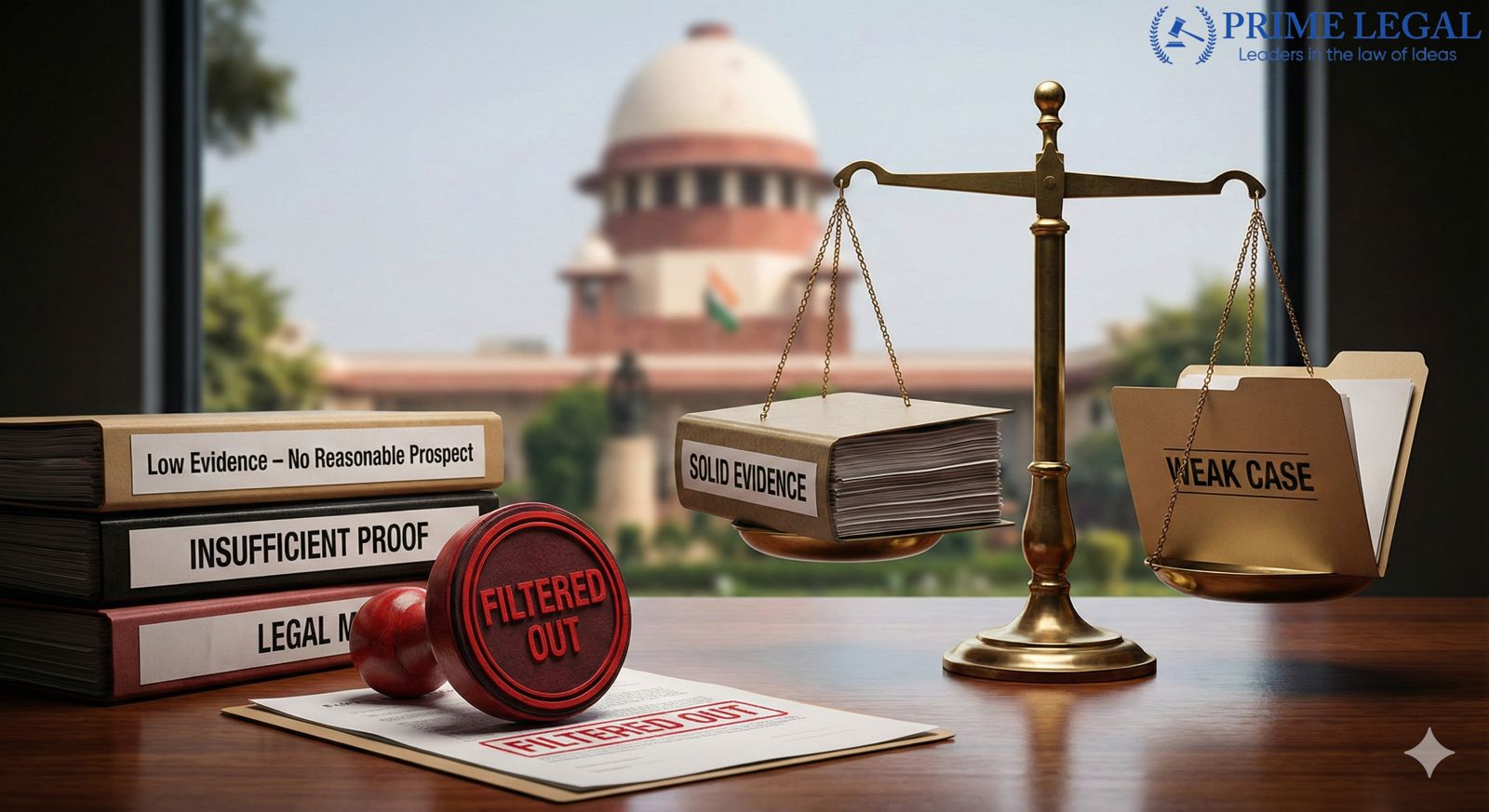
CASE NAME: Tuhin Kumar Biswas @ Bumba v/s State of West Bengal
CASE NUMBER: Criminal Appeal No. 5146 of 2025
COURT: Supreme Court of India
DATE: 02 December 2025
QUORUM: Justice Manmohan, Justice Nongmeikapam Kotiswar Singh
FACTS
The appellant and his father were joint possessors of a property at CF-231, Salt Lake, Kolkata shared with another co-owner due to an injunction order in a pending civil suit. The case originated from an FIR lodged on March 19, 2020 with Police Station Bidhannagar North. The complainant Ms. Mamta Agarwal claiming to be a tenant of Mr. Amalendu Biswas (one of the co-owners of the property in Salt Lake) alleged that on March 18, 2020 the appellant restrained her from entering the property. She further claimed that the appellant intimidated her and clicked pictures and videos without her consent thereby outraging her modesty.
The police filed a chargesheet despite the complainant’s unwillingness to make a judicial statement, for offences punishable under Section 341 of IPC for wrongful restraint (currently Section 126 of BNS), Section 354C for Voyeurism (currently Section 77 of BNS), Section 506 for Criminal Intimidation (currently Section 351 of BNS). The appellant sought discharge, which was rejected by the Trial Court and subsequently the Calcutta High Court, leading to the present appeal before the Supreme Court.
ISSUES
- Whether the FIR and chargesheet disclosed the offence of voyeurism under Section 354C of IPC.
- Whether the essential ingredients of criminal intimidation under Section 506 of IPC were made out.
- Whether the offence of wrongful restraint under Section 341 of IPC was disclosed
- Whether, in the absence of strong suspicion the appellant was entitled to discharge
LEGAL PROVISIONS
- Section 354C of IPC/ Section 77 of BNS (Voyeurism) – Capturing images of a woman engaged in a “private act”.
- Section 506 of IPC/ Section 351 of BNS (Criminal Intimidation) – Threat of injury to a person, reputation or a property.
- Section 341 of IPC/ Section 126 of BNS (Wrongful Restraint) – Preventing someone from going somewhere where they have a right to go.
ARGUMENTS
APPELLANT
Counsel for the appellant argued that the complainant was not a tenant as no tenancy document was submitted to support her claim of having legal rights to enter the property. The property was subject to a civil dispute between two brothers, Mr. Bimalendu Biswas and Mr. Amalendu Biswas. It was submitted that the civil court injunction required the co-owners to maintain joint possession and prohibited creation of third party rights, which meant that introducing a tenant would have violated the court’s order. It was further argued that the allegations under Section 354C of IPC was unfounded as no photographs were placed on record and there was no suggestion that the complainant was engaged in any “private act”. The prosecution’s case was further weakened due to absence of a judicial statement by the complainant to support the FIR which she had declined to provide under Section 164 of CrPC.
RESPONDENT
The State contended that the complainant was a prospective tenant, a fact acknowledged by the co-owner Amalendu Biswas, and therefore her presence at the property could not be dismissed. The counsel for the Respondent-State further contended that the provided materials were sufficient to make a prima facie case under Section 341 and 506 of IPC. It relied on the High Court’s finding that truthfulness of allegations had to be considered, and if accepted the Supreme Court was expected to determine whether they warrant a trial.
ANALYSIS
Upon considering the arguments advanced and the materials submitted, the court examined the legal principles using its precedents like Ram Prakash Chadha vs. State of UP 2024 INSC 522 and Union of India vs. Prafulla Kumar Samal (1979) 3 SCC 4. The court reiterated the principles governing discharge which stated that while the presence of strong suspicion is integral for discharge, it must be based on materials capable of becoming admissible evidence. The Court held that voyeurism involves watching or capturing a woman engaged in a “private act” as defined in the statute. The FIR contained no information about the complainant being in any such situation. The High Court had also noted that Section 354C of IPC was not made out clearly. Regarding the charge on Criminal Intimidation, the court also identified that the FIR and chargesheet were silent on the specific words which were used to intimidate the complainant or threaten her body, reputation or property in any manner. Therefore the essential ingredients for criminal intimidation were missing. The court further noted that wrongful restraint requires that the complainant had a “right to proceed” in the direction obstructed. It found that the complainant was not a tenant and she had come to merely see the property and thus, she had no right to enter whereas the appellant believed in good faith that he has a lawful right to prevent unauthorized entry. The court criticized the tendency to file chargesheets in matters where no strong suspicion is involved. It is said to clog the judicial system and such practices burdens courts and wastes judicial resources.
JUDGEMENT
The Supreme Court allowed the appeal, set aside the High Court judgement and discharged the appellant from G.R Case No. 223 of 2020. The court held that the FIR and chargesheet did not disclose any offence under Section 341, 354C or 506 of IPC.
CONCLUSION
The judgement reinforces that prosecution cannot proceed without strong suspicion of claims backed by legally admissible material. The Bench also highlighted the need for the Police and the Trial court to be cognizant as there was a pending civil dispute with regard to the property in question, as well as the subsisting injunction order. It lays down the specific ingredients which are essential for offences such as voyeurism, criminal intimidation and wrongful restraint.
“PRIME LEGAL is a full-service law firm that has won a National Award and has more than 20 years of experience in an array of sectors and practice areas. Prime legal falls into the category of best law firm, best lawyer, best family lawyer, best divorce lawyer, best divorce law firm, best criminal lawyer, best criminal law firm, best consumer lawyer, best civil lawyer.”
WRITTEN BY: ARCHITHA MANIKANTAN

