
INTRODUCTION
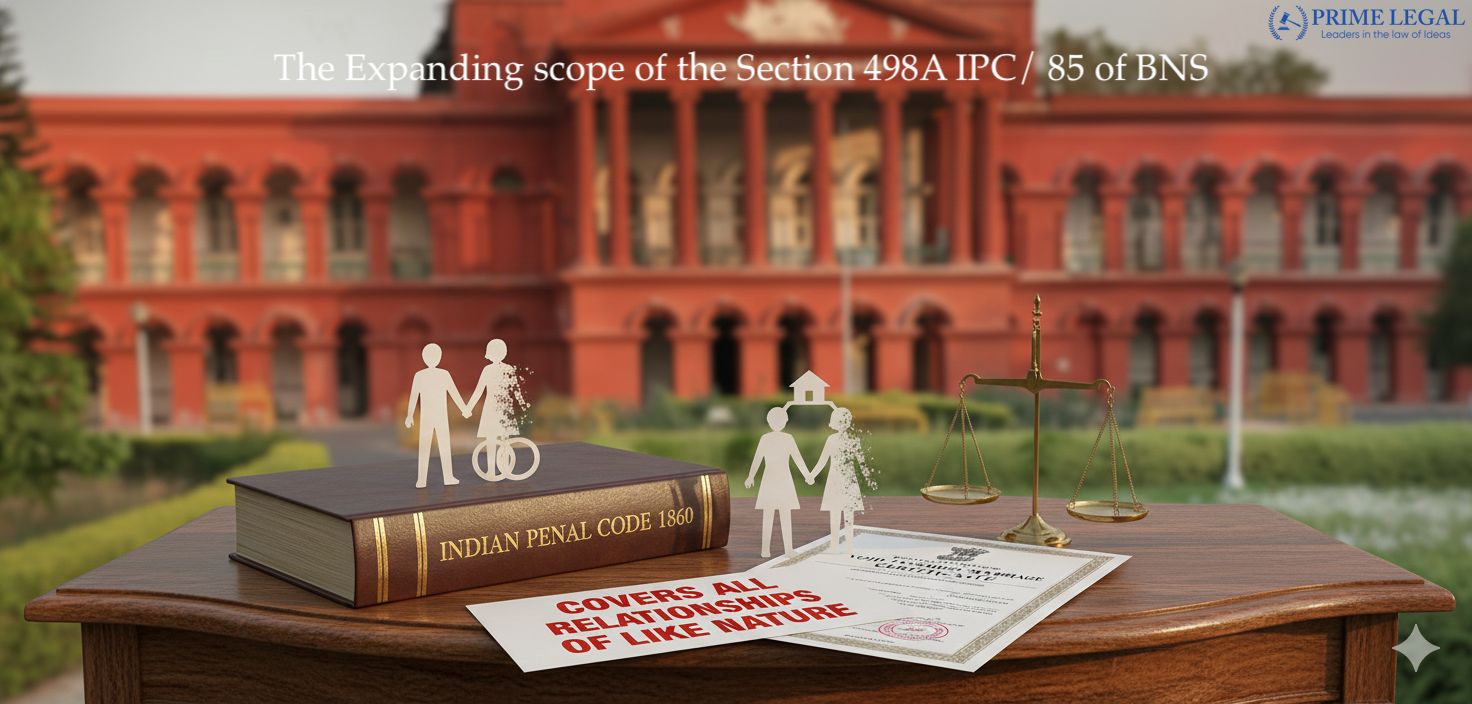
A single judge bench of the Karnataka High Court in Dr. Lokesh B H and Ors vs State of Karnataka (NC:2025:KHC:47594), broadened the definition of the term ‘Husband’ under section 498A of the erstwhile IPC (now under section 85 of BNS). The judgment aimed to uphold the legislative intent of the section and thereby included any relation that is in the nature of marriage under the purview of section 498A, provided the essentials of cruelty are met.
BACKGROUND
In the present case, the petitioner i.e. Teertha was married to Dr. Lokesh on 17th of October 2010 as per the Hindu customs and rituals. She was then staying with the respondent in Shivamogga. Subsequently, Teertha was subjected to cruelty by her husband for the want of dowry, and he also attempted to kill her by setting her ablaze with Kerosene. Nevertheless, she was rescued. She thus files a suit under Section 498A of the IPC.
The applicability of the section was contended by the respondent as he was already married to Smt. Naveena had consummated the marriage. He thus contends the marriage to be void as per section 5 of the Hindu Marriage Act and therefore, relied on the non-applicability of section 498A as it states the ‘Husband or his relatives’. Accordingly, the court now had to determine the applicability of section 498A.
Key Points
The High Court of Karnataka, after listening to both sides of the arguments, set aside the technical arguments made by the respondents and made the following observations:
- Laid importance on the legislative intent.
The court interpreted the intention of the legislature. It upheld the purpose of the section was to curb the social evil, i.e., ‘dowry’, which can be caused by any person who is not only a lawful husband but also a person acting as a husband under a void or voidable marriage.
- Expanded the scope of the husband.
The court broadened the scope of Section 498A of the IPC. It ordered that the applicability of the section is not only limited to a lawful husband but also to a husband under a void or voidable marriage, or when the relationship between the parties is similar to marriage, i.e. living relationship.
- Prevention of fraud and an escape mechanism.
The decision was largely based on the prevention of fraud. It also prevented the escape route of section 498A of IPC i.e. if a man with the knowledge of a void/voidable marriage could deftly abuse the wife for dowry and still be prevented from the applicability of this section. Thus, it prevented the escape mechanism.
- Substance over Form.
The court emphasized the nature and substance of the relationship between the parties. It did not stick to its traditional application of the word husband rather looked into the manner of the relationship between them.
Recent Developments
The court not only prevented the escape mechanism under section 498A but also prevented the voiceless women under the notion of marriage. It also included the voices of women who were in a living relationship. Thus, the court rightly highlighted the significant evolution in the judicial understanding of domestic relationships.
Conclusion
It could be concluded that the Karnataka High Court has significantly broadened the applicability of Section 498A of the IPC by ensuring that women in a relationship in the nature of marriage are protected under the social evil of dowry. The judgment reinforces the nature and substance of the relationship rather than the legality of marriage while determining the penal provisions of cruelty.
“PRIME LEGAL is a full-service law firm that has won a National Award and has more than 20 years of experience in an array of sectors and practice areas. Prime legal falls into the category of best law firm, best lawyer, best family lawyer, best divorce lawyer, best divorce law firm, best criminal lawyer, best criminal law firm, best consumer lawyer, best civil lawyer.”
WRITTEN BY: SHARANYA M

