
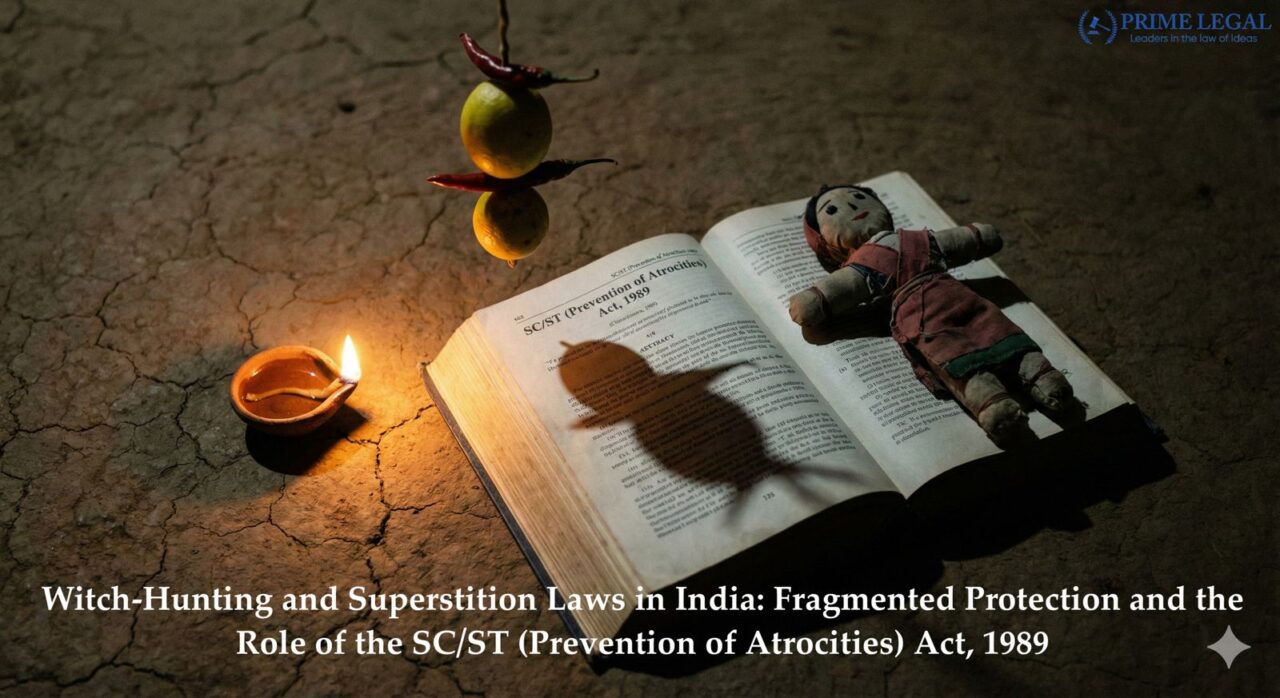
ABSTRACT
The occurrences of witch hunting and superstition-based violence against women remains a persistent phenomenon across India causing disproportionately affects to the members of Scheduled Castes and Scheduled Tribes communities. Despite the existence of state specific anti-witch hunting legislations being framed and the Schedule Castes and Schedule Tribes (Prevention of Atrocities) Act, 1989 has led to fragmentation of legal frameworks and has proven itself to be inadequate for prevention of systematic victimization of women from vulnerable backgrounds. This article examines the intersectional vulnerabilities that position women from Schedule Caste and Schedule Tribes communities as primary targets, analyzes existing legal gaps within the Atrocities Act and proposes comprehensive reforms for protections within human rights jurisprudence.
KEYWORDS
Witch hunting, Superstition, the Schedule Castes and Schedule Tribes (Prevention of Atrocities) Act, 1989, Gender based Violence, Intersectionality, Scheduled Castes, Scheduled Tribes, Vulnerable Women, Legal Protection, India
INTRODUCTION
India’s promise of constitutional equality and dignity remains aspirational rather than realized for millions of Scheduled Castes and Scheduled Tribes women confronting systematic violence rooted in superstition, witchcraft accusations, and patriarchal control. The constitutionally framed fundamental rights guaranteeing equality, freedom from discrimination and protection of life which are enshrined in Articles 14, 15, 21 of the Indian Constitution intersect with structural exclusions positioning marginalized women as expendable scapegoats for community misfortunes. Over seventy-five percent of witch-hunting victims are women, predominantly widows, elderly women, childless women, and women with disabilities. Geographically concentrated in Jharkhand, Bihar, Chhattisgarh, Odisha, Assam, Rajasthan, and parts of West Bengal, witch-hunting represents gendered violence weaponized through superstitious frameworks to silence dissent, consolidate male authority, control female sexuality, and usurp women’s property and land rights.
The Scheduled Castes and the Scheduled Tribes (Prevention of Atrocities) Act, 1989 represents landmark legislation recognizing caste-based violence and discrimination. However, witch-hunting remains inadequately addressed within its framework, revealing critical gaps in recognizing how superstition-based violence intersects with caste discrimination targeting SC/ST women with severity. This article examines whether existing legal structures sufficiently protect vulnerable women experiencing compounded discrimination based on caste, gender, and economic marginalization.
LEGAL LANDSCAPE: FRAGMENTATION AND INADEQUACY
Only eight Indian states have enacted dedicated anti-witch-hunting legislation: Bihar’s Prevention of Witch (Daain) Practices Act, 1999; Jharkhand’s Prevention of Witch (Daain) Practices Act, 2001; Chhattisgarh’s Tonhi Pratadna Nivaran Act, 2005; Odisha’s Prevention of Witch Hunting Act, 2013; Rajasthan’s Prevention of Witch Hunting Act, 2015; Assam’s Witch Hunting (Prohibition, Prevention and Protection) Act, 2015; Maharashtra’s Prevention and Eradication of Human Sacrifice and Other Inhuman, Evil and Aghori Practices and Black Magic Act, 2013; and Karnataka’s corresponding legislation. These scattered state-level responses create legal fragmentation preventing comprehensive national protection and creating enforcement inconsistencies. The conviction rate of such offences remains abysmal despite years of legislation. Rajasthan has secured a meagre amount of convictions despite widespread enforcement.
The Act, which was passed with an aim to prevent caste-based violence and discrimination, establishes definitions of atrocity encompassing violence, intimidation and systematic social exclusion while targeting individuals from Schedule Castes and Scheduled tribes. Section 3 enumerates specific atrocities including preventing access to water sources, fields, or public facilities; social boycotts; sexual violence; and physical assault. However, witch-hunting remains inadequately conceptualized within this framework. The Act fails to explicitly recognize superstition-based violence as a caste-motivated discrimination mechanism. Prosecutions typically proceed under general IPC provisions of murder under Section 302, hurt under Sections 323 to 326 rather than Atrocities Act provisions, failing capturing structural caste-gender dimensions distinguishing witch-hunting from ordinary violence.
Section 3 of the Act requires prosecutions to prove caste-animosity motivation. However, witch-hunting perpetrators deliberately obscure caste dimensions and justify the violence incited by them as a protective community action against supernatural threats and conveniently cloaking the practices and motives originated from caste discrimination. This strategic framing creates prosecutorial challenges when demonstrating caste-animus as an essential Atrocities Act element. Consequently, perpetrators often evade Atrocities Act consequences despite deliberately targeting SC/ST women through superstition-based mechanisms.
INTERSECTIONAL VULNERABILITIES
The vulnerability of victims of witch-hunting is derived primarily from several marginalizing dimensions which overlap with each other. SC and ST women are prone to face several disadvantages including caste-based exclusion from mainstream society, patriarchal gender subordination, economic deprivation limiting exit options, limited education preventing self-defense and isolation from state protection mechanisms. The widows and divorced women experience and even heightened magnitude of victimization as relatives who are greedy a property weaponize witchcraft accusations to consolidate family assets.
The land displacement is also representative of a critical witchcraft accusation as development pressures, resource scarcity and property disputes drive perpetrators towards weaponizing superstition to annex the landholdings of women belonging to Scheduled Castes and Scheduled Tribes. Once branded witches, victims face community ostracization, violent assault, forced displacement, and economic ruin. Many victims internalize witch-labels, abandoning property claims out of survival necessity. This systematic dispossession mechanism remains largely invisible within existing legal frameworks analyzing witch-hunting as isolated superstitious violence rather than coordinated property-expropriation strategy targeting marginalized women.
LEGAL REFORM IMPERATIVES
India requires unified national anti-witch-hunting legislation establishing consistent protections, standardized penalties, and integrated investigation procedures. A National Witch-Hunting Prevention Law should explicitly recognize witch-hunting as gendered violence intersecting caste discrimination, establish specialized investigation agencies, mandate victim compensation and rehabilitation, and require community awareness initiatives.
The SC/ST Prevention of Atrocities Act requires amendment explicitly incorporating superstition-based violence targeting SC/ST women. New provisions should enumerate witchcraft accusations, property disputes weaponizing superstition, and social ostracization facilitating violence as cognizable Atrocities Act offences. The amended provisions should specifically recognize gendered targeting of women under the pretext of witch-hunting and should establish rebuttable presumptions that accusations against women from SC and ST communities constitutes atrocities if there is lack of evidence demonstrating non-caste animus.
Criminalization of such activities must be paired with comprehensive victim shelter mechanisms, wherein, victims who require immediate shelter access, psychological counseling to address their trauma, seek legal assistance, economic rehabilitation and community reintegration support. States must assume the responsibility to establish victim welfare funds for addressing lost earnings, property damage, medical expenses and rehabilitation costs. Jharkhand’s Mayya Samman Yojana provides an instructive model offering financial support directly addressing victims’ economic vulnerability.
Legal frameworks alone prove insufficient. Complementary initiatives promoting constitutional values, scientific education, and gender equality remain essential. Panchayat-level awareness campaigns educating community leaders about witch-hunting’s illegality, harmfulness, and constitutional impermissibility must precede legal enforcement. Integrating scientific education within school curricula addressing superstition’s irrationality and promoting critical thinking represents long-term prevention strategy.
CONCLUSION
The practice of witch-hunting continues to remain as a pervasive violence mechanism targeting women from Scheduled Castes and Schedule, exploiting intersectional vulnerabilities positioning marginalized women as sacrificial community scapegoats. The fragmented nature of state level legislation and inadequate incorporating of safeguards within the Act is leading to creation of gaps which enable perpetrator impunity. The reform is necessary with coordinated national legislation, which establishes consistent protections and explicit amendments to the existing Act for providing recognition to witchcraft-based violence, victim support programs and complementary community engagement initiatives to promote constitutional values. Only through a holistic legal, institutional and social reform will India be able to protect vulnerable women in society and provide them with safety, dignity and equal citizenship.
“PRIME LEGAL is a National Award-winning law firm with over two decades of experience across diverse legal sectors. We are dedicated to setting the standard for legal excellence in civil, criminal, and family law.”
WRITTEN BY: KRISHNA KOUSHIK

